
Sonus Faber Concertino
Thirty years later, a small Italian loudspeaker returns with the same proposition: get the human part right first.
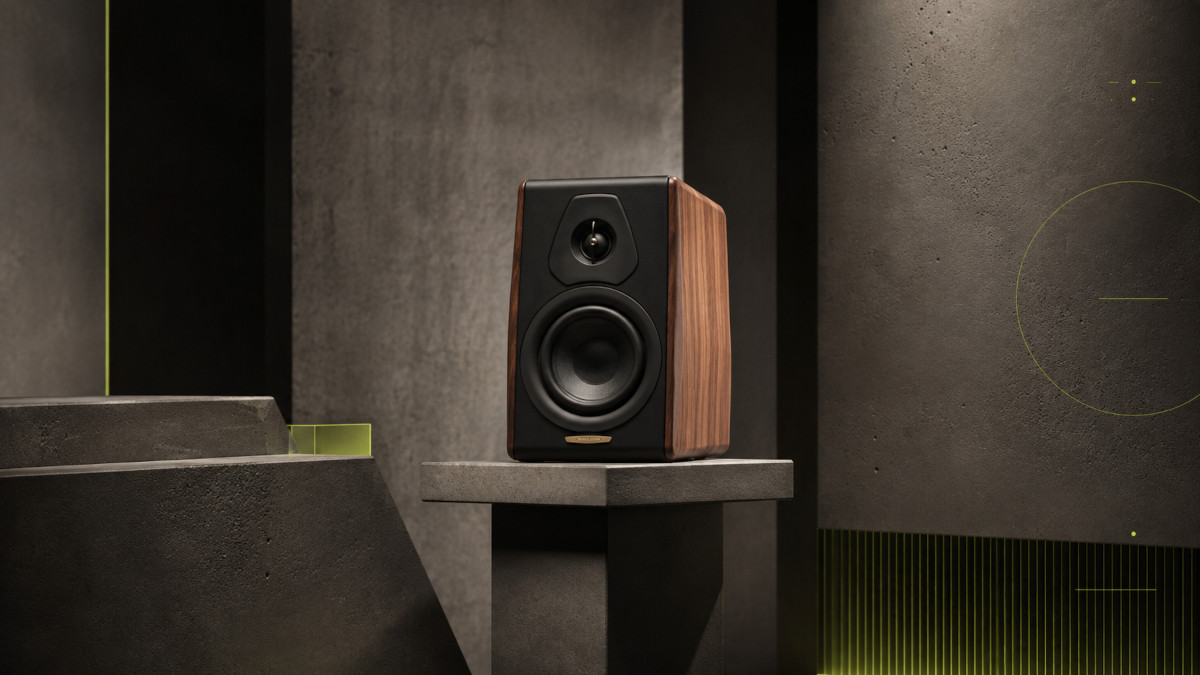
I remember hearing the Concertinos for the first time around 1998.
Diana Krall was playing, and what struck me was not detail, power or any of the usual audiophile vocabulary. It was simply how naturally her voice and piano emerged from two remarkably small speakers. There was an obvious limitation at the bottom end, but somehow it did not matter very much. The illusion was convincing enough that you stopped looking for what was missing.
That was part of the original Concertino's charm. Sonus faber introduced it in 1994 as a compact two-way loudspeaker, and the new Concertino G4 deliberately returns to that idea three decades later.
The shape remains unmistakably Sonus faber: compact, slightly unconventional and more like a piece of Italian furniture than an anonymous rectangular box. The new version combines solid walnut, brass and leather alternatives with a vented enclosure using cork, continuing the company's preference for natural materials not merely as decoration but as part of the acoustic design.
Technically, it is still refreshingly modest. This is a two-way passive speaker, rated at 85 dB sensitivity, with a specified frequency response beginning at 60 Hz. In an era when product pages compete with ever larger numbers, the Concertino doesn't pretend to be a miniature full-range monster.
That may be precisely the point.
A good small loudspeaker makes a trade. It gives up scale and the lowest octave in exchange for coherence, imaging and the ability to disappear into a room. When that trade is made well, you become far less conscious of listening to drivers, cabinets and crossover components. Voices acquire bodies. Instruments occupy spaces. The mechanical apparatus retreats.
The original Concertino demonstrated that beautifully. What I remember after almost thirty years is not its specification sheet, but a voice and a piano appearing in front of me with an ease that seemed disproportionate to the little boxes producing them.
The new Concertino does not need to reproduce the old one literally. Sonus faber describes it instead as a meeting between its heritage and modern experimentation, and that seems the more interesting approach.
Some objects deserve to return not because technology failed to move forward, but because the original idea was already right.