
Fosi Audio BT20A Pro: The Little Amplifier That Has Nothing to Prove
Affordable, compact and genuinely capable, this Class D amplifier shows how little hardware a good stereo system may actually need. Just order it with the 48 V power supply.
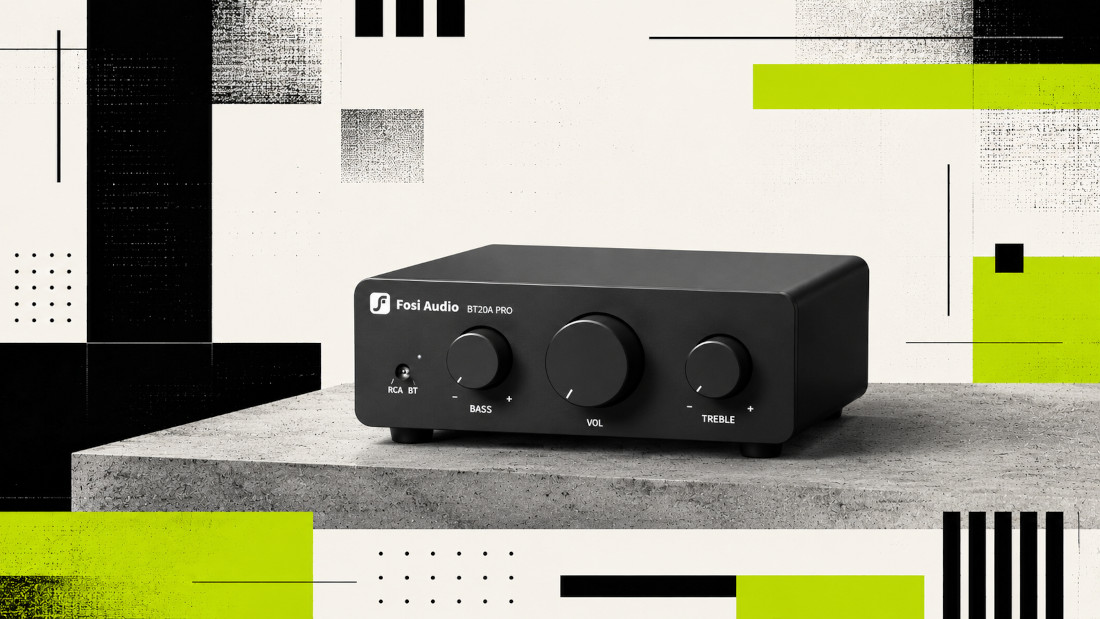
There is something almost suspicious about the Fosi Audio BT20A Pro. It is smaller than many traditional amplifiers’ power transformers, costs less than some audiophile cables and arrives with none of the physical ceremony historically associated with serious hi-fi. No massive front panel. No rows of inputs. No illuminated meters. Just a small metal box, three knobs and enough connections to build a proper stereo system.
And yet it works.
I own one, and that matters here. This is not a recommendation based exclusively on specifications or the enthusiasm that surrounds inexpensive audio products online. In everyday use, the BT20A Pro sounds clean, controlled and entirely convincing. It does not perform some miraculous transformation, nor does it pretend to be a cost-no-object amplifier. It simply drives passive speakers properly, produces more than enough volume for a normal room and stays out of the music’s way.
The amplifier is built around Texas Instruments’ TPA3255 Class D chip. It accepts either an analogue RCA signal or Bluetooth, provides bass and treble controls with central neutral positions, and includes a volume-controlled 3.5 mm pre-out that can be used with a powered subwoofer or another device. Its replaceable operational amplifiers also invite experimentation, although the standard configuration already performs perfectly well.
The front panel explains much of the product’s appeal. Volume is in the centre, bass and treble sit on either side, and there is no app, menu or configuration process standing between the listener and the music. For purists, the tone controls can remain centred. For everyone else, they offer a practical way to compensate for a difficult room, small speakers or recordings that need a little help.
Bluetooth makes it convenient, but the RCA input is what allows the BT20A Pro to become part of something more interesting. Connect a streamer, DAC, television, computer, turntable preamplifier or any conventional line-level source and the little Fosi becomes the centre of a minimalist audio system. Add a pair of decent passive speakers and there may be surprisingly little left to solve.
The Power Supply Is Part of the Amplifier
The BT20A Pro can be used with different power supplies, but the choice matters. A lower-voltage supply is sufficient for moderate listening levels and efficient speakers. The 48 V version, however, gives the amplifier more usable headroom and allows the TPA3255 platform to deliver substantially more power, particularly into four-ohm loads.
My recommendation is therefore straightforward: buy it with the 48 V power supply.
Not because everyone needs maximum volume, but because power is not only about loudness. Additional headroom helps an amplifier reproduce musical peaks without strain and gives it greater authority when driving less efficient speakers. The result is not necessarily a dramatic change in tonal character. It is a system that feels less constrained when the recording becomes demanding.
The manufacturer’s maximum power figures should not be confused with continuous, simultaneous output under normal listening conditions. Even so, the BT20A Pro can deliver an impressive amount of real-world power for a device of this size and price, especially when paired with the 48 V supply.
What Has Changed Is Not Only the Technology
Traditional amplifiers were large partly because their power supplies, heatsinks and output stages had to be large. Modern Class D designs change that equation. They are highly efficient, generate comparatively little waste heat and can deliver serious power from an enclosure that would once have seemed absurdly small.
That does not automatically make every Class D amplifier good. Implementation still matters. Power-supply quality matters. Noise, distortion, thermal design and the behaviour of the amplifier under real speaker loads all matter. The achievement of the BT20A Pro is not that Class D exists, but that a competent implementation has become this inexpensive.
The listening experience supports that impression. The amplifier sounds balanced, clean and controlled. It offers enough power for most domestic systems and does not impose an obvious character on the music. This is not merely a novelty product that becomes attractive because it is cheap. It is a credible amplifier whose low price makes it unusually easy to recommend.
There are limitations. It has only one analogue input. There is no remote control, built-in DAC, phono stage or display. Anyone assembling a complex system with several sources may quickly outgrow it.
But that is not the system it is trying to be.
The BT20A Pro is for the person who already has—or only needs—one source, a pair of passive speakers and a volume knob. It is ideal for a desktop, a secondary room, a television setup, a workshop or a simple living-room stereo. It can also revive an excellent pair of older speakers whose original amplifier has failed or become obsolete.
The most compelling thing about it is not that it competes with every expensive amplifier. It is that, for many listeners and many systems, it removes the need to compete at all.
A small aluminium box, a good pair of speakers and the 48 V power supply may be enough.