
The Feel of Work
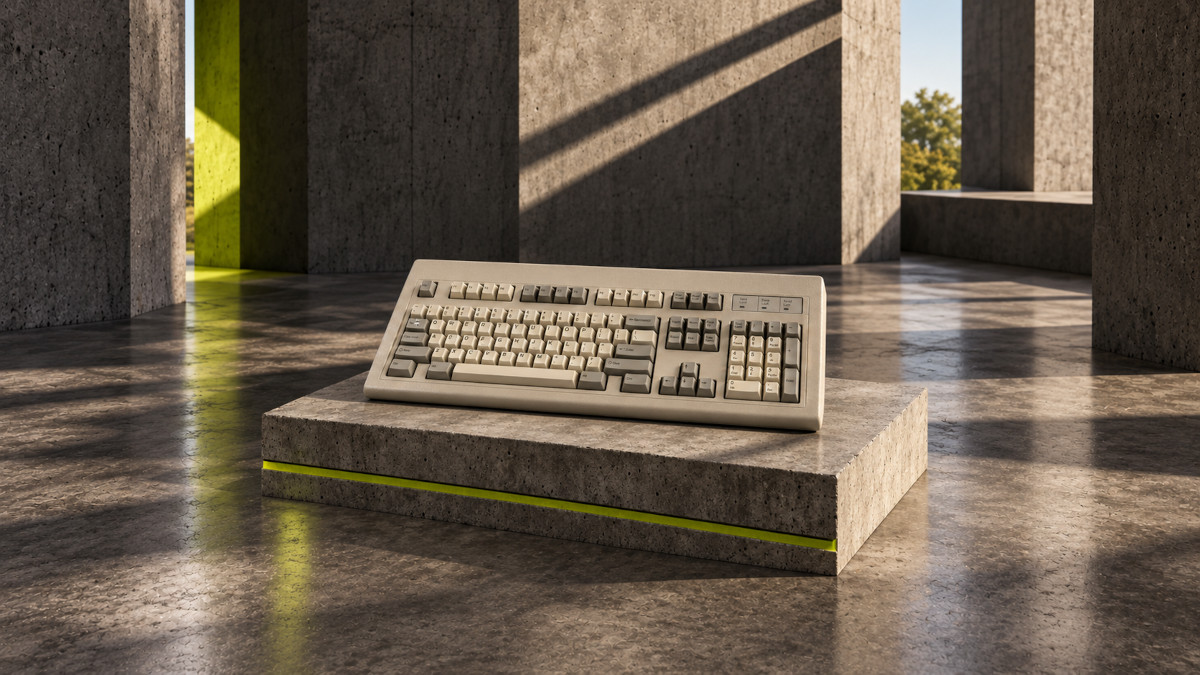
The IBM Model M, and the enduring appeal of a keyboard that makes every keystroke felt.
A keyboard is one of the most frequently touched objects in a working life. We use it to write proposals, answer difficult messages, build software, and turn unfinished thoughts into something another person can understand. Yet it often receives less consideration than almost anything else on the desk.
The IBM Model M invites a little more attention. Its substantial case, sculpted keys, and unmistakable sound give typing a physical presence. There is resistance beneath the fingers, followed by a distinct release. Each keystroke announces itself.
For some people, that sound would be reason enough to choose something else. For others, it is part of the attraction.
A Mechanism With Character
The Model M’s signature comes from its buckling-spring mechanism. Pressing a key compresses a spring until it buckles, producing the tactile event and characteristic click associated with the design.
That feedback gives the keyboard its personality. A sequence of words becomes a sequence of small, deliberate physical actions. The experience has a rhythm that a thin, quiet keyboard deliberately minimizes.
Neither approach suits everyone. A shared office, a late-night writing session, and a private workspace place different demands on an object. The Model M asks its owner to have a preference—and to consider the people within hearing distance.
Its appearance is equally direct. The broad case and distinct groups of keys occupy their space without much concern for visual lightness. The original beige and gray palette feels particularly at home among paper, books, and the other ordinary materials of a working desk.
A Classic With a Continuing Life
The design’s story extends into current production through Unicomp. Established in 1996 after acquiring keyboard technology from IBM and Lexmark, the Kentucky manufacturer continues the buckling-spring lineage with products including the New Model M.
That distinction matters. An original IBM keyboard is a vintage object, with its own condition, history, and connection requirements. A newly manufactured Unicomp offers a present-day route into the same design tradition. The New Model M is available with a USB connection, bringing that distinctive typing experience to a contemporary desk.
The continuity makes the Model M especially interesting. Its appeal can still be explored through use, beyond collecting or admiring a photograph.
What the Hands Remember
People develop remarkably specific relationships with tools. The position of a control, the weight of an object, or the resistance of a key becomes familiar through repetition. Eventually, the body expects it.
A keyboard participates in that process for hours at a time. Its feel can become part of how someone settles into work, just as a particular chair, lamp, or notebook can help define a workspace.
This gives the Model M a place in a conversation about contemporary computing. Even as more activity moves through software and automation, the physical points of contact still deserve thoughtful design. We continue to sit, reach, touch, read, and listen.
A well-chosen tool makes those ordinary actions more satisfying. Sometimes that satisfaction comes from silence and a light touch. Sometimes it comes from a substantial keyboard with a very definite opinion about what pressing a key should feel like.
The Model M has that opinion. Its continuing appeal suggests there is still room on the desk for an object with character.