
Nikon F3: Built for the Hands
A camera that made room for new technology while keeping the photographer close to the work.
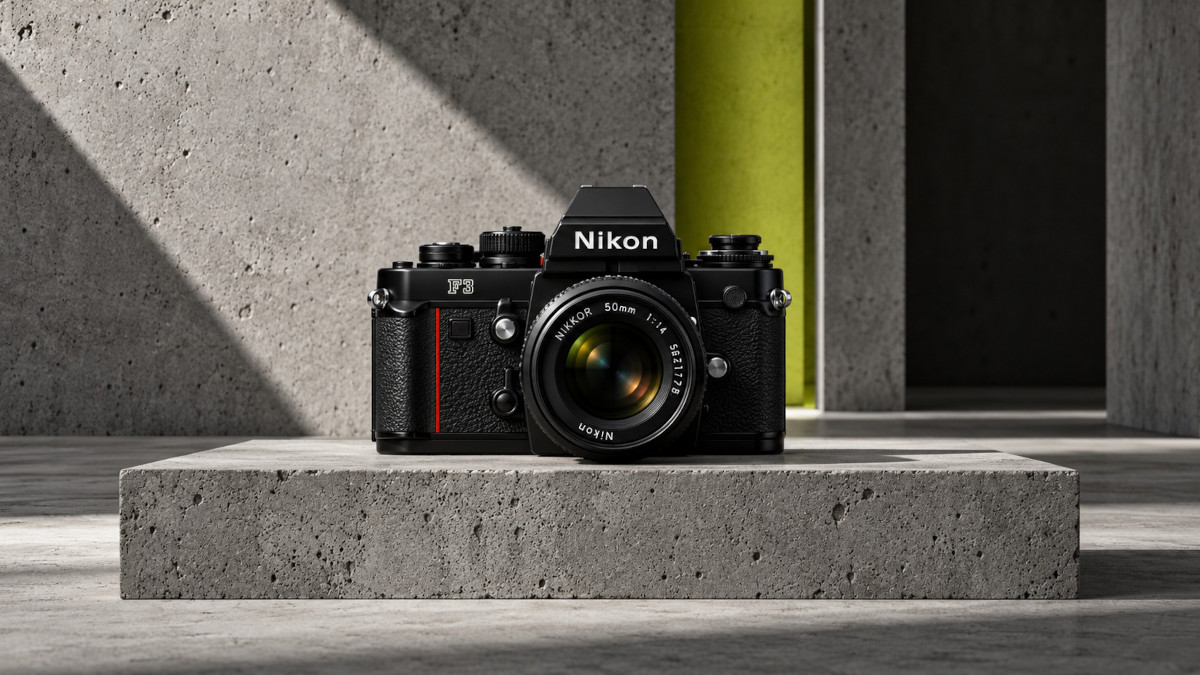
The fingers find their places. One hand supports the lens, turning the focus ring until the subject becomes clear. The other holds the body, ready at the shutter release. After the exposure, the thumb advances the film.
The Nikon F3 gives each of these actions a place. Its shape makes sense through use: the grip, the dial, the lever, the weight resting between two hands. Familiarity grows one frame at a time.
Introduced in March 1980, the F3 brought electronic shutter control and aperture-priority automatic exposure to Nikon’s professional flagship line. It retained manual focusing and, without an optional motor drive, manual film advance. New capabilities arrived within a camera that still asked the photographer to remain physically involved.
A Shape with a Purpose
Giorgetto Giugiaro designed the exterior of the camera and its MD-4 motor drive. The front grip and small vertical red line gave the F3 a distinctive identity, with details that would influence later Nikon cameras.
There is a quiet confidence to the result. Black surfaces, clear markings, an angular finder above the lens. The controls suggest actions. The body offers something to hold.
Seen today, it can look almost inevitable. Nikon’s own development history describes a much less straightforward path, with substantial revisions as its engineers worked through new approaches to metering, electronics, and operation. The apparent simplicity was an achievement.
Help Where It Counts
The F3’s automatic exposure offers a useful example of how a machine can share the work.
In aperture-priority mode, the photographer chooses the aperture and the camera selects the shutter speed. One decision remains directly in the photographer’s hands; another is handled by the camera’s metering and electronic control. Manual exposure remains available.
That arrangement leaves room for both assistance and intent. The photographer still chooses a position, a frame, a point of focus, and a moment. The camera contributes precision to part of the process.
There is a design lesson here that travels well beyond photography: useful automation can fit around a person’s judgment.
The Familiar Tool
A well-used camera becomes a collection of small, learned movements. The hand knows where to reach. The eye knows where to look. Less attention goes toward operating the object, leaving more for what is happening in front of it.
That familiarity is part of an object’s value, even when it never appears on a specification sheet.
The Nikon F3 makes this relationship visible. Its engineering sits inside a form that invites repeated use. Over time, the machine’s controls become part of the photographer’s own rhythm.
A focus ring turns. The frame settles. A finger releases the shutter.
For an instant, the tool and the intention arrive at the same place.