The Cheap Model Gets the Job
In mature AI systems, the most powerful model may become the exception rather than the default.
Enterprise AI is still discussed as if model selection were a contest.
Which model is smartest? Which one leads the benchmarks? Which one reasons better? Which one should the company standardize on?
That framing makes sense during experimentation. It becomes less useful in production.
Most business tasks are not frontier problems. They are repetitive, structured and narrow. Classify this message. Extract these fields. Summarize this document. Match this request to a category. Check whether this transaction fits a known pattern.
Using the most capable model available for every one of those tasks may work perfectly well. It may also be an unnecessarily expensive way to run a system.
A production architecture should begin separating tasks by the level of intelligence they actually require.
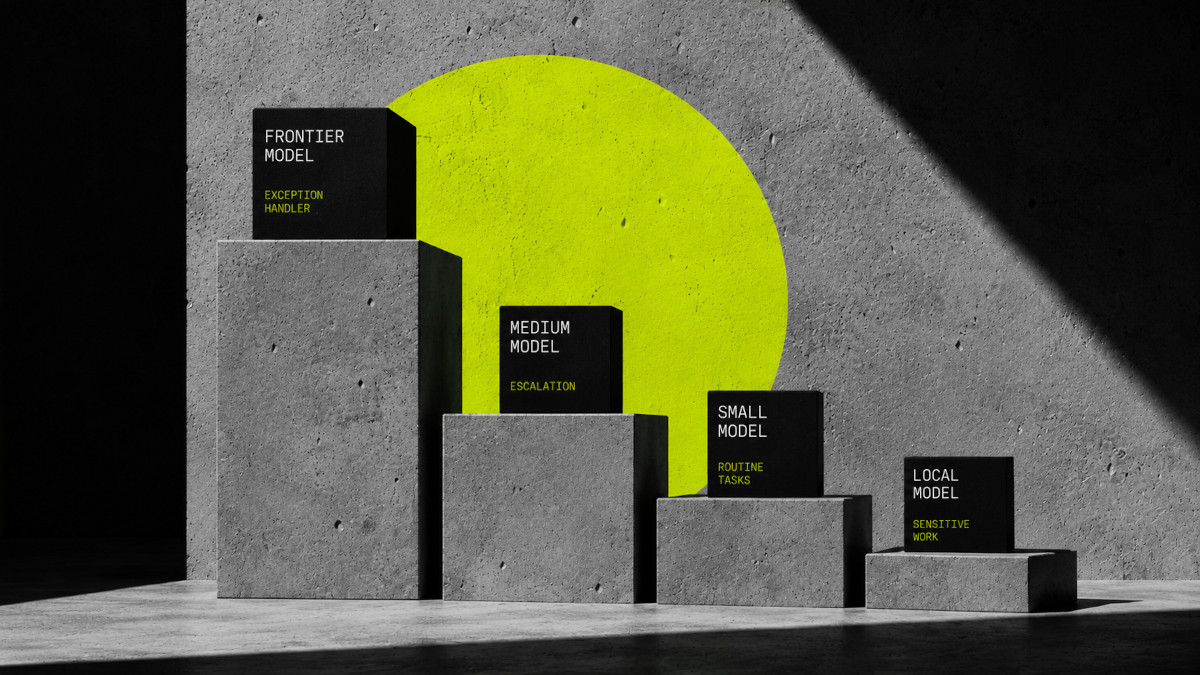
A small model can handle routine classification. Another can extract structured information. A local model can work with sensitive material. A stronger commercial model can be called only when confidence drops, the case is unusual or the consequences of an error are higher.
The interesting part is not simply that smaller models are cheaper.
It is that the role of the most powerful model changes.
Instead of performing every operation, it becomes an escalation layer.
That is already a familiar organizational pattern. Most companies do not send every decision to their most experienced executive. Routine work is handled where it can be handled efficiently. Difficult cases move upward.
AI systems are beginning to acquire the same structure.
The first model may solve the problem. If it cannot, another model takes over. A third may verify the result. Different workloads may be routed according to cost, latency, privacy or required capability.
At that point, the system is no longer choosing a model.
It is allocating intelligence.
This changes what optimization means.
A company that reduces the number of calls to its most advanced model without reducing the quality of the final outcome has not downgraded its AI. It has improved the architecture.
The same applies to open-weight models. They do not need to replace commercial systems entirely to become strategically important. They only need to perform certain classes of work reliably enough that those tasks no longer require premium external intelligence.
This is likely to become one of the practical differences between early and mature enterprise AI.
Early systems connect an application to a model.
Mature systems connect a business process to a portfolio of capabilities.
The application should not care very much which model performed the work. It should care whether the result met the required standard, arrived within the expected time and cost an acceptable amount.
That also makes the infrastructure more resilient.
Models change quickly. Prices change. Providers improve. Open-weight alternatives catch up. New specialized models appear.
If every business process is tied directly to a particular model, each change becomes an engineering project.
If the process is designed around capabilities instead, models become replaceable components.
That is a much more durable architecture.
There is also a cultural adjustment here.
For the last few years, access to the strongest possible AI has been treated as a competitive advantage. In some cases, it still is.
But production systems introduce another kind of advantage: knowing when strong intelligence is unnecessary.
A company processing millions of operations does not need every one of them to receive the maximum available reasoning power.
It needs each one to receive enough.
That distinction will matter more as AI moves deeper into ordinary business processes.
The smartest model may continue to receive the headlines.
The cheaper model may end up doing most of the work.