Beneath Berlin’s Sky
In 1987, German filmmaker Wim Wenders filmed Berlin from the sky. Almost four decades later, Danish artist Kudsk Steensen (Køge, Denmark, 1987) looks at what lies beneath. And he does it in NY.
Der Himmel über Berlin (Wings of Desire) made Berlin, divided by the Wall, one of the most recognizable cities in European cinema. Wenders explored it through the eyes of his angels: from above, among buildings, streets and people. Steensen takes the opposite route.
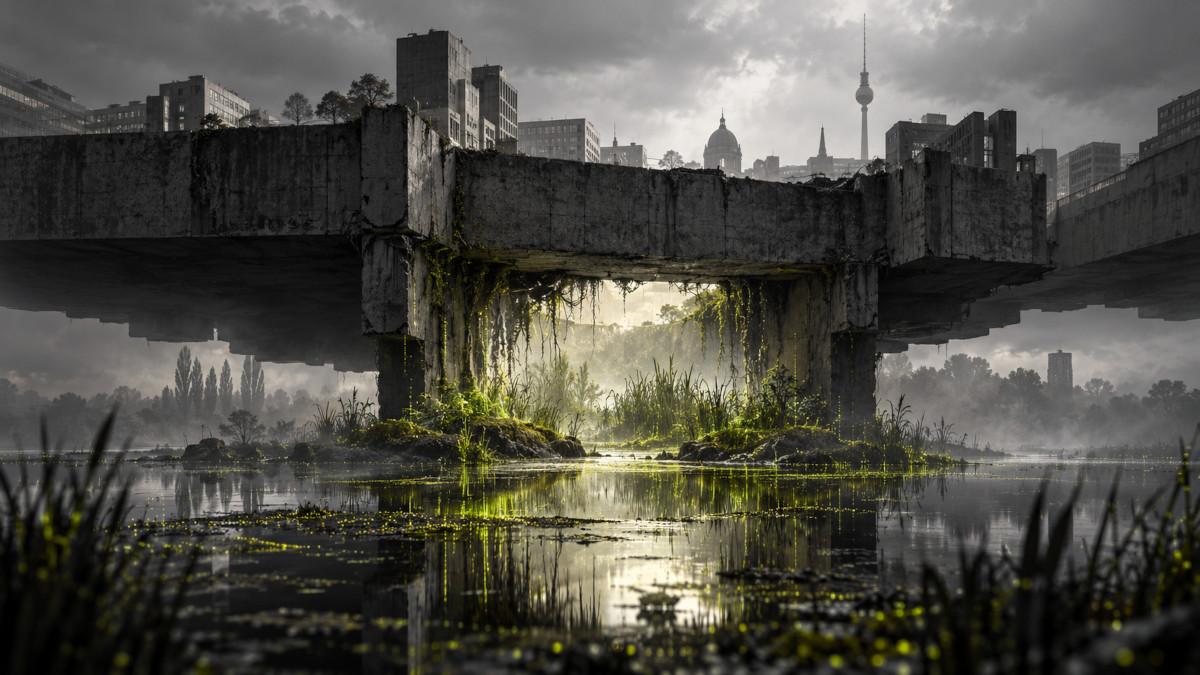
His work Berl-Berl, presented at the Museum of Modern Art in New York (MoMA) as part of Wetland, descends into a landscape that existed there long before the city: Berlin’s wetlands.
The exhibition, which opens on October 12, 2026, and runs through March 7, 2027, is part of the Hyundai Card Digital Wall, MoMA’s program dedicated to digital art and emerging technologies.
What lay beneath Berlin before Berlin was Berlin?
The answer is even in the city’s name. Berl comes from a Slavic word associated with marshland and is linked to the etymological origins of Berlin. Before the city we know, its buildings, parks, museums, stations and celebrated cultural scene, there was water, damp earth and vegetation. That is the landscape Steensen began researching in 2021.
For months, he explored wetlands in Berlin and Brandenburg, conducted fieldwork, researched archives and collaborated with the Museum für Naturkunde Berlin. To build Berl-Berl, he used photogrammetry, 3D scanning and video game engine technology. He also incorporated flora, fauna, rocks and sounds recorded in those places. The result is a digital landscape that changes in real time.
It is not an archaeological reconstruction of Berlin. Nor is it a postcard showing what the city looked like before it became a city. Steensen builds a virtual territory based on information, images and sounds from a real landscape. He makes us look down.
Today, the city is focused on restoring its natural systems. Berlin is working on some of its waterways to give them back their space. Meanwhile, Steensen digitally reconstructs the wetlands that are part of the territory’s history. The past appears on a screen. The present, in a public works project.
From the Wetland to MoMA
Berl-Berl did not originate in New York. The project was originally commissioned by LAS Art Foundation, a Berlin-based organization dedicated to projects at the intersection of art, science and technology. It was first presented in 2021 at Halle am Berghain. Five years later, it arrives at MoMA as part of Wetland, within the Hyundai Card Digital Wall. The program presents digital artworks and works involving emerging technologies, and is part of the way the museum integrates these practices into its contemporary programming.
For Steensen, technology is far from the starting point. First comes the territory. The artist works from direct observation, research, sound recordings, images, archives and collaboration with scientists. Then come 3D scanning, photogrammetry and video game engines. The process moves from the real landscape to the digital landscape. And that direction matters. Berl-Berl does not attempt to replace a place with a virtual experience. It uses digital tools to rebuild a relationship with a place we can no longer experience in the same way.
One city beneath another. Not a secret city of tunnels and passageways, but something far more elemental: water, plants, animals, earth.
In Berlin, that layer is documented in the territory and in its name. Steensen turns it into an artwork that moves, makes sound and changes before the viewer. And as we explore it from New York, Berlin continues to exist on the other side of the world, above, with its streets, museums, buildings and parks. Two landscapes at the same time.
And what lies beneath your city? Perhaps an artist is already looking.
Jakob Kudsk Steensen: Wetland
Museum of Modern Art (MoMA), New York
October 12, 2026 - March 7, 2027