The Machine Sends the Bill
Artificial intelligence was sold as weightless software. Now its physical costs are arriving—in electricity bills, infrastructure, devices, and public budgets.
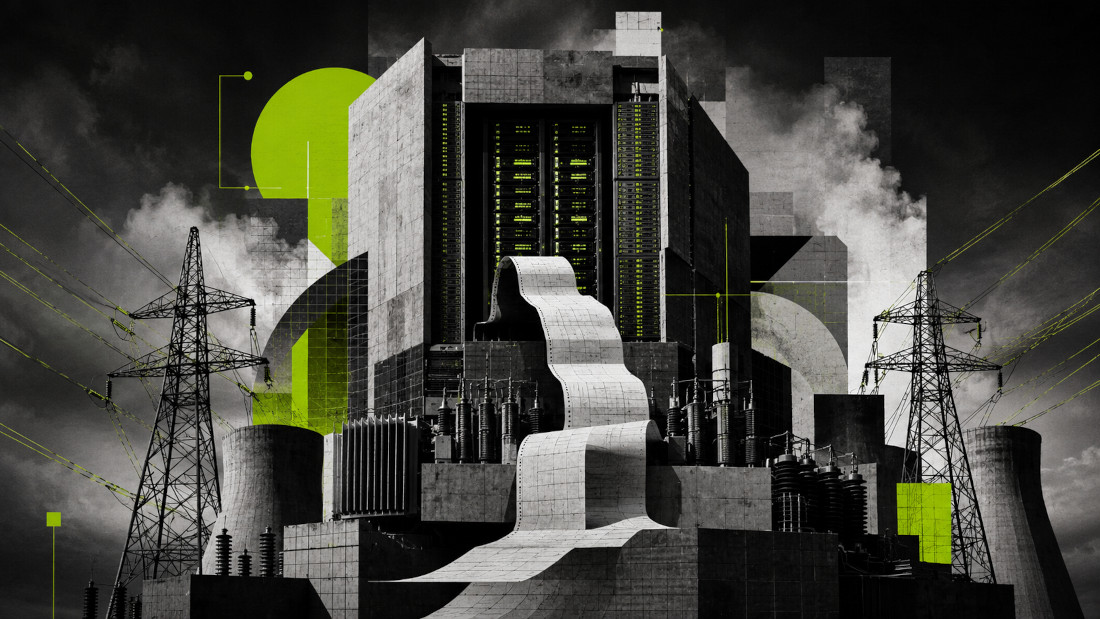
The machine was never weightless.
It only appeared that way because its factories were hidden behind the screen.
A question entered. An answer returned. Between them sat power plants, transformers, cooling systems, semiconductor foundries, transmission lines, water, land, and an expanding industrial architecture that almost nobody using artificial intelligence was asked to see.
Now the infrastructure is becoming visible for a simple reason.
The bill has arrived.
For most users, artificial intelligence still feels like an unusually capable website. There is no smoke, no mechanical noise, no sense of physical resistance. The interface presents intelligence as an abundant substance generated instantly from language.
But the interface is a carefully maintained illusion.
Behind every effortless response is a system that must be built, powered, cooled, connected, repaired, financed, and eventually replaced. The cloud has always been someone else’s machinery. AI is simply making that machinery too large to remain invisible.
The International Energy Agency expects electricity consumption by data centres to roughly double between 2025 and 2030, reaching approximately 950 terawatt-hours. AI is the most important force behind that growth. In the United States, data centres could account for almost half of the increase in electricity demand through the end of the decade.
These figures are often presented as an environmental problem. They are that, but they are also something more fundamental.
They reveal that artificial intelligence is becoming infrastructure.
And once a technology becomes infrastructure, the central question is no longer merely what it can do.
It is who must pay for it.
The Abstraction Was Part of the Product
Digital technology has spent decades removing evidence of its own material existence.
The word “cloud” was extraordinarily effective. It replaced buildings with weather. It allowed vast industrial systems to be imagined as something soft, ambient, and naturally available.
Streaming removed the disc. Software removed the box. Platforms removed the office. AI removed even the appearance of conventional computation, replacing menus and commands with conversation.
Each stage made technology feel less physical while requiring more physical infrastructure underneath it.
This was not accidental. Abstraction made adoption easier. Users did not need to understand servers, networks, processors, databases, or electrical systems. They only needed to touch the surface.
But abstraction also separated consumption from consequence.
A person turning on an industrial machine can see that energy is being used. A person asking an AI system to rewrite an email receives no equivalent signal. The action feels almost free because its marginal cost has been hidden by scale, subscription models, venture capital, corporate subsidies, and the extreme distance between the user and the machinery.
That distance is beginning to collapse.
Data centres are no longer arriving as modest extensions of existing digital infrastructure. Some are emerging as projects measured in gigawatts and tens of billions of dollars. Meta’s expanded Louisiana development, for example, has been reported as a five-gigawatt project costing more than $50 billion.
At that scale, the data centre is not simply another building connected to the grid.
It becomes one of the forces around which the grid must be redesigned.
Intelligence Enters the Utility Bill
The economics of electricity infrastructure are not structured like the economics of an app.
A new model can be released in months. A major power plant, transmission line, or grid interconnection may require years. Artificial intelligence moves at software speed while the systems supporting it move at industrial speed.
The difference creates pressure.
Utilities must anticipate demand before it fully materializes. They may need to build generation capacity, substations, transmission infrastructure, and other facilities in preparation for data-centre projects whose future requirements are enormous but not always certain.
Someone must finance those investments.
Traditionally, many utility costs are distributed among customers through regulated rates. That model becomes politically difficult when infrastructure built primarily for a small number of exceptionally large corporate consumers begins appearing in household electricity bills.
The conflict is no longer theoretical. Policymakers and regulators are actively considering how to prevent residential customers from subsidizing the infrastructure required by AI companies. On July 13, the White House was preparing to bring utilities and data-centre developers together around a pledge under which large technology companies would cover the costs of new power generation and grid upgrades associated with their facilities. Amazon, Google, Meta, Microsoft, OpenAI, Oracle, and xAI had already signed the initiative.
The existence of such a pledge is itself revealing.
You do not need to promise that ordinary customers will not pay unless there is a credible possibility that they might.
Oregon has taken a more structural approach. Its regulatory changes require very large electricity users to bear a greater share of the costs they generate, while residential customers receive a modest reduction.
These measures establish a principle that may become central to the AI economy:
The cost of private computational scale should not automatically become a public utility obligation.
The New Industrial Consumer
Technology companies often describe AI infrastructure as a source of broad economic development. The argument is not without merit.
Large data-centre projects can generate construction activity, tax revenue, local contracts, energy investment, and new demand for technical services. They can accelerate upgrades that might otherwise be postponed. A sufficiently large customer can sometimes provide utilities with predictable revenue and help distribute infrastructure costs across a wider base.
There are communities where the financial effects have been substantial. The expanded Meta project in Louisiana has produced major local contracts and a sharp increase in tax revenue, including unusually large bonuses for teachers in the surrounding parish.
The machine does not arrive empty-handed.
But neither does it arrive alone.
It brings demand for electricity, water, land, transmission capacity, backup generation, roads, tax concessions, and political accommodation. It may produce relatively few permanent jobs compared with its physical footprint and capital intensity. It can also reshape energy planning for every other consumer connected to the same system.
This makes the AI data centre a new kind of industrial actor.
It resembles a factory, but its output is not a car, a chemical, or a household object. Its product is computational possibility: predictions, generated media, automated decisions, synthetic knowledge, and access to increasingly capable models.
The benefits can be distributed globally while the physical burdens remain intensely local.
A model may serve millions of people across continents. The transformer is installed in one town. The transmission line crosses a particular landscape. The water comes from a specific watershed. The higher utility bill arrives at an identifiable home.
The intelligence is global.
The invoice has an address.
The Cost Behind the Device
The pressure does not stop at electricity.
The AI infrastructure boom is competing for semiconductors, memory, construction equipment, transformers, skilled labour, and manufacturing capacity. Investment by the largest technology companies is now sufficiently large to affect prices beyond the data-centre industry.
The Associated Press reported that AI-related capital spending in 2026 is expected to exceed $700 billion, contributing to higher demand for chips, memory, electricity, and other constrained resources. Those effects are beginning to appear in the prices of ordinary electronic devices as well as in broader inflation concerns.
This is another way the bill travels.
The user may never directly purchase an AI subscription. Yet the same infrastructure race can influence the price of a laptop, the cost of power, the availability of components, public investment priorities, and potentially even interest-rate decisions.
Artificial intelligence is becoming too economically large to remain confined to the technology sector.
It is entering the price system.
That does not make AI uniquely destructive. Every major industrial transition reallocates capital and creates scarcity before new capacity catches up. Railways consumed steel. Automobiles transformed oil, roads, cities, and land. Electrification required power plants, grids, standards, and immense public and private investment.
The significant point is that AI must now be understood within that lineage.
It is not merely a better category of software.
It is a claim on the industrial world.
Efficiency Will Not Make the Question Disappear
The standard technological response is efficiency.
Models will become smaller. Chips will perform more operations per watt. Cooling systems will improve. Workloads will move to regions with cleaner or more abundant electricity. Data centres may reduce consumption during periods of grid stress or schedule less urgent computation when power is more available.
These improvements matter. Recent research suggests that AI workloads can be orchestrated more flexibly, allowing data centres to reduce or relocate consumption in response to grid conditions.
But efficiency does not necessarily reduce total consumption.
When a resource becomes cheaper and more effective, people often discover more uses for it. A model that requires half the energy per task may still consume more electricity overall if the number of tasks grows tenfold.
This is particularly likely with intelligence.
The demand for answers is not fixed. Neither is the demand for generated video, autonomous agents, automated research, synthetic simulations, personalized software, continuous inference, or machines acting on behalf of other machines.
AI companies are not trying to provide the same amount of intelligence more efficiently.
They are trying to make intelligence ubiquitous.
Efficiency may lower the cost of each operation while expanding the number of operations society chooses to perform. The result can be a more efficient system that is also much larger.
The question therefore survives every technical improvement:
Who has the right to consume shared infrastructure, in what quantities, under what conditions, and at whose expense?
From User to Ratepayer
The first phase of generative AI addressed us as users.
The next phase will address us as citizens, workers, neighbours, customers, and ratepayers.
The distinction matters because markets alone do not decide how electrical grids, water systems, land-use rules, tax incentives, and public infrastructure should be allocated. These systems are governed through political decisions, even when those decisions are presented as technical necessities.
A society may reasonably decide that AI infrastructure is worth building. It may conclude that abundant computation will produce enough innovation, productivity, scientific progress, and strategic capacity to justify a rapid expansion of energy supply.
But that decision should be made visibly.
The benefits should not remain private while the costs become ambient. Infrastructure agreements should specify what large operators must build, finance, disclose, and restore. Communities should know how much power and water projects require, what happens if predicted demand fails to materialize, and which customers carry the risk.
Promises are useful.
Tariffs, contracts, reporting requirements, and enforceable obligations are better.
The political challenge of AI may ultimately be less about controlling a mysterious superintelligence than about governing a familiar pattern: powerful companies using shared systems to construct privately owned advantages.
The machine does not need to seize the grid.
It only needs to become important enough that the grid is rebuilt around it.
The Bill Is a Form of Knowledge
The arrival of the bill is not proof that artificial intelligence has failed.
It is proof that the technology has become real.
Every serious technology eventually leaves the demonstration room. It acquires supply chains, labour disputes, zoning hearings, maintenance schedules, insurance costs, energy contracts, and political constituencies.
It stops being magic and becomes an institution.
That transition is now happening to AI.
The glowing prompt box will remain. The answer will continue to appear with no visible effort. The interface will become faster, more natural, and even more effective at concealing the machinery beneath it.
But outside the screen, the physical system will continue to expand.
More generators.
More substations.
More chips.
More cooling.
More land.
More negotiations over who must carry the cost.
The machine was never weightless.
We were simply permitted to use it before being shown the invoice.