The Nest and the Network
Nature, technology, and ancient forms of intelligence begin to weave the same story
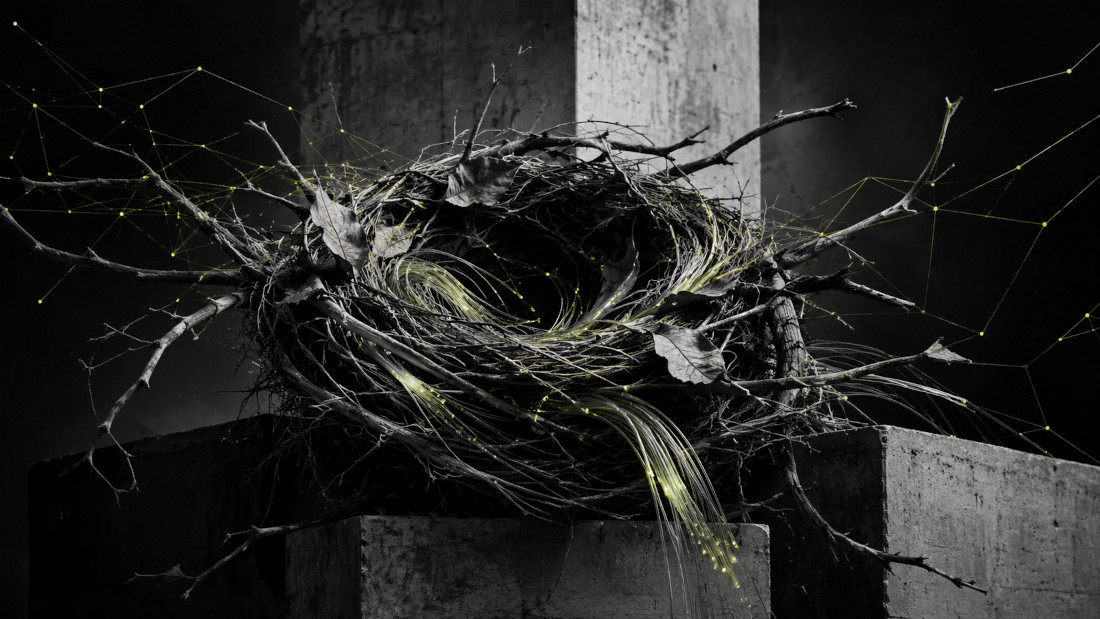
The photograph looks like a work of contemporary art. But it is not. It is a bird’s nest built with branches, dry leaves… and fiber-optic cables. Among the materials the birds found to protect their eggs are filaments designed to carry information at the speed of light. The image is beautiful, but also unsettling.
A material designed to transmit data ends up holding something as fragile as an egg. A technology conceived to connect machines becomes part of an architecture of life.
Birds do not distinguish between the natural and the artificial. They build with what they find. Without intending to, they reveal a truth that contemporary art has been exploring for years: nature and technology have long ceased to be separate universes.
The Argentine artist Tomás Saraceno understood this a long time ago. For more than two decades, he has developed a practice where architecture, science, biology, astronomy, art, and activism converge. He studies spiderwebs through three-dimensional scans and computational models, records their vibrations, transforms data into sound, and collaborates with scientists to understand how other species communicate.
Yet all that technological sophistication never takes center stage. In his work, a network is never just a network: it is a system of relationships, a language, and a form of coexistence. Technology appears almost silently, not as spectacle, but as a tool for listening more closely to what was always there. Far from replacing nature, it allows us to understand it more deeply.
His new exhibition, Ancestral Futures, opening on July 17 at Haus der Kunst in Munich, is not simply a contemporary art show. It is an invitation to change the way we understand our relationship with the planet, with other species, and with forms of knowledge that were pushed aside for centuries by the idea of progress.
Born in San Miguel de Tucumán and based in Berlin for many years, Saraceno builds, above all, questions. Is it possible to imagine another way of living? What would happen if we stopped thinking of the human being as the center of everything?
Ancestral Futures brings together two of his most recognized lines of research: Aerocene, the project that explores forms of flight without fossil fuels, and Arachnophilia, his fascinating study of spiders and their webs as models of intelligence and cooperation. It also includes a new work created with the eleven Indigenous communities of the Atacama Network, in the Salinas Grandes, in northern Argentina.
There, where lithium has become one of the world’s most coveted minerals for powering the global energy transition, a silent battle over water is also taking place. Saraceno chooses not to speak for those communities, but to work with them. The result is The Sanctuary of Water, a work that exceeds the limits of the museum and becomes a platform for reflection on extractivism, memory, and the defense of ancestral territories.
As much of the world celebrates the arrival of green energy, the artist reminds us that no transition will be truly sustainable if it reproduces the same logic of exploitation over other peoples and other ecosystems.
As has been the case for years in his work, spiders once again become protagonists. Their webs reveal forms of communication, cooperation, and design that challenge the human gaze. In the same way, his sculptures, inflated only with air and solar energy, imagine a future in which movement does not require pollution.
More than objects to contemplate, the works function as experiences that ask us to slow down. They force the visitor to look up, listen, stop, and accept that there are other intelligences besides our own… and besides artificial intelligence.
More and more artists are using digital technologies not to build parallel universes, but to understand the real world. Data ceases to be an end in itself and becomes a tool capable of revealing what the human eye cannot perceive.
The filaments of a spiderweb and the cables of a fiber-optic line belong to different worlds, but both speak of connection. One was born from millions of years of evolution; the other, from decades of technological development. And yet, for a bird, they end up serving the same function: to hold.
Far from using technology as spectacle, Tomás Saraceno integrates it quietly into his creative process. Technology does not seek to replace nature. It becomes a way of understanding it and learning from it. Art and technology appear, then, not as a means of escaping the natural world, but as a way of returning to it.
I look at the photograph again. What surprises me is not that a bird used a cable, but that nature, once again, found a way to turn a leftover fragment of our civilization into the beginning of another story. That nest seems to confirm the existence of an immense network of interdependencies that makes no distinction between eras, species, materials, or technologies. It simply continues to weave itself.
Humanity never stopped weaving; it only changed the threads. Penelope wove while she waited. And if Odysseus had had a drone, perhaps The Odyssey would have been considerably shorter. But that is another story…