Digital River
If Heraclitus Had Visited teamLab Phenomena Abu Dhabi
If you have been to Abu Dhabi but have not yet visited teamLab Phenomena, you still have one of the world’s most innovative artistic experiences left to discover.
I imagine that, if we could invite Heraclitus—the Greek philosopher who said more than 2,500 years ago that no one can step into the same river twice because everything is in a constant state of change—he would probably accept.
Although, upon entering, he would surely ask with a certain degree of suspicion:
“Is this art?”
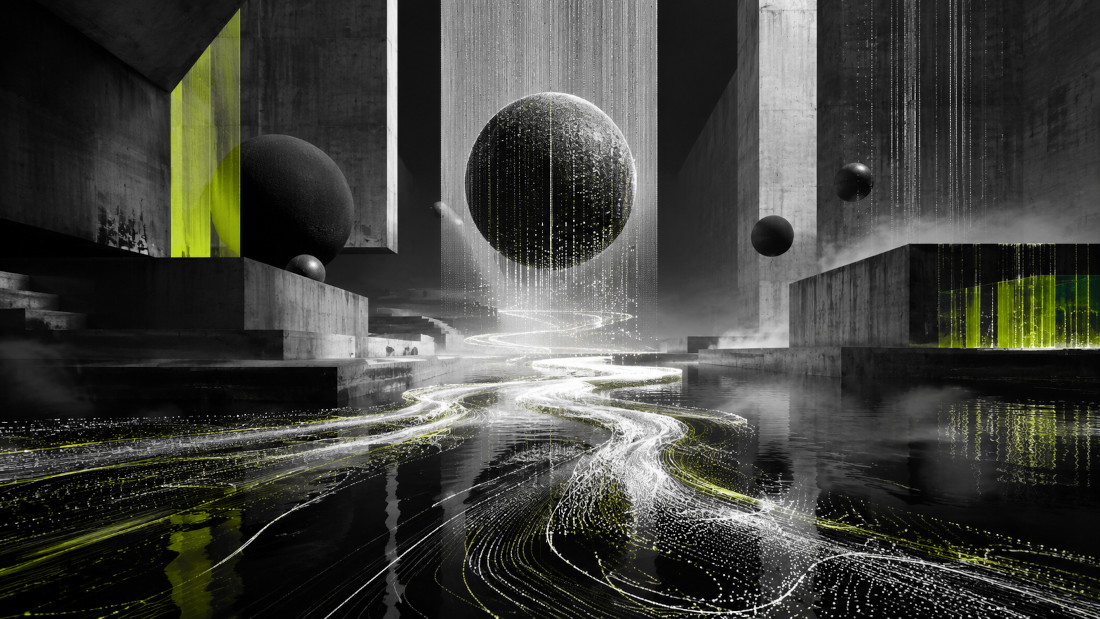
teamLab’s works are not hung on walls or observed from a distance. They are explored, crossed and transformed by the presence of the public. Light, water, sound, sensors, algorithms and computational intelligence work in real time to create experiences that never repeat themselves in exactly the same way.
Today, the best place to understand this research is teamLab Phenomena Abu Dhabi, located within the Saadiyat Cultural District. Inside a 17,000-square-metre building designed specifically for its permanent installations, the Japanese collective brings together some of its most recent investigations and most innovative propositions.
The emirate is seeking to become one of the great cultural hubs of the twenty-first century. The Saadiyat Cultural District is already home to institutions such as Louvre Abu Dhabi, while new spaces including Guggenheim Abu Dhabi and the Zayed National Museum are also being developed. The arrival of teamLab is part of a broader commitment to connecting art, science, innovation and technology.
But let us return to Heraclitus.
The first work he would encounter is Massless Suns and Dark Suns, an installation in which enormous luminous and dark spheres appear to float through space. Some emit light; others seem to absorb it. When a visitor approaches, they react, altering the atmosphere of the room.
“Are they objects?” the philosopher would ask.
Not exactly. They are phenomena.
Behind this apparent simplicity lies an intricate system of motion sensors, high-precision LED technology, real-time programming and complex optical calculations.
Let us continue the journey.
As he approached Levitation Void, the Greek philosopher would see an enormous black mass suspended in perfect balance. With no visible supports, it appears to defy gravity. When someone touches it, it loses its stability, slowly descends and then rises again.
Heraclitus would probably smile: even a sculpture must accept that nothing remains still.
Much less a river.
In Morphing Continuum, water becomes artistic material. Hydraulic systems, digital lighting and computational simulations continuously transform its movement. The work does not represent a natural phenomenon. It behaves like one.
When the light, the space, the movement or the people change, the artwork changes with them.
All these works emerge from a precise combination of disciplines. teamLab uses generative programming to create images that never repeat themselves; physical simulations to reproduce the behaviour of nature; sensors and cameras to detect the public; computer vision to interpret what is happening inside the room; LED lighting and synchronised projections to construct immersive environments; and computer networks that recalculate every installation from one second to the next.
The result is not a digital reproduction, but a living process.
This is why each experience is unrepeatable: the same combination of people, space, time and environmental conditions will never come together again in exactly the same way.
A work can exist without remaining unchanged. It can exist as an experience, a relationship, an event.
Heraclitus: “They say no one steps into the same river twice. Everything changes.”
Exactly. And the artists have brought that idea into art. They do not create fixed objects. They create phenomena that change with the light, the environment and every visitor.
Heraclitus: “Then they do not make artworks. They make rivers with an audience.”
That is right. The work never ends. It happens.
Heraclitus: “Forgive me for interrupting... If everything changes, what remains?”
The experience, Heraclitus.
And the certainty that contemporary art will continue doing what it does best: opening up new questions.
We leave this river without definitive answers—and always a little wetter.