The Evidence Engine
How VAR, connected balls, optical tracking, and human judgment are turning the 2026 World Cup into a new test of proof.
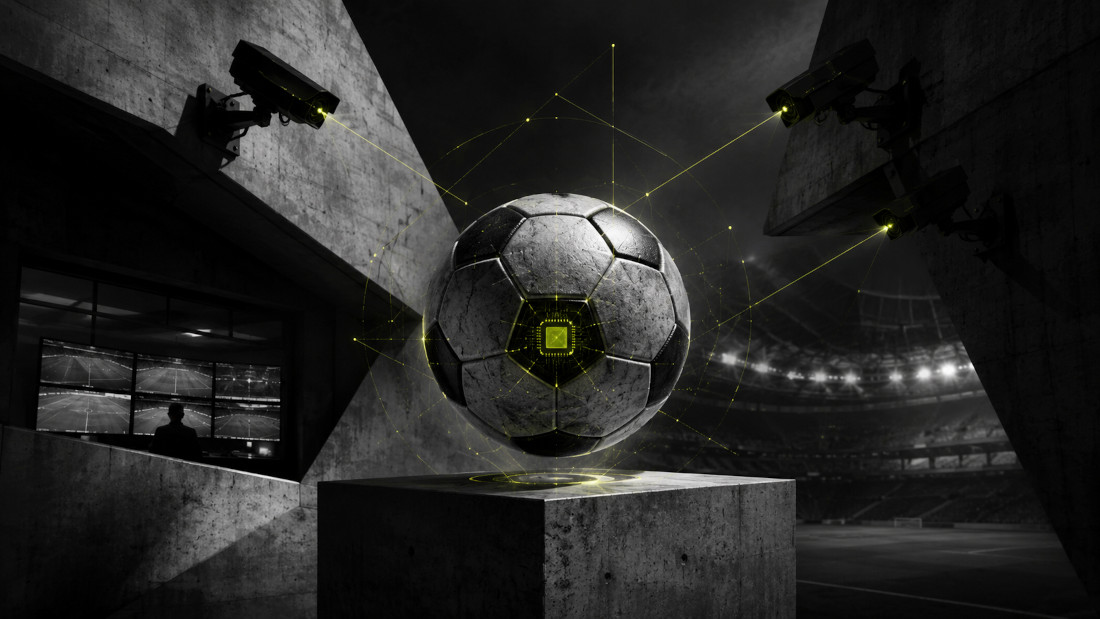
Football used to be governed by sight.
A referee saw. An assistant raised a flag. A crowd protested. A replay appeared on television, sometimes too late, sometimes from the wrong angle, and the match moved on carrying a permanent trace of doubt.
The 2026 FIFA World Cup is different. Not because doubt has disappeared, but because the machinery around doubt has become more sophisticated than ever. VAR is no longer just a referee watching a screen. It is part of a larger evidentiary system: cameras, sensors, optical tracking, connected-ball data, goal-line technology, semi-automated offside, 3D player models, replay operators, assistant video referees, and, at the end of the chain, still one human referee asked to transform evidence into a decision.
That is the important point. The machine does not replace the referee. It surrounds the referee with proof.
The scheme is now layered. The official match ball, adidas TRIONDA, contains connected-ball technology: a 500Hz motion sensor chip that sends real-time information to the video assistant referee system. Its job is not to decide whether a goal should stand. Its job is to help establish facts that used to be extraordinarily difficult to isolate: the precise moment the ball was touched, the movement of the ball, the possible contact that changes an offside sequence.
Around the ball, stadium cameras track players and the ball in space. Semi-automated offside technology combines skeletal tracking, ball data, and positional information to detect whether an attacker was ahead of the relevant defender at the exact moment the ball was played. Goal-line technology uses its own camera-based system to determine whether the entire ball crossed the entire line. Out-of-bounds technology applies optical tracking to another supposedly simple question: did the ball leave the field of play?
These are not minor upgrades. They change the nature of football evidence.
Offside, goal-line decisions, and ball-out-of-play situations move closer to the category of objective proof. They are still mediated by systems, calibration, visibility, and protocol, but the question itself is essentially factual. Where was the player? Where was the ball? When was it touched? Did it cross a line?
Fouls are different.
A sensor can help identify contact. A camera can show the point of contact. Slow motion can reveal whether a foot landed on an ankle, whether a hand touched a shirt, whether a challenge arrived late. But football does not punish contact alone. It punishes meaning: careless, reckless, excessive force, handball context, interference, advantage, intensity, consequence. Those are not merely measurements. They are interpretations.
This is where the human-and-machine team becomes visible.
Inside the video operation room, the VAR and assistant VARs do not referee the match from scratch. Under the VAR protocol, the on-field referee must still make an original decision. VAR is there to check potential match-changing incidents: goals, penalties, direct red cards, mistaken identity, and, depending on the competition option, certain corner-kick situations. If there is no clear and obvious error, the original decision usually stands. If there is a likely factual correction, the VAR may communicate it. If the issue is subjective, the referee is normally sent to the monitor for an on-field review.
That architecture matters because it defines what technology is allowed to do.
The machine can help say: the player was offside. The ball was out. The ball crossed the line. The contact happened here. The touch occurred at this moment.
But it cannot fully answer: was that enough? Was the contact trifling or decisive? Did the defender make a legitimate challenge? Was the attacker meaningfully impeded? Did the referee’s original reading of intensity survive review?
The more technology improves, the more football exposes the difference between evidence and judgment.
This is why the 2026 World Cup feels like a turning point. The connected ball can detect touches that spectators may not see. Semi-automated offside can turn a movement of centimeters into a decision. 3D recreations can make the ruling legible to television viewers. But controversy does not vanish. It migrates.
Before VAR, the argument was often: did the referee see it?
Now the argument is: why did this incident qualify for review, and that one did not? Why was this contact treated as decisive, while another was absorbed into the flow of the game? Why was a foul in the attacking phase considered relevant enough to cancel a goal? Where does objective evidence end and re-refereeing begin?
That is the deeper story. Technology is not making football less human. It is revealing exactly where the human part remains.
The 2026 system gives the referee more information than any previous generation of officials could have imagined. The ball reports. The cameras track. The software models. The VAR checks. The replay operator isolates. The monitor displays. The crowd waits.
Then one person must decide.
This may be the future of many human systems, not only football. Courts, hospitals, companies, schools, governments, and newsrooms are all moving toward the same structure: more sensors, more data, more models, more proof. But proof does not automatically produce trust. Trust depends on the rules that decide when evidence matters, who is allowed to interpret it, and how clearly the final decision is explained.
Football is useful because it compresses that problem into ninety minutes.
The promise of VAR and connected-ball technology is not perfection. Perfection is the wrong standard. The promise is a better chain of accountability: fewer missed facts, fewer invisible errors, fewer decisions made from a single angle at full speed.
The risk is different. The risk is that the game becomes formally more precise while emotionally less intelligible. A goal is scored. The stadium explodes. Then the machine begins to search the past. A slight touch, a distant foul, a foot beyond a virtual line, a ball that may have left the field seconds earlier. The decision may be correct, but the experience feels interrupted by a logic that belongs somewhere outside the game.
That tension will not disappear.
In fact, it may define modern football: a sport still played by bodies, rhythm, improvisation, deception, anger, balance, fatigue, and chance, now judged through an expanding apparatus of measurement.
The question is no longer whether technology belongs in the game. It already does.
The real question is what should remain challengeable once almost everything can be measured. Not every complaint is a failure of technology. Sometimes it is a disagreement about the philosophy of the game. Should football privilege microscopic truth or competitive flow? Should every provable fact matter equally? Should a goal be erased for an offence that was real but remote? Should the referee correct only the clearly wrong, or optimize every decision toward technical accuracy?
VAR did not end controversy. It refined it.
The 2026 World Cup shows us the new frontier: not the arrival of machine referees, but the construction of an evidence engine around human judgment. The ball has a chip. The stadium has eyes. The replay has memory.
But the whistle is still human.