Aphotic Zone
At Singapore’s ArtScience Museum, a journey into the ocean’s depths reveals life, art, and the darkness within us.
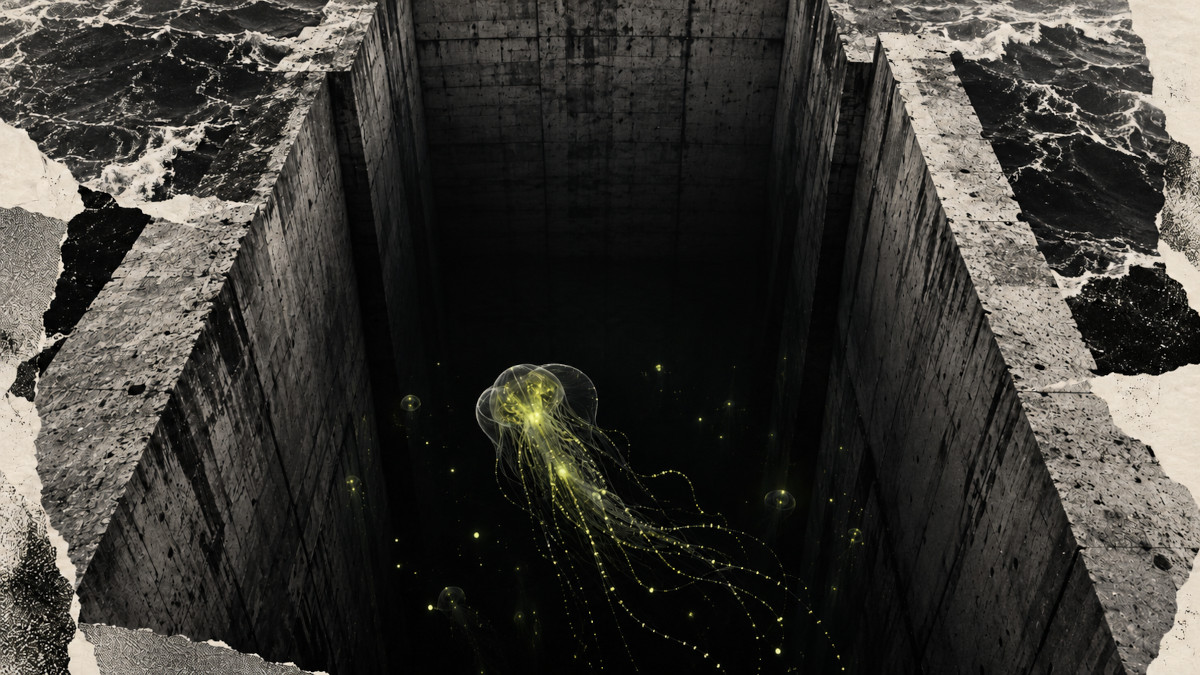
Where I live, we have been missing the sun. When it appears, we rush to catch it, as though we could recharge our batteries with enough sunlight to last the rest of the day. A little more! Let it last. Let it be enough. But the sun hides, clouds gather, afternoons grow shorter, and darkness eventually takes over. What lies beyond the reach of light?
The ocean has an answer. If everything depended on the sun, what would become of its depths? There, where sunlight disappears, creatures produce their own glow, and an entire universe challenges our understanding of darkness. Not everything wonderful needs light to exist. Sometimes, we need to stop looking toward the sun and dare to descend.
That is the invitation offered by Into the Ocean: Journey Beneath, an exhibition at Singapore’s ArtScience Museum created in collaboration with OceanX. The exhibition takes visitors from surface waters to the most extreme depths, combining footage from underwater expeditions, artworks, scientific specimens, and interactive experiences. A dazzling descent that also reveals the fragility of the ecosystems sustaining life on our planet.
Let’s Descend
In Coral Sonic Resilience (2025–2026), Italian artist Marco Barotti offers an audiovisual journey into the ocean’s world of sound. The work draws on research into acoustic enrichment: underwater sculptures play recordings of healthy reefs in damaged ecosystems to attract marine life and support their recovery. Poetic images, underwater recordings, songs, and electronic soundscapes create an experience that invites us to listen to what usually lies beyond our perception. Sound becomes more than an accompaniment: it becomes a possible tool for ecological regeneration.
A more unsettling dimension emerges in Echinoidea Future – Adriatic Sensing (2022), by Slovenian artist Robertina Šebjanič. The work explores the changes that human-generated liquid waste causes in sea urchin habitats, including low oxygen levels in the water. Here, technology and research do more than fill us with wonder at the unknown; they also reveal the traces of our presence. What we discard does not disappear. It ends up affecting other bodies, other ecosystems, other forms of life.
Twilight Zone: Life in the Half-Light
Between 200 and 1,000 metres below the surface lies the ocean’s Twilight Zone. Sunlight barely reaches it, temperatures drop, and pressure rises, yet life continues. Each night, vast numbers of organisms rise toward the surface to feed, returning to the depths during the day. This vertical migration, considered the largest animal migration on the planet in terms of its scale, also helps transport carbon from surface waters into the deep ocean.
The exhibition translates these phenomena into images, data, and interactive experiences.
In Lucida (2025), American artist Lachlan Turczan turns light into an immersive sculpture that responds to visitors’ movements. Planes of light curve, ripple, and dissolve as we move through the space. The work transforms waves and energy into a physical experience: light is no longer simply what illuminates, but a shifting substance we perceive with our bodies. Its relationship with the ocean is particularly evocative. In the depths, many organisms produce their own light to communicate, attract prey, confuse predators, or camouflage themselves. In Turczan’s installation, light also seems to have a life of its own. The experience reminds us that our perception is limited and that there are other ways of inhabiting and experiencing the world.
Aphotic Zone: Where the Sun Cannot Reach
The aphotic zone begins at a depth of 1,000 metres: a territory of permanent darkness extending to the seafloor. Life there depends on organic matter descending from the upper layers or, in certain ecosystems, on chemical energy. Organisms develop extraordinary adaptations: bioluminescence and metabolisms capable of functioning with scarce resources.
In this section, Norwegian sound artist Jana Winderen invites us to listen to extreme marine environments through recordings that reveal little-known acoustic landscapes. Footage from OceanX expeditions brings us closer to creatures adapted to darkness, while British filmmaker James Honeyborne revisits an exploration of deep-sea brine pools: basins of hypersaline water found in very specific locations that can be toxic to many organisms.
Returning to the Surface
After the descent, Resurface brings us back to coastal waters and seagrass meadows. In Seagrass Stories, an interactive experience developed by marine ecologist Nada Abdelkader together with the University of Bristol, visitors symbolically participate in a restoration project inspired by traditional Tunisian fishing traps. Through simple gestures, they activate a process showing how a meadow can grow and become more resilient through collective participation.
Exhibitions about nature risk turning the environmental crisis into an aesthetic experience. Beauty can bring us closer to a problem, but it does not solve it. Into the Ocean turns wonder into an experience of reflection and commitment.
As I wait for the sun to return, I think about that universe deep within the ocean. About creatures that invent their own light, about landscapes that need no sunrise to exist. And about that other darkness we so rarely dare to descend into: our own Aphotic Zone, where the sun cannot reach, but where there is still so much to discover.
And believe me, great works of art are born there.
Into the Ocean: Journey Beneath. ArtScience Museum, Singapore. June 6–November 1, 2026.