Before the Pixel, the Thread
From Goya’s Tapestries to Computerized Looms
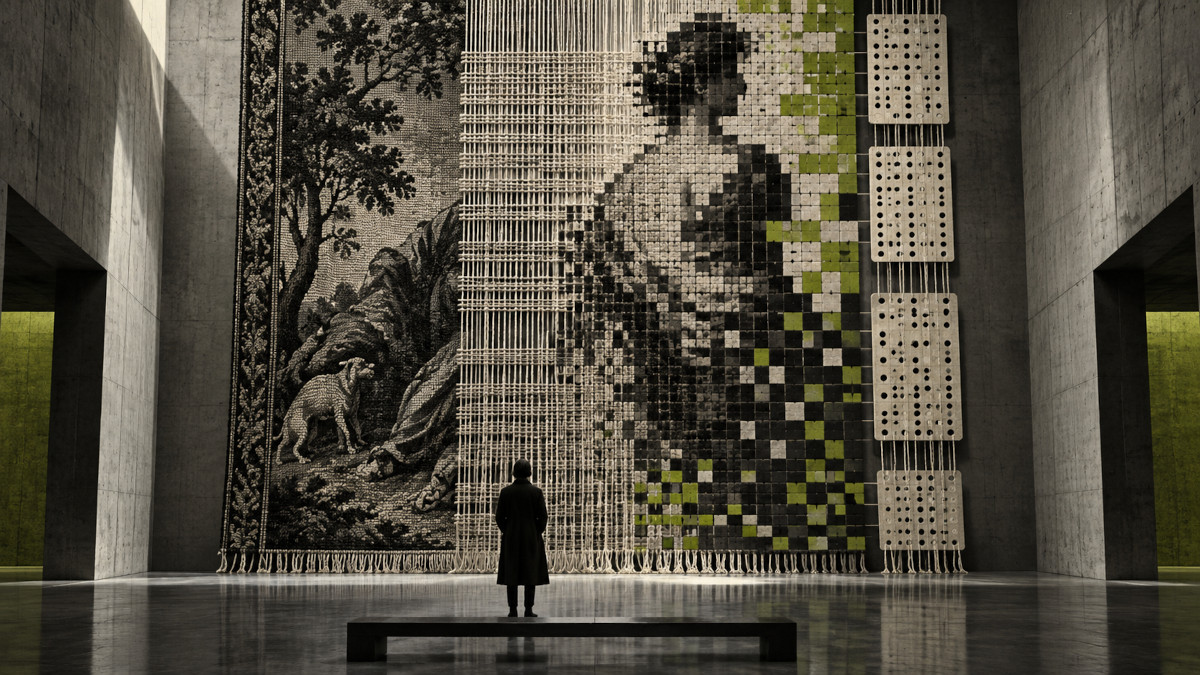
I see Goya’s two tapestries at the Museo Nacional de Bellas Artes in Buenos Aires, Argentina. I look for the right distance from which to view a woven image.
The Kite and Blind Man’s Buff, designed by Goya between 1776 and 1788 and woven at the Royal Tapestry Factory of Santa Bárbara, have come to Buenos Aires from Spain’s Gallery of the Royal Collections. They are on display until January 17, 2027, marking the first time a work from that institution has been exhibited in the Americas.
The scenes seem simple.
A group of young people plays. Others talk. There are fields, dresses, gestures, leisure, seduction. Goya constructs recognizable, even agreeable situations. But the longer I look, the less innocent they become. This is one of his most powerful devices: showing everyday life to speak about something else.
Blind Man’s Buff depicts a game, but it also stages deception, courtship, appearances, and social relationships. Goya does not spell out a moral. He lets it work within the scene. And then I look at the clothes.
The dresses, the colors, the fabrics, the accessories, the differences between the figures. Nothing is there merely to beautify. Clothing locates people socially; it constructs gender, age, status, desire. It tells a story.
Goya made the cartoons that served as models. Weavers translated those images into wool and silk, turning lines, colors, light, and figures into a weave. The image was built thread by thread. That process holds a fascinating technological history.
In 1804, Joseph Marie Jacquard introduced a loom in Lyon that used punched cards to control which threads were raised and to produce complex designs. The cards acted as instructions: their sequence determined the pattern. The loom was making textiles, but it was also working through programmable logic.
Charles Babbage knew the system and drew on it for his Analytical Engine. Ada Lovelace understood the potential of that logic for working with instructions and operations. Among the precursors to computing is a loom.
A textile pattern could become a sequence of instructions. Today, that relationship is finding its way back into art.
In Tilburg, the TextielMuseum marks the 25th anniversary of its TextielLab in 2026 with Man <3 Machine, an exhibition bringing together eleven works produced there through collaboration among artists, designers, textile specialists, and machines. Computer-controlled weaving makes it possible to build complex structures layer by layer and develop pieces that move beyond flat surfaces to take on volume and shape.
In San José, California, The Woven Pixel explored the emergence of digital weaving, bringing together works made with digital looms and Jacquard software. Its title points to a concrete relationship: each crossing of weft and warp can function as a basic unit from which an image is built.
A pixel builds an image from units. A textile does too. The tools, scale, and result change, but the logic of construction remains. The phenomenon extends beyond the loom.
Fashion, too, is entering the museum in force. The Louvre presented Louvre Couture, in which contemporary pieces by major designers entered into dialogue with paintings, sculptures, and objects from its collections. The exhibition approached fashion through art history, techniques, references, and influences.
The runway adds another dimension: movement. A garment does not remain still in a display case. It has a body, scale, drape, sound, motion. The viewer no longer looks only at an object, but at how that object transforms a body.
Today, textiles are meeting digital art again. After years of looking at luminous images on screens, fabric restores weight, volume, texture, and temperature. It can cover a body, divide a space, become architecture. It can be soft or structural. And it can be programmed.
The return of textiles to the museum is not about recovering an old technique as a decorative object. Weaving connects programming and craft, image and object, surface and space.
I return to Goya and to what I see before his tapestries: matter’s ability to conceal information. His designs are woven scenes that speak of morality, desire, appearances, and social relationships. The thread does not merely illustrate: it reveals.
Contemporary textile art takes up that power with other materials, other bodies, and new technologies. And what do its threads reveal today? Morality, desire, appearances, social relationships.
Goya, some things never change.