Got You
In a former prison in Venice, Li Yi-Fan turns digital bodies and screens into an uncomfortable question: do we look at what we want, or what we are shown?
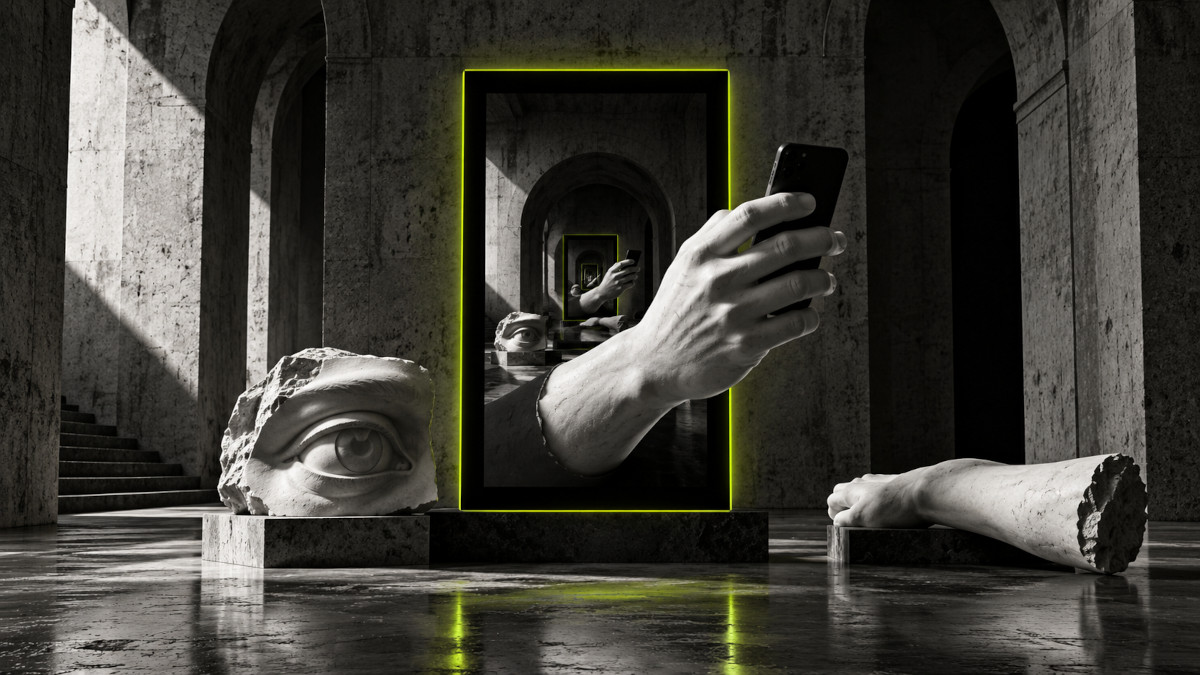
October arrives, and the Venice Biennale begins to enter its final stretch. In November, when its doors close, we will have to wait two years for the pavilions, palaces, and canals to fill once again with works, artists, and visitors from around the world. Meanwhile, there is still time to look at some proposals that continue to ask uncomfortable questions about the way we live with images.
At the Palazzo delle Prigioni, a former prison beside the Palazzo Ducale, Li Yi-Fan offers one of those experiences that are difficult to forget. His exhibition Screen Melancholy, presented as a collateral event of the 61st Biennale, transforms the building into a digital stage where the body appears fragmented, multiplied, and turned into an image.
A screen reproduces the Palazzo delle Prigioni itself, but something does not quite fit. Within that virtual architecture, a puppet-like character moves around, while enormous 3D-printed hands, feet, arms, heads, and legs await visitors in the room. Some of these pieces are sculptures; others also serve as seats. The body ceases to be a complete figure and becomes parts, objects, models that can be touched, photographed, and inhabited.
The scene mixes video games, absurdist theater, animation, and a strange dream. Behind its playful appearance lies a very concrete question: what happens to our perception after spending so many hours in front of a screen?
The Taiwanese artist builds his world using a game engine, a tool commonly used in video games, to digitally reconstruct the Palazzo delle Prigioni and animate his characters. He then brings some of those elements into physical space through 3D printing. The process reverses the usual path: what began as a digital image ends up occupying space, has volume, and can support our bodies.
Li Yi-Fan also leaves part of the machinery exposed. Modeling, surfaces, masks, movements, and keyframes cease to be invisible tools and become part of the experience. The work shows how an image is made while making us question what we are looking at.
Screen Melancholy began as a reflection on what is called “screen melancholy,” linked to prolonged exposure to devices, information overload, and the transformation of our sensory experience. It does not express a simple nostalgia for a world without technology. Nostalgia emerges elsewhere: in the feeling that we have lost a certain distance from images. An image once could make us pause. Today, an image usually takes us straight to another.
One window opens another window, one video leads to another, one search triggers ten more. We swipe a finger, and the world keeps appearing. The screen seems to expand our field of vision infinitely, but it can also turn completely different experiences into a succession of surfaces that we move through at the same speed.
The artist retrieves traces of VHS, cinema, photography, painting, and physical models, but not to reconstruct an ideal past. He brings them together with digital tools and the accelerated logic of the screen. He even introduces humor: an eye tries to return home, organs meet, and characters explain technological procedures as though taking part in an impossible class.
The building adds another layer. For centuries, the Palazzo delle Prigioni was a place of confinement. Now Li Yi-Fan turns it into a virtual architecture inside a real one. Visitors enter with their phones in hand, look at a screen reproducing the building they are standing in, photograph sculptures that resemble parts of a body, and can sit on an enormous plastic limb. We are inside a former prison, surrounded by images, looking at a screen while simultaneously using our own devices. And we are also inside the work.
Screen Melancholy does not try to convince us that technology is the problem, nor does it suggest switching off all our devices to recover some supposedly lost purity. What it does is take digital tools, dismantle them before us, and force us to observe how they construct what later shapes the way we look.
Li Yi-Fan poses an unsettling question: “Is what you see on your phone really what you want to see, or is it simply what you are being shown?”
For the artist, discovering that everything reaches us already selected produces a feeling of powerlessness that is, precisely, the true melancholy. In his world, we can be both those who watch and those who are watched, those who pull the strings and those who end up moving to their rhythm. Puppeteer or puppet.
I do not want to be trapped. I leave the Palazzo delle Prigioni. Outside, freedom, Venice, the water, the stone, the light. I walk, breathe, and look at my phone again. Got me!