Fresh Air Please
A fifteenth-century painting, a twenty-first-century climate system, and the quiet data infrastructure that keeps beauty alive.
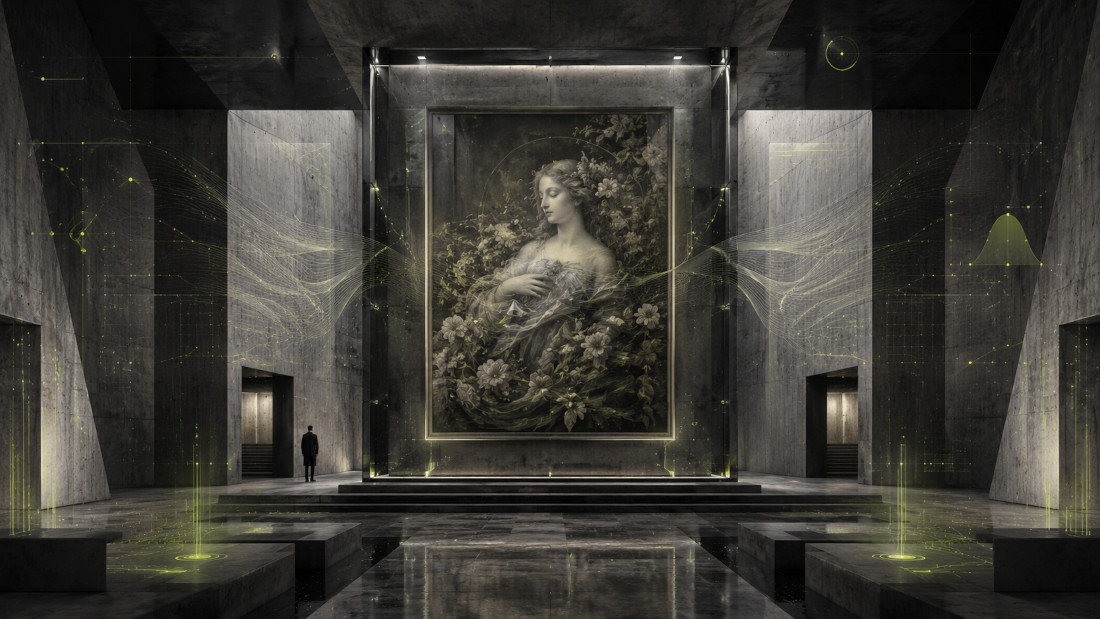
As Europe goes through a new heat wave, millions of people look for shelter under the shade of a tree, inside a church, or in a museum. But there are other inhabitants of those buildings that also suffer from high temperatures and cannot move: works of art. A painting does not sweat, but it breathes.
I enter the room, and the first thing I sense is not the painting, but the climate. A stable air, almost suspended, as if time itself had been tuned before reaching this place. I take a few steps, and Botticelli’s Primavera appears before me. I am in the Uffizi Gallery, in Florence, Italy. And it is summer.
There is no noise, no excess. Everything seems designed so that nothing overflows.
I move closer. Not too close. There is an invisible distance that is not only museographic: it is technological. The work is inside an intelligent climate-controlled display case that regulates temperature, humidity, and airborne particles as if sustaining a constant respiratory balance. Nothing is accidental. Even my presence enters that system as one more variable.
I breathe more slowly, without thinking. I feel that the museum is breathing too, but in another way.
I look up, and the painting is still the same as ever: Venus at the center, the figures caught in arrested movement, nature ordered like an impossible choreography. But around it there is another layer, one that cannot be seen directly: the layer of data. Invisible sensors record the environment in real time. If humidity changes, the system corrects it. If temperature fluctuates, it compensates. If something deviates, it is recorded. The work is not alone: it is accompanied by an infrastructure that translates it into continuous information.
And then I begin to understand something both uncomfortable and fascinating: there is not just one work here. I take a step and think that what I am looking at is not only a painting, but a state. A physical, chemical, and digital state all at once. A fifteenth-century image sustained by a twenty-first-century system. Because there is another version of this work.
A second work.
It is not hanging on any wall. It is distributed. It is in gigapixel scans that record every crack in the varnish. It is in multispectral images that reveal what the eye cannot see. It is in databases that store its evolution over time. It is in digital models that simulate how it ages, how it changes, and how it resists. It is not a copy. It is a scientific translation of the original. A way of seeing it without looking at it directly.
I walk slowly to one side. A small QR code interrupts the continuity of the space. It is discreet, almost shy, but it opens another dimension: the work explained, expanded, decomposed into layers. The painting is no longer only what stands before me; it is also what can unfold on another screen.
And yet, I am still here. Facing the physical. Facing the unrepeatable.
The restorer no longer begins with the hands, but with data. Before touching the work, the restorer analyzes it through digital maps, compares states, and simulates interventions. Restoration is first rehearsed on an invisible version of the painting. Decisions are made on information before matter. And when the intervention finally takes place, that physical gesture has already been guided by layers of accumulated knowledge. Then everything is recorded again. What was done becomes part of the digital archive. The work is updated as if it had an expanded memory.
I pause a little longer than usual.
I feel that the real transformation is not only technological, but conceptual. Before, the museum preserved objects. Now it preserves processes. And the “original” stops being something fixed and becomes a relationship between what is seen, what is measured, and what is interpreted. A relationship between matter, science, and memory.
I leave the room.
What remains and matters to me, what resists any data system, is the same thing that has mattered for centuries: a moving image that continues to breathe in silence.
Outside, the thermometer reads 39 degrees. Inside, thousands of data points work silently so that a painting can continue breathing.
Technology has never seemed so human to me.