Training The Machine
How AI learned from language, images, code, people, and the world — and why the future of intelligence will depend on what machines are allowed to absorb, imitate, correct, and remember.
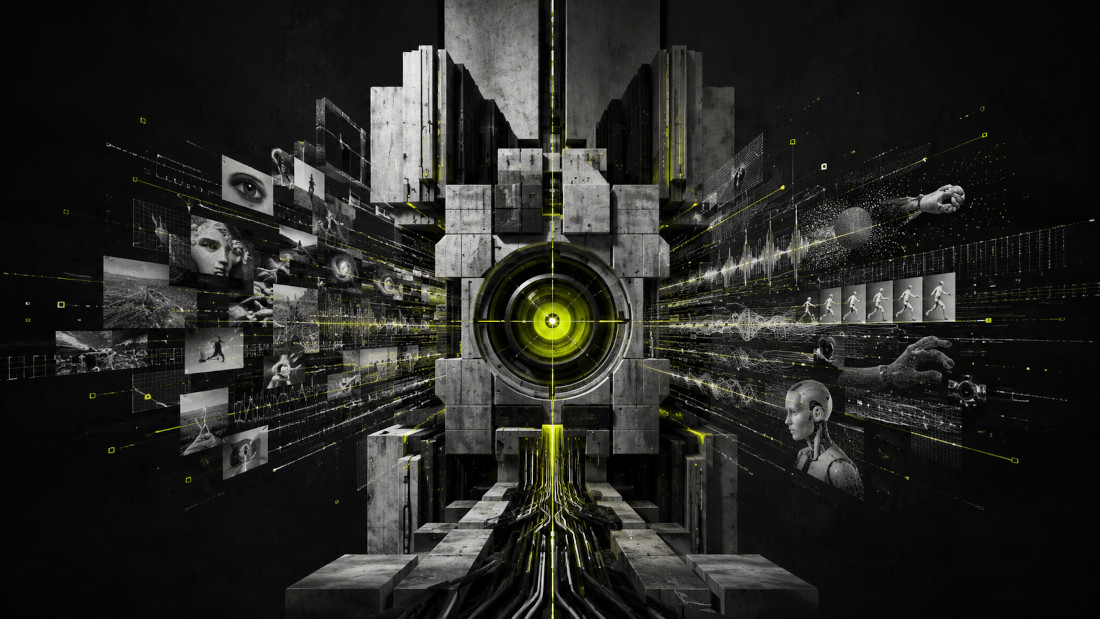
Before the model answers, it has already been trained.
That is the fact most easily hidden by the apparent magic of artificial intelligence. A prompt goes in, an answer comes out, and the machine seems to have understood. But the answer is only the visible end of a much longer process. Before there is fluency, there is exposure. Before there is behavior, there is correction. Before there is intelligence, or something that resembles it closely enough to matter, there is training.
Modern AI models are not programmed in the old sense. Nobody writes every sentence they may produce. Nobody teaches them one concept at a time. Instead, they are built through a process of statistical absorption. A model is shown enormous quantities of material — text, images, code, audio, video, structured data — and learns patterns from that exposure. In language models, the basic exercise is brutally simple: predict what comes next. Given a fragment of text, the system learns to anticipate the next token. Repeated at massive scale, this exercise becomes grammar, style, factual association, reasoning patterns, translation, imitation, and eventually conversation.
The simplicity of the mechanism is part of the shock. A machine trained to predict the next piece of language begins to display behaviors we associate with intelligence. It can summarize, explain, compare, write, code, translate, argue, teach, and improvise. Not because it was manually instructed to perform each of those acts, but because the structure of human expression contains more than words. It contains knowledge, intention, hierarchy, causality, taste, conflict, and habit.
Training is the hidden industrial process behind this transformation.
The first great training ground was the archive. The web became a raw material. Books, forums, documentation, articles, repositories, captions, transcripts, encyclopedias, and public datasets entered the machine as examples of how humans describe the world. Code taught models how instructions become systems. Images taught them how language attaches to shape, texture, composition, object, and scene. Audio and video began to extend that process into speech, music, motion, and the physics of visible life.
But raw exposure is not enough. A base model trained only to continue patterns may be fluent without being useful. It may complete a sentence, but not answer a question. It may imitate confidence without caring about truth. It may produce toxic, evasive, verbose, or incoherent responses. This is where training becomes more than ingestion.
The second stage is alignment.
In the most familiar version, humans write examples of good answers, compare different model outputs, and rank which responses are more helpful, honest, safe, or appropriate. Those preferences are then used to tune the model’s behavior. The machine first learns language from the archive, then learns manners from judgment. A base model learns how people write. An aligned model learns how people want to be answered.
This changed the profession of AI. Training a model is not only a computer science problem. It is a vast coordination problem involving researchers, data engineers, infrastructure teams, linguists, annotators, red-teamers, safety specialists, product designers, lawyers, and domain experts. Some work on architecture. Some on data. Some on evaluation. Some on the human feedback that teaches the system what kind of answer is preferred. Some try to break the model before the public does.
The machine may look autonomous, but its behavior is full of human decisions.
What should count as high-quality data? Which languages should be represented? Which sources should be filtered out? What is harmful? What is merely controversial? What should the model refuse? When should it speculate? How much personality should it have? How much uncertainty should it show? What does it mean for a model to be useful without becoming obedient to everything?
These are not peripheral choices. They are training choices.
The evolution of model training has moved through several phases. First came scale: larger models, more data, more compute. Then came the science of scale: the discovery that performance could often be predicted by relationships between model size, dataset size, and computation. Then came the correction: bigger was not always better if the model had not been trained on enough data. Quality, mixture, deduplication, and balance mattered. Then came post-training: human feedback, constitutional methods, synthetic data, tool use, evaluation, and increasingly complex pipelines designed to turn a powerful pattern engine into a usable assistant.
The new phase is different again. Models are no longer learning only from what humans have already written or uploaded. They are beginning to learn from the world as something seen, heard, navigated, and acted upon.
This is where cameras matter.
A language model trained on text learns the world indirectly, through description. A vision model learns from images. A video model learns motion, continuity, scene change, gesture, and time. A robot model trained on vision, language, and action begins to connect perception with movement. It does not only learn that a cup is called a cup. It learns that a cup can be grasped, moved, tipped, avoided, filled, or broken.
This shift points toward what researchers often call world models or embodied AI: systems trained not only on cultural archives but on sensory experience and action. Some of that experience comes from cameras. Some comes from robot demonstrations. Some comes from simulation. Some may eventually come from continuous real-world recording: machines watching factories, roads, kitchens, hospitals, stores, fields, and homes.
That is a different kind of training. It moves AI closer to the human condition, though not into it. Humans learn with bodies, limits, pain, memory, attention, desire, and consequence. Machines learn from data traces of the world. But the gap is narrowing in one important sense: training is becoming less textual and more environmental. The archive is being joined by the sensor.
This may be the real long-term transition. The first generation of generative AI learned from the internet. The next generation may learn from the world.
There is also another turn: synthetic data. Once models become strong enough, they can help generate material for training other models. They can produce problems, answers, simulations, variations, explanations, code, and controlled examples. This does not remove the need for reality. Synthetic data can amplify errors, narrow diversity, or create a closed loop of machine taste. But when used carefully, it can fill gaps, improve reasoning, create rare scenarios, and reduce dependence on scraped material.
Training, then, is no longer one thing. It is a stack.
There is pre-training, where the model absorbs broad patterns. There is fine-tuning, where it becomes better at specific tasks. There is reinforcement learning from human feedback, where preference shapes behavior. There is reinforcement learning from AI feedback, where models help evaluate other models. There is synthetic data, where machines generate part of their own curriculum. There is multimodal training, where text, image, audio, and video begin to share a common space. There is embodied training, where perception connects to action.
The result is not a database. A trained model does not simply retrieve the works it has seen. It compresses patterns into weights: billions or trillions of numerical relationships distributed across a network. This is why the output can feel both familiar and new. The model does not quote the archive by default. It generates from the statistical structure it has learned. But that structure was still learned from somewhere.
And this is where the arts become impossible to ignore.
For writers, illustrators, photographers, designers, filmmakers, and musicians, training is not an abstract technical procedure. It is a cultural event. Their work may have been part of the material from which the model learned style, genre, composition, harmony, lighting, phrasing, sound, and mood. Even when the output is not a direct copy, the question remains: what does it mean for a machine to learn from creative labor at planetary scale?
Music makes the objection especially clear. A song is not only information. It is performance, voice, production, atmosphere, touch, timing, and identity. To train on music is to learn more than notes. It is to learn the gestures of musicians, the habits of producers, the emotional codes of genres, the grain of recorded culture. When a system can generate a track in seconds, musicians hear not only a tool but a new competitor trained on the sound-world they helped build.
The legal state is still unsettled. Courts, regulators, artists, publishers, labels, and AI companies are now negotiating the terms after the fact. Some argue that training is a transformative use of existing material. Others argue that it is unauthorized extraction, especially when the output can substitute for the market that produced the training material. The dispute will not be solved by one slogan. It will likely be shaped case by case, sector by sector, license by license.
But the dispute should not obscure the deeper fact.
Training is now one of the central acts of technological civilization. It is how machines inherit the world. It is how archives become behavior. It is how human work becomes machine capability. And it is where the future of AI will be decided: not only in the answer the model gives, but in the material it was fed, the people who corrected it, the rules that shaped it, and the worlds it is allowed to watch.
The machine does not emerge intelligent.
It is trained.