Art Basel 2026: Point Zero
The Year Data Entered the Conversation
There is a scene that repeats itself every June in Basel. Thousands of people walk through enormous halls, looking at paintings, sculptures, monumental installations, and, above all, searching for a silent answer to an uncomfortable question: where is art going?
This year, at Art Basel 2026, one of the many possible answers appeared where many expected it: in data.
Art Basel took place from June 18 to 21, bringing together more than 290 galleries and over 4,000 artists from around the world, once again consolidating Basel as the great gravitational center of the international art market. For years, the main conversation around the world’s most important fair revolved around established names, multimillion-dollar figures, and “trophy” works. This year, those operations were still there — a Picasso sold for 35 million dollars was one of the opening headlines — but the real novelty appeared somewhere else.
Just a few meters away from traditional paintings and sculptures, Zero10 made its European debut: a platform dedicated to digital art. It was not simply a technological section. It was a statement of intent.
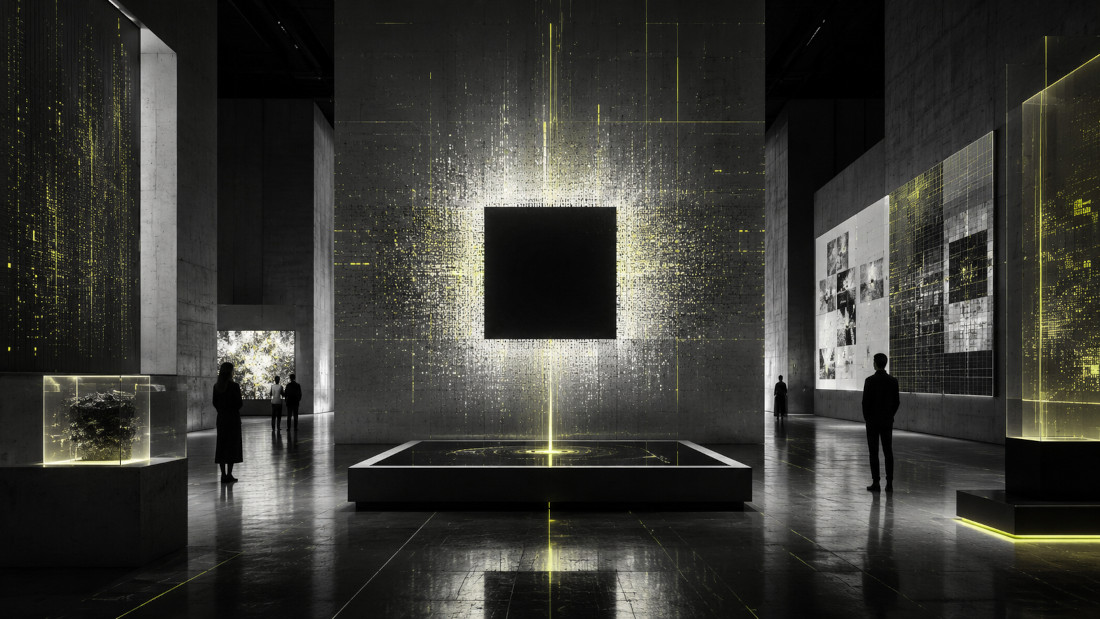
In 1915, the artist Kazimir Malevich first presented Suprematism, including his famous Black Square. Malevich said he wanted to reduce art to its “point zero” in order to free it from the weight of the traditional academic world and begin creating from pure abstraction. The digital era represents a new “point zero”: a completely blank canvas from which to redefine what art is and how we experience it.
Art Basel seems to have understood that the next generation of collectors grew up in front of screens, and that their visual references were born inside an ecosystem entirely different from that of those who began by buying prints or paintings. What is interesting is not that digital art exists. That no longer surprises anyone. What is interesting is that, perhaps for the first time, the conversation centered on conservation.
How do you preserve a work made of code? What happens when the software becomes obsolete? What exactly is the “original” of a piece generated by artificial intelligence?
These questions, which only five years ago seemed philosophical, are now part of the concrete concerns of gallerists, museums, and collectors. According to the global Art Basel and UBS report, digital art sales grew from 1% to 3% of the global market in just two years. It remains a small portion, but the speed of growth is impossible to ignore. Institutions are learning to preserve systems, files, protocols, and data. In other words, they are preserving information as much as matter.
Zero10
In contemporary art, a work has long ceased to be only what we perceive through the senses. It is also the set of instructions that allows it to exist. It is also the data. It is also the experience.
If there was one place where this shift could be clearly perceived, it was Zero10, Art Basel’s initiative dedicated to artists working with digital technologies. This year marked its European debut in Basel, as well as its most ambitious edition to date.
Curated by digital strategist Eli Scheinman together with artist Trevor Paglen, the platform brought together generative works, digital installations, and projects that cross different media. More than a specialized section, it functioned as a window into an artistic scene that, until recently, occupied the margins and is now beginning to move into the center of the conversation. Collectors, curators, and museum representatives came to explore a territory that no longer feels like a bet on the future, but a reality of the present.
Zero10’s sales reflected that same feeling. John Gerrard’s STANDARD (2022) was acquired by a major private collection in the United States for 500,000 dollars. The work is a real-time digital simulation depicting a gas flare in the shape of a flag over the South Pacific Ocean near Tonga, operating as a warning signal before a warming ocean.
Several works by Mexican artist Rafael Lozano-Hemmer were also sold, while twelve pieces by generative art pioneer Vera Molnár found new collectors across Europe and the United States.
Beyond the figures, the data reveals something more interesting: the market no longer sees these practices as a technological curiosity. The most influential fair on the planet understands this shift, and is paying attention.
If the twentieth century was obsessed with preserving objects, the twenty-first century seems to be facing a much more complex challenge: preserving information without losing the emotion that made it valuable in the first place. And that conversation, quiet but persistent, could be heard at Art Basel.
The cultural memory of the future is no longer preserved only in storage rooms, archives, and display cases. It lives in servers, algorithms, and systems capable of preserving every piece of data, every image, and every movement with a precision no human being could match.
And yet, there is still something no technology has managed to solve: why one work follows us for years while another fades the moment we leave the room.
As the art world learns to preserve code, I still choose to trust a much more fragile and imperfect support. That disorderly territory where we do not store data, but emotions. Science will say it only pumps blood. But it remains the place where we feel that the things we do not want to forget are still alive.
Art Basel
Next edition: Art Basel Paris, October 23–25, 2026, Grand Palais.