The Great Portrait
When technology makes the forces of the Earth visible, the way we represent it changes as well.
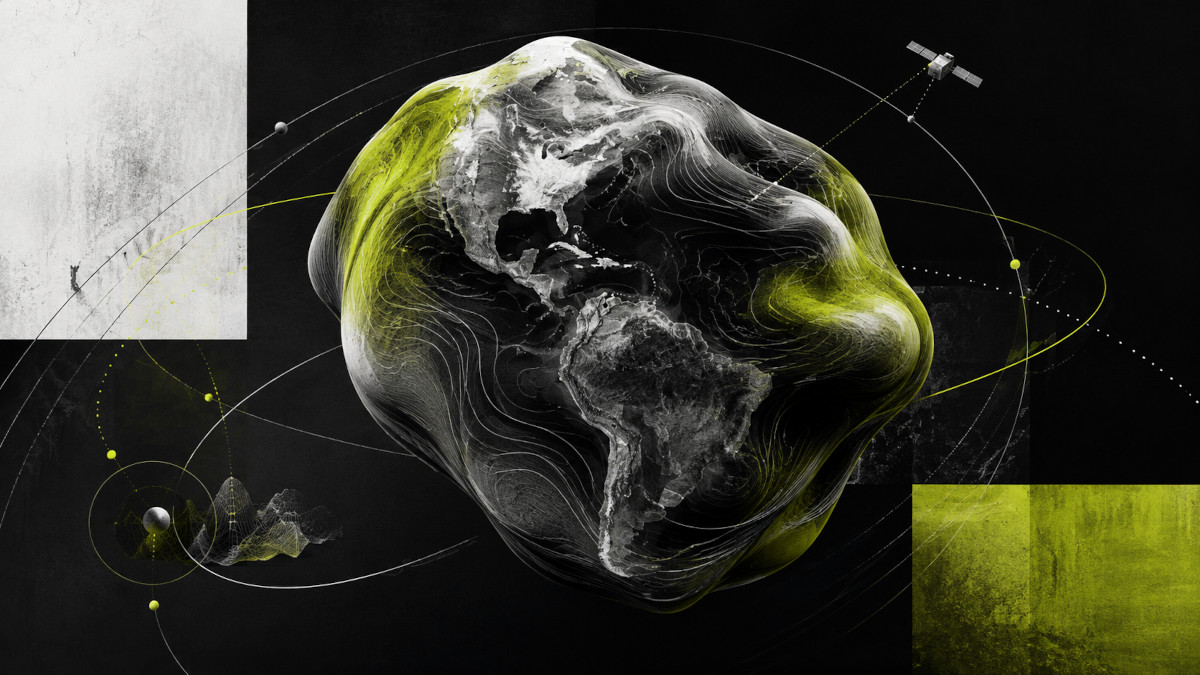
When art moved beyond exclusively divine representation, the aura also shifted: from the gold of sacred iconography to the power of the human being as creator, protagonist of a real time and space: the Earth.
At the intersection of science, technology and digital art that characterizes much of contemporary art, the possibility emerged some time ago of making visible what, until recently, lay beyond our sight. Art moved from representing celestial bodies to representing invisible forces.
The Image of Gravity
NASA has just made one of those invisible realities visible. It is the geoid, a representation of the Earth’s gravitational surface. It is not a photograph of the planet, nor a perfect sphere. It is a model built from enormous amounts of satellite data. A visualization of its gravitational field. And its shape is strange, irregular, almost organic. At times it resembles a digital sculpture. At times, a planet imagined by an artist. But it was not drawn; it was calculated.
Sometimes I think the history of art could also be told as the history of the way we look at the Earth. For centuries, we painted it from afar. We imagined it, ordered it, turned it into landscape.
In the backgrounds of Leonardo’s works, nature seemed to unfold behind the figures like a mysterious territory. Later, with the great landscape painters, the Earth ceased to be simply the setting of a story and became a protagonist. Turner turned it into light, Monet into atmosphere, Van Gogh into movement.
Then photography arrived. Suddenly, we no longer needed to paint the landscape in order to preserve it. A camera could freeze it. The Earth could be captured in an instant. But photography also changed our position in relation to the world. We began to look from other places, to discover frames that the eye alone could not see.
Then came airplanes. And later, satellites. The Earth began to be seen from above. For thousands of years, our gaze had been tied to the height of our eyes.
The planet also began to become an image. And that image began to enter art. The Earth observed by machines. Suddenly, a machine could move away from us and show us what we had never seen: continents, coastlines, deserts, cities, fires, storms and the solar winds on both sides of the Moon.
The Moons of Venice
At the current Venice Biennale 2026, American artist Dawn DeDeaux presents "Studies of a Meteor: Time & Space", an installation in which two moons that seem to have lost their life rotate in a video projection while an asteroid crosses their trajectory.
The scene has something of science fiction about it, but also something of a warning: the cosmic and the terrestrial can no longer be thought of separately.
DeDeaux does not represent the Moon as artists of other eras did. She turns it into a technological, moving, unsettling image. And at the same time, she turns her gaze back toward the Earth, toward its floods, its traces and its possible futures.
After centuries of trying to represent celestial bodies, technology is not only offering art new tools to do so. It is expanding what can become an image. It is no longer only a matter of showing what they look like, but of making visible their forces, their movements, variations in mass, changes in ice, the fires that devastate.
Copernicus displaced the Earth from the center. Contemporary art also displaces us in order to return something more valuable: matter that changes in form, scale, medium and behavior. An Earth and a Moon that no longer need to resemble us because, for the first time, they are not trying to show us what they look like. They are trying to show us how they flow.