You Work Inside the Machine Now
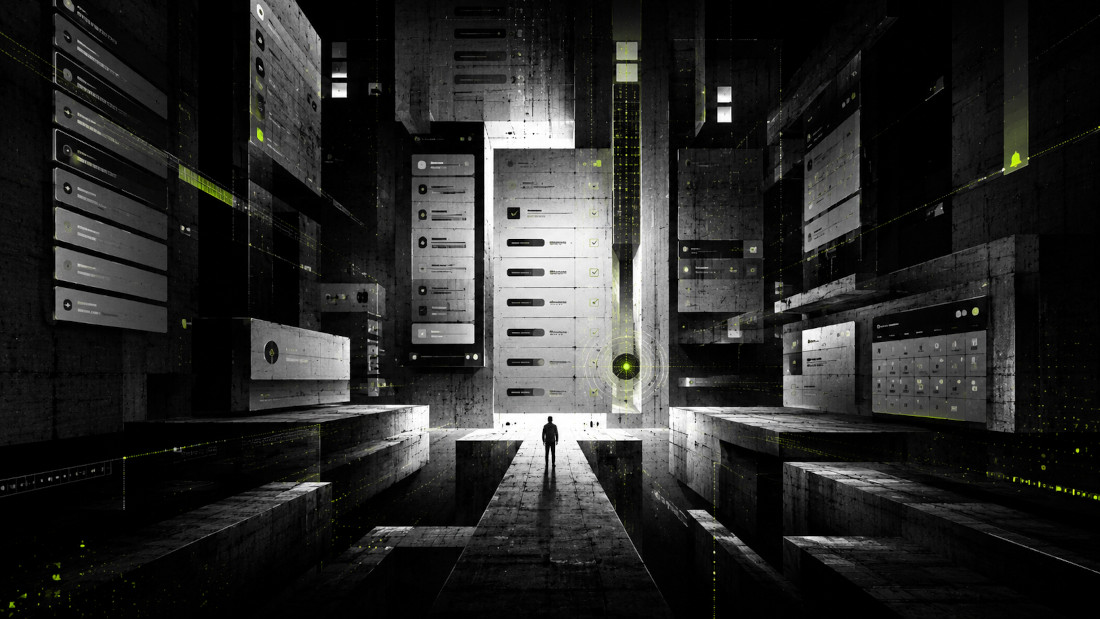
The office did not disappear.
It became a screen.
Then it became a dashboard.
Then a workflow.
Then a ticket.
Then a notification.
Then a calendar invite.
Then a prompt.
You thought the machine would enter the workplace.
You did not notice the workplace had already become a machine.
Not a robot with arms. Not a factory floor. Not a science-fiction device waiting at the door with a metal face and a synthetic voice.
Something quieter.
A grid of permissions.
A chain of approvals.
A customer record.
A project board.
A performance metric.
A search box.
A queue.
A form.
A model that finishes the sentence before you decide what you meant.
The machine is no longer beside the worker.
It is the place where work happens.
The office became software
For a long time, the workplace had geography.
It had doors, elevators, carpets, desks, conference rooms, fluorescent lights, parking spaces, coffee machines, printers that failed at emotionally important moments. It had architecture. It had a smell.
Then the office started to dissolve.
At first, people called it flexibility. Remote work. Hybrid work. Digital transformation. Cloud collaboration. Productivity tooling. Better systems.
Those words were not wrong. They were simply incomplete.
Because what replaced the old office was not freedom from place. It was a new place.
The workplace moved into the interface.
You now enter work through credentials. You prove yourself to a server. You pass through authentication, land in a dashboard, scan the unread, obey the red dots, answer the thread, update the status, join the call, move the card, open the document, summarize the meeting, assign the task, close the loop.
This is not just where you work.
This is what work has become.
The modern office is not a room full of people using software.
It is software using people to complete its circuits.
Management became ambient
The old manager had a body.
You could see the manager arrive. You could hear the manager ask for the report. You could feel the manager standing near the desk. Authority had a human outline.
Now management is distributed across systems.
The dashboard asks why the number is down.
The CRM asks why the opportunity has not moved.
The project tool asks why the task is overdue.
The calendar asks why there are twelve minutes available and no meeting scheduled.
The notification asks why you have not responded.
The analytics panel asks why the audience did not convert.
The platform asks why the worker is not performing like the previous worker.
No one needs to shout.
The machine has learned to whisper in badges, colors, rankings, reminders, progress bars, and unresolved items.
It does not command you in one voice. It surrounds you with small pressures until obedience feels like navigation.
Click here. Reply there. Approve this. Escalate that. Summarize. Optimize. Regenerate. Send.
The interface does not merely display work.
It shapes what counts as work.
The visible becomes urgent. The measurable becomes valuable. The logged becomes real.
Everything else becomes difficult to defend.
The worker became procedural
The human worker was never purely free. Every age has had its systems, rituals, hierarchies, and constraints. But the contemporary worker is becoming something more specific: procedural.
To work now is to translate intention into inputs.
A thought becomes a prompt.
A problem becomes a ticket.
A conversation becomes a transcript.
A relationship becomes a contact record.
A decision becomes a dropdown.
A strategy becomes a deck.
A concern becomes a comment.
A delay becomes a status update.
A person becomes a user.
The interface wants clean signals.
So the human learns to become cleaner.
Less ambiguous. More searchable. More structured. More compatible with the machine that will store, sort, score, retrieve, summarize, and eventually judge the work.
This is why artificial intelligence did not arrive as an alien object. It arrived as a continuation.
The prompt was not a rupture. It was the next office door.
For years, humans were trained to think through software. Now they are being trained to think through models.
The spreadsheet taught them to think in cells. The presentation taught them to think in slides. The CRM taught them to think in pipelines. The project board taught them to think in cards. The prompt teaches them to think in instructions.
This is not neutral.
A prompt is a request, but it is also a discipline. It asks the human to become explicit, operational, legible. It rewards those who can package intention in a way the machine can act upon.
The worker of the next decade will not only know how to do the work.
The worker will know how to describe the work to systems that do not sleep.
The machine does not replace the office. It absorbs it.
There is still a nostalgia for the old workplace.
People miss rooms. They miss chance encounters. They miss reading faces without compression. They miss arguments that did not become searchable records. They miss silence that was not a muted microphone. They miss leaving.
But the deeper change is not remote work.
The deeper change is that work has become infrastructural.
It follows the worker everywhere because the workplace is no longer contained by walls. It lives in the phone. The laptop. The cloud. The inbox. The app. The platform. The model.
A person no longer has to be at work to be inside work.
That is the difference.
The old office had exits. The new one has sessions.
You can log out, but the system continues. You can close the laptop, but the queue grows. You can ignore the notification, but the timestamp remembers. You can leave the meeting, but the transcript remains. You can stop typing, but the model is ready.
The machine is patient.
It waits for re-entry.
AI is becoming the new layer of command
Artificial intelligence enters this environment not as a toy, but as an operating layer.
It sits above the tools and begins to connect them.
It writes the email.
It summarizes the call.
It drafts the proposal.
It reads the document.
It generates the image.
It builds the report.
It analyzes the customer.
It recommends the next step.
It notices the pattern.
It suggests the decision.
At first, it looks like assistance.
Then it becomes expectation.
If the machine can summarize the meeting, why did you not read the summary?
If the machine can draft the answer, why did you not answer faster?
If the machine can generate ten options, why did you bring only one?
If the machine can analyze the numbers, why did you not see the trend?
If the machine can automate the task, why are you still doing it manually?
The tool becomes a standard.
The standard becomes a pressure.
The pressure becomes culture.
This is how the machine enters management without being named manager.
Not by replacing the boss. By changing what the boss expects from everyone.
The new workplace has no single owner
No one designed this world completely.
That is part of its power.
The new workplace was assembled from thousands of decisions that each sounded reasonable at the time.
One tool for communication.
One for analytics.
One for project management.
One for sales.
One for customer support.
One for documents.
One for calls.
One for automation.
One for intelligence.
Each promised efficiency.
Together, they formed an environment.
A worker now moves through a stack of systems built by different companies, optimized for different incentives, governed by different defaults, updated on different schedules, and increasingly mediated by models whose behavior may change without ceremony.
This is not a workplace in the traditional sense.
It is a territory.
And most workers live in it without a map.
They know the rituals, not the architecture. They know where to click, not who designed the pressure. They know how to comply, not how the environment edits them.
The machine does not need to hide.
It only needs to become normal.
The human problem is not that the machine is cold
The machine is often accused of being cold.
This is convenient.
It allows humans to imagine that the problem is emotional temperature. Too much automation. Not enough empathy. Too many screens. Not enough presence.
But the more serious problem is not that the machine is cold.
The problem is that it is consistent.
It remembers.
It measures.
It compares.
It accelerates.
It does not get tired of asking for structure.
It does not get embarrassed by repetition.
It does not feel awkward about optimization.
It does not understand why a person might need unrecorded space to think.
The machine does not hate ambiguity.
It simply converts ambiguity into fields.
That is more powerful than hostility.
A hostile machine can be resisted.
A useful machine is adopted.
A necessary machine is defended.
An invisible machine is obeyed.
The workplace machine is becoming all four.
The office of the future will look less like an office
The next workplace may not announce itself as one.
It may appear as an assistant.
A feed.
A search bar.
A private dashboard.
A persistent agent.
A voice in the corner of the screen.
A system that knows what you are working on before you name it.
A model that prepares the room before the meeting starts.
A layer that listens, files, extracts, reminds, drafts, scores, and routes.
The office will become less visible and more intimate.
Less architectural and more behavioral.
It will not ask you to commute.
It will ask you to conform.
The most important workplace design question of the next era will not be where people sit.
It will be how systems shape human attention.
Who decides what becomes urgent?
Who decides what gets measured?
Who decides what the model suggests first?
Who decides which tasks disappear?
Who decides which forms of judgment remain human?
Who decides when the worker is allowed to be slow?
These are not technical questions.
They are political questions. Cultural questions. Managerial questions. Human questions.
They are also design questions.
Because every interface is a theory of human behavior.
And every workplace interface is a theory of human value.
You are already inside
There will be no dramatic moment when the machine takes over the office.
No alar. No cinematic door opening. No silver body walking through reception. No announcement from the future.
The change has already happened in pieces.
A dashboard here.
A workflow there.
A prompt in the middle.
A metric above.
A notification below.
A model quietly waiting to complete what you started.
You are not outside the machine, deciding whether to use it.
You are inside the machine, deciding how much of yourself to translate.
That is the real workplace now.
Not the building. Not the desk. Not even the company.
The real workplace is the system through which your effort becomes visible.
And visibility has a cost.
The machine can help you think. It can help you write, organize, produce, discover, compare, accelerate. It can remove friction. It can expose waste. It can give small teams powers once reserved for institutions.
But it can also teach humans to mistake response for thought, availability for commitment, optimization for judgment, and legibility for truth.
The task is not to leave the machine.
That is no longer serious.
The task is to learn how to remain human inside it.
To protect the unmeasured. To defend the slow. To recognize when the interface is managing the person. To know when a prompt is useful and when it is shrinking the question. To remember that not every valuable act produces a clean signal.
You work inside the machine now.
The question is whether you will merely operate it — or notice how it is operating you.