The Third Vector
Why the most disruptive technology of our lifetime is also the one most likely to make room for everyone. AI, productivity, and the new expansion of the possible.
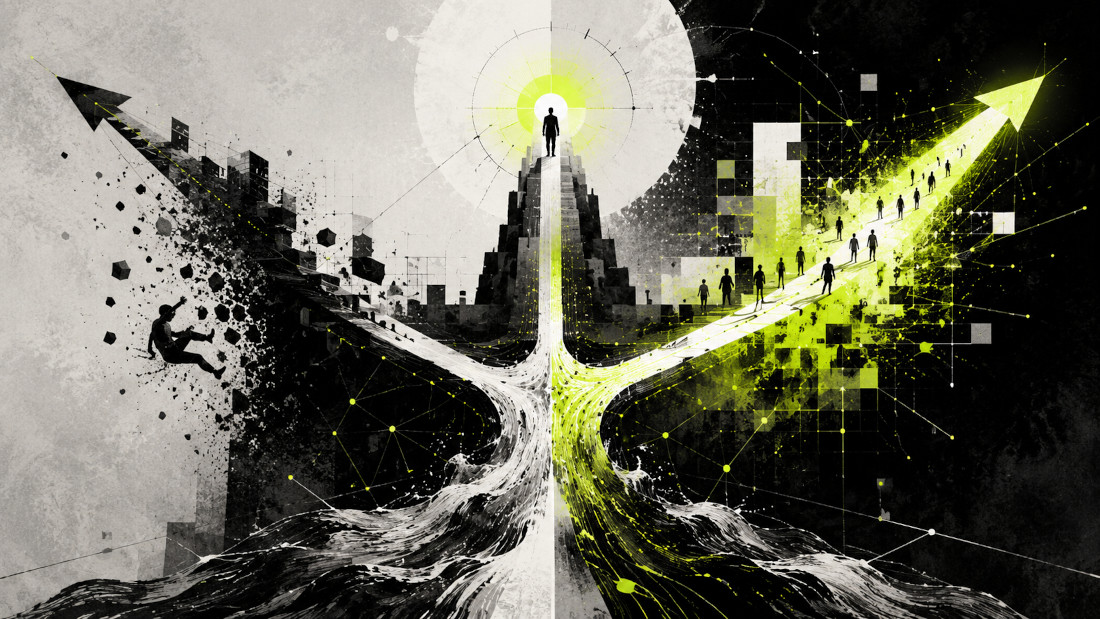
When Alvin Toffler described history as a sequence of waves — agriculture, industry, information — he caught something the headlines of any given decade tend to miss. The force that arrives as disruption leaves as transformation. The plow, the factory, the microchip: each crashed into the world, broke the arrangements it found there, and frightened the people whose livelihoods sat in its path. And each, once the water settled, left behind a society in which nearly everyone — producer and consumer, worker and owner — was better off than before. The wave that knocks you down is the same wave that lifts the whole shore.
Artificial intelligence is the new crest of that information wave, and it is moving fast enough that we get to watch the disruption and the transformation almost simultaneously. That speed is a gift and a trap. It is easy to mistake the turbulence at the leading edge for the shape of the whole thing.
It helps to separate what the wave is actually doing into three vectors.
The first is substitution. Some tasks — and the jobs built entirely out of those tasks — are simply being done by machines now. This is the vector that gets written about, because it is the one that hurts, and the pain is real and worth taking seriously. But substitution is the front of the wave, not its destination.
The second is hybridization. Far more common than the job that disappears is the job that changes shape: the lawyer, the designer, the analyst, the founder who now works alongside a machine and, in doing so, does more and reaches further than before. This is the bridge vector — the one most of us are actually crossing right now.
The third vector is where the wave repays its debts, and it is the one worth lingering on.
When a tool makes production cheaper and better at the same time, something happens that is easy to state and easy to underestimate: the field gets larger on both sides at once. On the producing side, work that used to demand a team, a budget, or a credential now sits within reach of someone who has none of those things. The threshold for making something worth selling drops, and people who were standing outside the market walk into it. On the consuming side, what was once a luxury becomes ordinary, and people who were priced out of a product become its customers.
There is a concept in economics called Say's Law: supply creates its own demand. Producing is itself what creates the buying. Give the wave time to settle and that is just what happens. The new tools get absorbed, productivity climbs steeply, and goods and services that were once expensive become far more affordable. The motion runs the other way too: products get better and take less time to make, so the producers come out earning more once the wave has settled. Cheaper for the buyer and richer for the maker are not a trade-off: at scale, each one feeds the other, and the gain on both sides only grows.
Seen through that lens, a wave of falling production costs is not a threat to demand. It is the engine of it. Every time AI makes something cheaper to produce, it does two things at once: it supplies that thing, and it frees up purchasing power that immediately goes looking for more of that thing or the next thing. Cheaper does not mean smaller. Cheaper means wider.
This is also why the gains refuse to stay put. A falling cost is a signal, and signals travel. They tell the alert — the ones forever scanning for the gap a new price has just opened — where to rush in and build something that did not exist yesterday. The market is not a fixed pie being recut into thinner slices; it is an open-ended process of discovery, and cheaper inputs hand more people the tools to go discovering. The consumer, in the end, is the one this entire machinery serves: the final judge of what was worth making, now choosing from a far larger menu than before.
That is the quiet promise buried inside the noise. The first vector is loud and the third is slow, so the first is the one we hear. But if Toffler was right — and three waves of history suggest he was — then the disruption is the toll we pay at the entrance, and the transformation is what waits on the other side: more producers, more consumers, more participants in a game that just got bigger for everyone in it.
The wave always looks like a wall from underneath.
From the far shore, it looks like the tide coming in.