The Letter and the Particle
On Writing, AI, and the Observer Problem
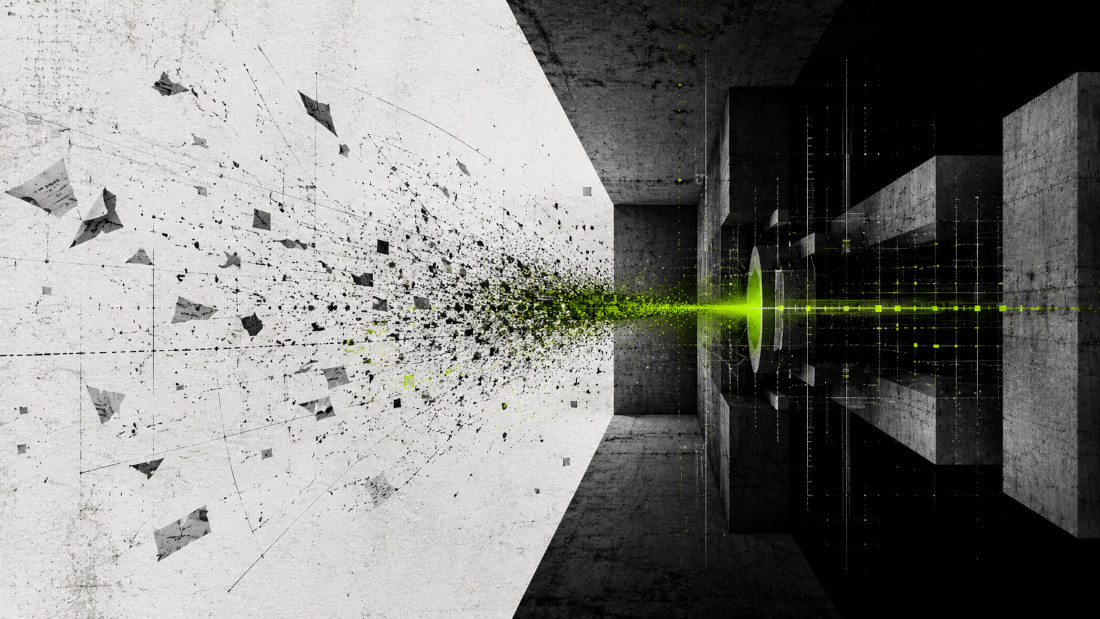
There is a principle in quantum physics which states that it is not possible to know, with simultaneous precision, both the position and the velocity of a particle. This indeterminacy is not a flaw in the measuring instruments, but a constitutive property of reality: both variables do not coexist as defined values at the same time. Werner Heisenberg formulated this in 1927, proposing a markedly philosophical consequence: certain things do not have a precise state until an interaction or measurement forces them to have one.
This principle offers the appropriate framework for analyzing the impact of artificial intelligence on writing, shifting the usual discussion away from the replacement of human labor. The real phenomenon is not replacement, but the disturbance of the system. When AI intervenes in the act of writing, it does not act as a neutral witness recording a preexisting thought. It functions like Heisenberg’s instrument: its mere presence modifies the conditions of the system and transforms the final product. What is produced is no longer what it would have been without its intervention. This observation is not an ethical complaint; it is an operational description.
Historically, writing technologies have shaped the structure of thought. The letter demanded a specific discipline of attention: it required defining the core of what one wanted to communicate before executing it, or discovering it through the physical process of writing. There were no automatic correctors or predictive suggestions; the text was managed in silence and resolved in an irreducibly personal voice. Email and instant messaging accelerated this process, shortening the timeframes of interaction and modifying the nature of the other person’s presence within the text. However, AI does not represent one more step in this linear evolution, but rather a qualitatively different leap.
When a language model intervenes in composition, the resulting text can achieve optimal levels of coherence and fluency. The methodological problem lies in a question the device cannot answer: who is the subject of that voice? AI generates language by replicating patterns extracted from accumulated human writing, statistically processed and returned in the form of synthesis. The result simulates an identity, but a voice that emerges from the average of all previous voices is not a new voice; it functions as a high-fidelity mirror. Before a mirror, the relevant question is always which part of what is observed belongs to the subject, and which part is the reflection of the device.
The transfer of writing to AI tools reveals its most critical aspect when the principle of indeterminacy is applied to identity: one’s own voice does not preexist the act of writing as a fixed entity, but is constituted and defined during that process. By delegating composition, one does not merely automate an operational task; one gives up the exact space in which the subject defines its position and constitutes itself as such.
Recognizing this mechanism does not imply rejecting the technological tool, but rather subjecting our decisions about attention to a stress test. Preserving spaces for analog writing, or limiting automation, is not a nostalgic refuge, but a conscious decision about how to manage our presence. The value of human writing never resided in the technical perfection of the output, but in the impossibility of separating the text from the impurity of the person who produces it. In that inevitable trace of the subject lies the resistance to AI imitation, which, in attempting it, will only produce a new statistical average, measuring a particle that has already changed position.