Carving with Light and Code
The Middle Ages and the twentieth century were periods of crisis. The Renaissance and the twenty-first century are periods of paradigm change.
The Middle Ages were marked by a worldview in which authority was unquestionable and knowledge was concentrated. The Renaissance broke with that structure: it placed the human being at the center and recovered science, experimentation, and observation. It did not destroy the past; it reinterpreted it with new tools.
The twentieth century was dominated by great certainties: the avant-gardes, manifestos, museums, critics, and traditional media. The twenty-first century is once again questioning those structures. Artificial intelligence, extended reality, digital fabrication, and generative art are changing not only how a work is produced, but also how it is experienced and who can create it.
From the manuscript to the printing press.
From the physical work to the digital and immersive work.
From the master’s workshop to the laboratory of artists and engineers.
From linear perspective to augmented and mixed reality.
From the patron to technology platforms and new financing models.
From the discovery of the human body to the exploration of data, algorithms, and virtual worlds.
During the Renaissance, Michelangelo Buonarroti used the most advanced technology of his time: new engineering techniques, pulley systems, anatomical studies, and carving tools to transform sculpture.
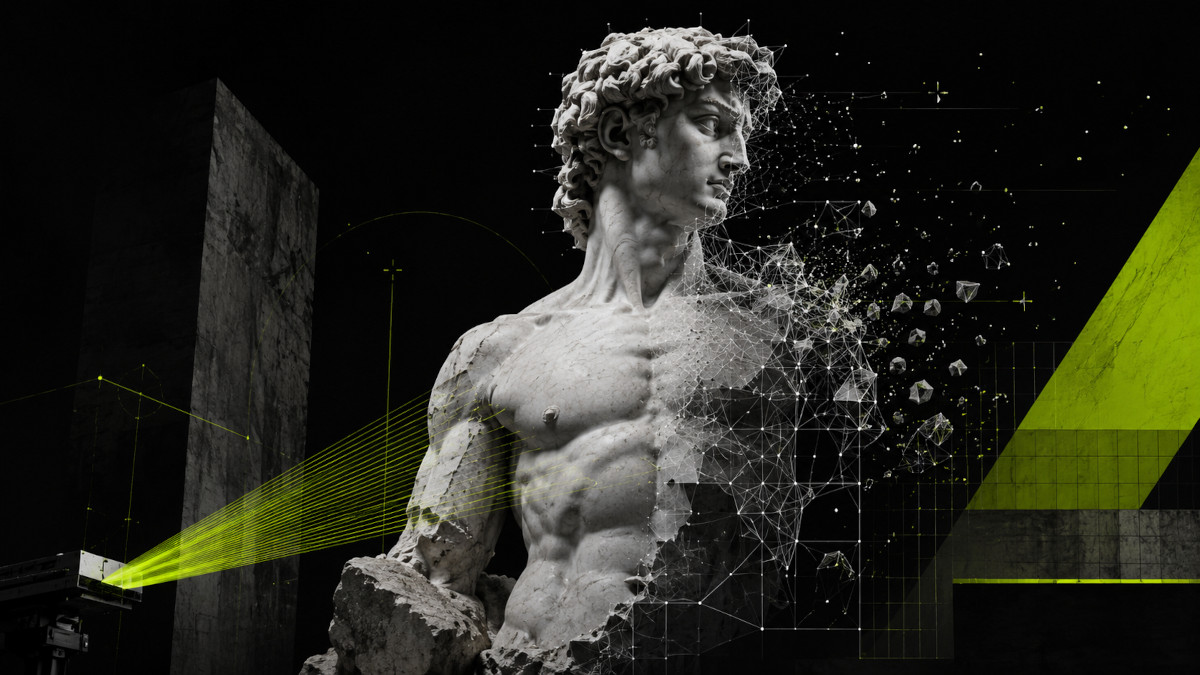
Five centuries later, at the Chaco Biennial in Resistencia, Argentina, David appears once again. At first glance, the David of Chaco seems to be a classical reproduction. In reality, it is the result of one of the most sophisticated heritage digitization processes carried out in Argentina. It all began with the historic plaster copy preserved at the Ernesto de la Cárcova Museum of Casts and Comparative Sculpture. Because the piece was too fragile to be transported or molded, specialists scanned it without touching it. Millions of points recorded by laser and structured-light equipment made it possible to create a digital twin of extraordinary precision. Using that virtual model, they corrected the marks left by time, taking the Florentine original as a reference, and then 3D-printed the molds that made it possible to build the sculpture that is now part of Resistencia’s heritage.
And there is another David. In the mixed-reality experience Buonarroti, developed together with Crossline VR, one stops looking at art and begins to interact with it. As soon as you put on the headset, a sculpture appears on a stand. It may be David or another of the Biennial’s remarkable works. Suddenly, it explodes into dozens of fragments. The mission is to reconstruct it with our own hands. Without a hammer, without a chisel, and without touching a single stone. I understood that a sculpture can also be known by assembling it—or by imagining that we are doing so.
Artificial intelligence and mixed reality are inaugurating a new Renaissance. In Resistencia, technology did not replace the craft; it expanded the way it can be experienced. This time, marble coexists with code. And believe me, no one can resist it.