Demand Arrived First
AI is finding uses inside businesses faster than the systems supporting it can expand. That gap creates opportunities—and makes it easier to mistake a forecast for a customer.
At the end of the 1990s, telecom companies laid vast amounts of fiber in anticipation of internet traffic. The traffic eventually came, but too slowly for some of the companies that financed the networks. Useful infrastructure did not guarantee a good return for its first owners.
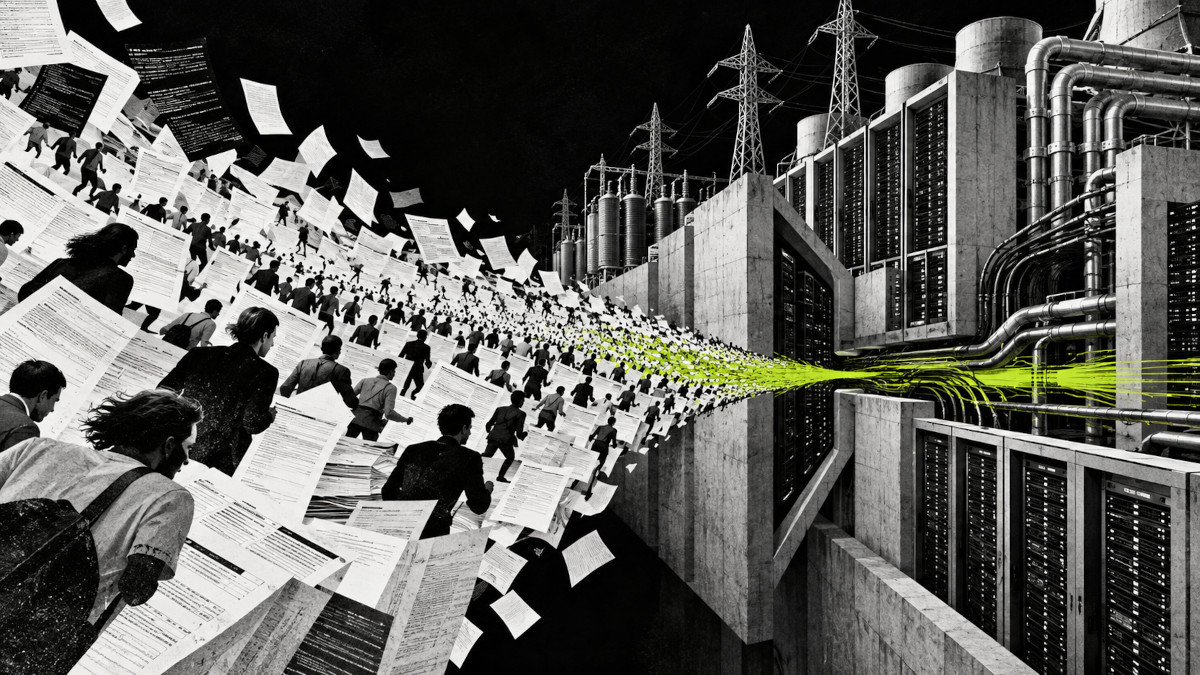
AI has begun with a different sequence. Companies already use it to review documents, write software, process applications, and assist customers. Demand is visible in operating budgets and daily work. The physical systems needed to support much wider use—chips, electricity, cooling, data centers, and grid connections—cannot expand at the same speed.
The International Energy Agency reports that electricity consumption at AI-focused data centers rose 50 percent in 2025. It expects continued growth, while warning that shortages of equipment, chips, and available power could delay construction. A data center may take one to three years to build; planning and completing new grid infrastructure can take five to fifteen.
For suppliers, the mismatch is an opportunity. Companies that can deliver power equipment, construction, cooling, grid capacity, or more efficient computing have customers with pressing needs. For businesses using AI, it is a reason to pay attention to cost and reliability before the technology becomes indispensable to a process.
There is also a second bottleneck, inside the company.
A model may produce a useful answer in seconds. Putting that answer into dependable work takes longer. Customer records may be incomplete. Two departments may define the same field differently. An employee may need to check an output before it reaches a client. None of those problems disappears when more computing power becomes available.
This is where many businesses will determine the value of AI. Consider a team that prepares reports in half the time. The saved hours are real. The business return depends on what the team can do with them: serve more clients, investigate difficult cases more thoroughly, improve the report, or reduce its cost. If the faster report creates more corrections downstream, the gain will be smaller than the demonstration suggested.
Company leaders therefore have two capacities to understand. One is the external supply of AI services and the infrastructure behind them. The other is their organization’s ability to use those services well. Expanding the first does little for a business that has not worked through the second.
Neither should be judged by impressive totals alone. A request for a grid connection is not an operating data center. Reserved computing capacity is not proof that its future users can earn money from it. Project plans can overlap, move, or disappear. The IEA cautions that many proposed data centers will not be built and calls for better forecasts of actual demand.
That does not erase the shortage facing customers now. It means a shortage today and excess capacity later are both possible. Capacity may also be scarce in one location while a proposed project elsewhere struggles to find customers. The economics will depend on timing, location, financing, and what buyers are willing to pay once more supply arrives.
The same discipline applies within a business. More AI use does not automatically mean more value. Before committing a process to a model, a leader should be able to identify the work it improves, the people who check it, its full operating cost, and the result customers experience. Those answers may point to a modest application with a clear payoff rather than a sweeping transformation program.
The companies that know their own work in that detail have an advantage. They can recognize a genuine improvement, reject an attractive demonstration that solves the wrong problem, and adapt when the price or quality of an AI service changes.
The infrastructure buildout will produce indispensable assets. It may also produce expensive mistakes. Business leaders do not need to predict the size of the entire AI economy to make sound decisions now. They need to know where demand is already present in their own company—and whether they can turn faster work into a better business.