I Doubt, Therefore I Look
I am at Fundación Proa in Buenos Aires, standing before the work of Thomas Demand. And almost immediately, I begin to doubt what I am seeing.
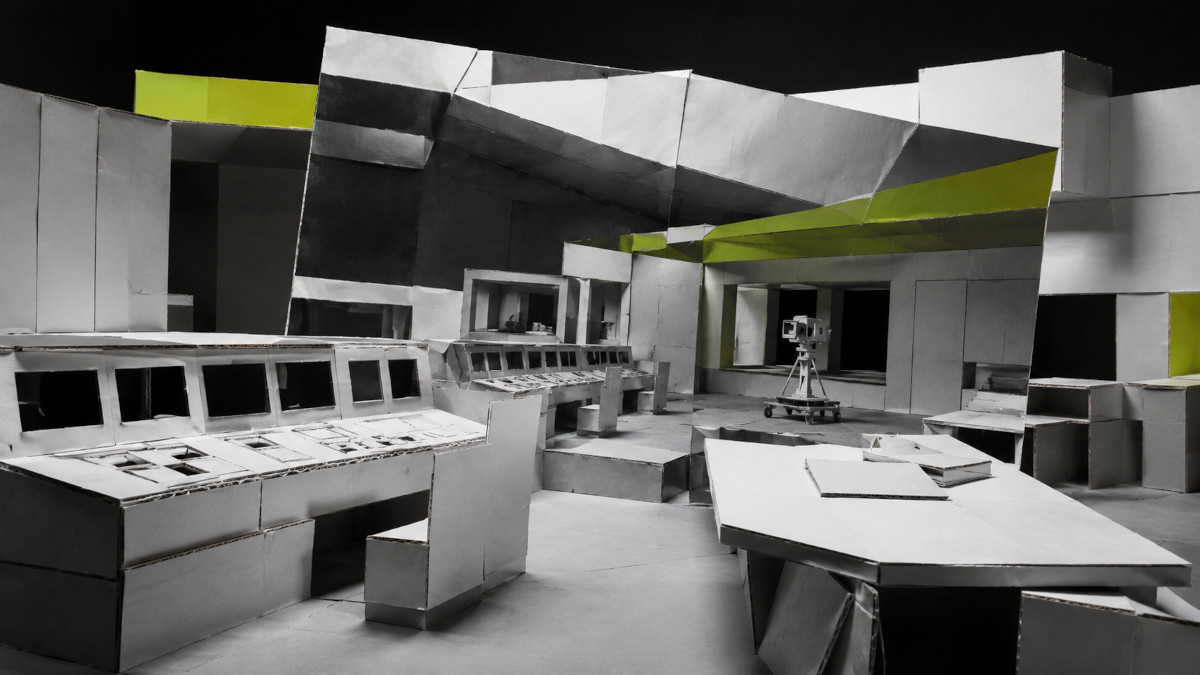
The German artist reconstructs scenes that belong to our visual memory using paper and cardboard. He photographs them, turns those models into images, and then destroys them. Only the photograph remains.
There is something unsettling about this process: I recognize places I have never visited.
A control room at Fukushima. A television studio. An office. A staircase. Demand begins with photographs that have circulated in newspapers, magazines, archives, and on the Internet, and reconstructs what they depict. He does not copy reality: he builds a version of it in order to photograph it.
In “Thomas Demand: The Stutter of History,” Fundación Proa presents the artist’s first major retrospective in Argentina. Curated by Douglas Fogle and organized with the Foundation for the Exhibition of Photography, it brings together around 60 works, including large-format photographs, videos, and wallpapers. The exhibition spans three decades of a practice that moves with complete freedom between sculpture, photography, and conceptual art.
As I move through the galleries, the question running through the entire exhibition emerges: do I remember an event, or do I remember the image the media constructed of it?
Demand works precisely within that gap. He empties his scenes of people but fills them with history. Everything seems familiar and, at the same time, something does not quite add up. It is a copy of a copy that manages to make me doubt the original.
I look beyond the image. I begin to look differently.
Because these photographs are not simply reproductions of familiar scenes. Before the camera came a meticulous construction: light, shadow, color, reflections, scale, composition. Demand not only reconstructs what he sees; he constructs the conditions through which I will see it.
In his Histories, he takes images that the mass media repeated until they became part of our collective imagination and returns them to our attention. He forces me to pause before images I thought I knew.
Then the Dailies appear, and the scale changes. Demand observes his surroundings with his phone and discovers small visual events: an object, a shadow, a few cups, a clothespin. The everyday—what would ordinarily pass unnoticed—acquires a different density.
I think then of the haiku: capturing a fleeting instant and revealing something that was already there, but that we had not known how to see.
Demand slows the image down. And in a culture that produces and consumes photographs at a dizzying speed, stopping is almost a form of resistance.
Then the image begins to move. Demand does not only reconstruct photographs. He also reconstructs movement.
In Tunnel (1999), he recreates the tunnel where Princess Diana died. In Pacific Sun (2012), he takes this process into the realm of video and stop-motion animation.
The work is based on two minutes of footage captured by security cameras aboard a cruise ship caught in a storm off the coast of New Zealand. For months, Demand and his team reproduced every movement of the furniture in paper and cardboard: chairs, tables, cabinets, plates, monitors, and even a potted plant.
Frame by frame, the chaos of a ship becomes a handcrafted choreography.
I find the paradox fascinating. The Internet turns an accident into a viral image in seconds. Demand needs months to reconstruct it by hand. His method is the exact opposite of algorithmic speed: faced with technology capable of generating a scene in seconds, he builds slowly, using paper, cardboard, light, and manual labor. Like a sculptor.
AI can invent a scene that never existed. Demand reconstructs a scene that did exist—and that still exists in our collective memory—to make us doubt it.
I doubt, therefore I look, and I ask myself: why do we choose to believe what we see?
I look until I begin to doubt again.