LA Plays and AI Dreams
While Los Angeles watches the World Cup, DATALAND is playing another game.
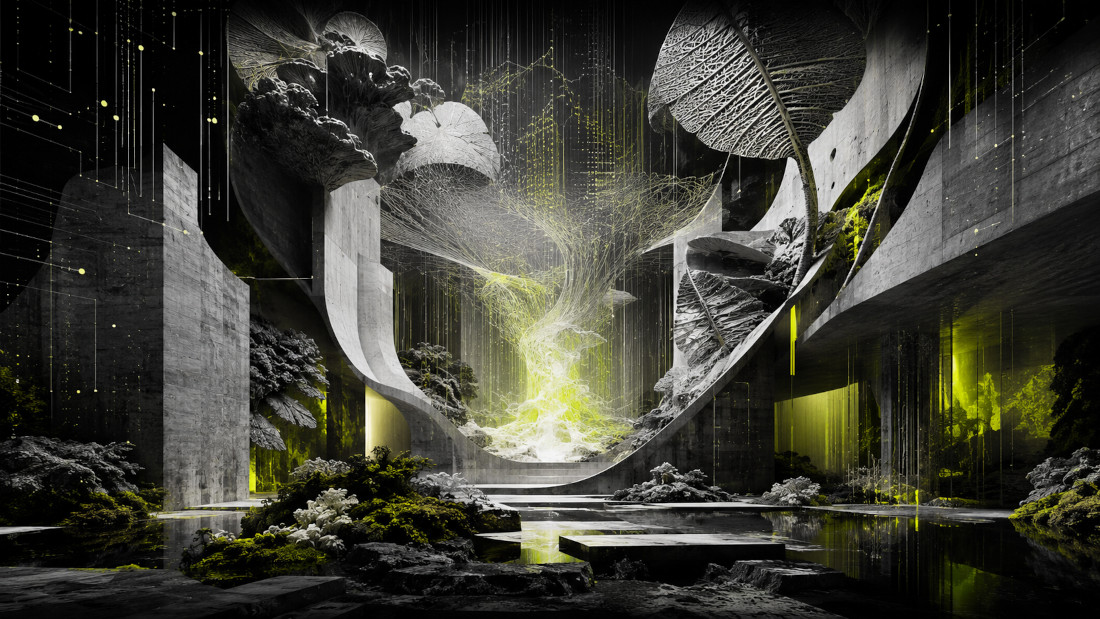
While Los Angeles watches the World Cup, DATALAND is playing another game. Conceived by Refik Anadol Studio, this space redefines the idea of the museum by fusing generative AI with the biological flows of nature. An architectural organism breathing data.
If you are in Los Angeles these days, someone will probably ask you about the World Cup. But another spectacle has just opened its doors in the heart of the city, and for those following the evolution of art, it may be even more tempting.
DATALAND is the world’s first museum of AI art and digital ecosystem: a space where human imagination meets the creative potential of machines. It is not a traditional museum, nor simply an exhibition of screens. Under the artistic direction of Refik Anadol Studio, this new concept opens its flagship location at The Grand LA, the striking complex designed by architect Frank Gehry. Here, data stops being cold information and becomes a work of art in permanent process.
Conceived as a Breathing Organism
The inaugural exhibition, Machine Dreams: Rainforest, occupies five immersive galleries where there are no hanging paintings or static sculptures. Visitors encounter real-time generated images, soundscapes, aromas, and environments that evolve according to constant flows of data coming from nature.
Behind the project is Turkish-American artist Refik Anadol, one of the most influential figures in AI-generated art. His studio developed the so-called Large Nature Model, an AI trained exclusively through one of the most ambitious and ethically minded data-collection processes in contemporary art.
To achieve this, a team of scientists, engineers, and researchers traveled directly to more than 16 rainforest regions and ecosystems around the world — from the Amazon to Indonesia, Chile, and Australia. There, they scanned the real structure of trees, plants, and landscapes in three dimensions to capture the exact morphology of nature, while also installing sensor networks in flora and fungi to record their acoustics and biological signals.
At DATALAND, this data flows in continuously. The generative works change their luminosity and structure according to real weather conditions transmitted by sensors from the forests at that very moment. Anadol has also designed environments that react to data from the visitors themselves inside the museum, capturing movement flows and spatial responses so that the work can “dream” and mutate in real time.
A Machine Learning to “Dream” with Nature
In this space, the Amazon rainforest is not represented: it is reinterpreted. AI processes bird songs, weather patterns, and vegetal forms to produce impossible landscapes. The machine uses data as if it were digital pigment. There is no definitive artwork; the artwork is happening in the present.
At first glance, little seems to connect Antoni Gaudí — the architect who transformed Barcelona at the end of the nineteenth century — with Refik Anadol. Gaudí worked with stone, ceramics, and iron; Anadol works with algorithms, servers, and machine-learning models. And yet, both begin from the same intuition: nature is not copied, but studied in order to understand its generative rules.
Gaudí observed the growth of trees, the geometry of honeycombs, and skeletal structures to design buildings that seemed to emerge organically. He did not imitate a leaf; he tried to understand the system that produces infinite different leaves. The Sagrada Família itself was not conceived as a static monument, but as a living organism that grows with time and with the technologies of each era. Just a few days ago, the world witnessed the drone spectacle that illuminated its new tower.
With his acclaimed installation Gaudí Dreams, presented inside the immersive cube at Barcelona’s Casa Batlló, Anadol had already used AI to process a billion points of historical and botanical data, attempting to decipher and “make dream” the tunnels of thought of the Catalan master. Now, at DATALAND, he is attempting to decode the mind of the Earth itself.
Where Gaudí used geometry, gravity, and mathematics, Anadol uses data, machine learning, and generative models. In both, we can explore the same question: how can we create from the laws of nature? Gaudí said that originality consists in returning to the origin. More than a century later, one enters DATALAND expecting screens and leaves thinking about forests.
The Debate Over the Canvas of the Future
DATALAND also arrives with a debate that runs through the entire universe of artificial intelligence. Anadol is seen by many as one of the most important pioneers of data-based art, while others regard his work with a certain degree of suspicion. They wonder whether technological fascination ends up eclipsing content, or whether the future of digital art will truly be able to move us without leaving us lost only in spectacle.
The clearest sign that something important is happening is precisely that there is still no consensus. And to discover it while machines dream, it is best to stay fully awake.
DATALAND
June 20, 2026
The Grand LA, 100 S Grand Ave, Los Angeles, USA