The Invisible Work of AI
Every intelligent system removes visible tasks while creating a hidden layer of supervision, context, judgment, and organizational responsibility.
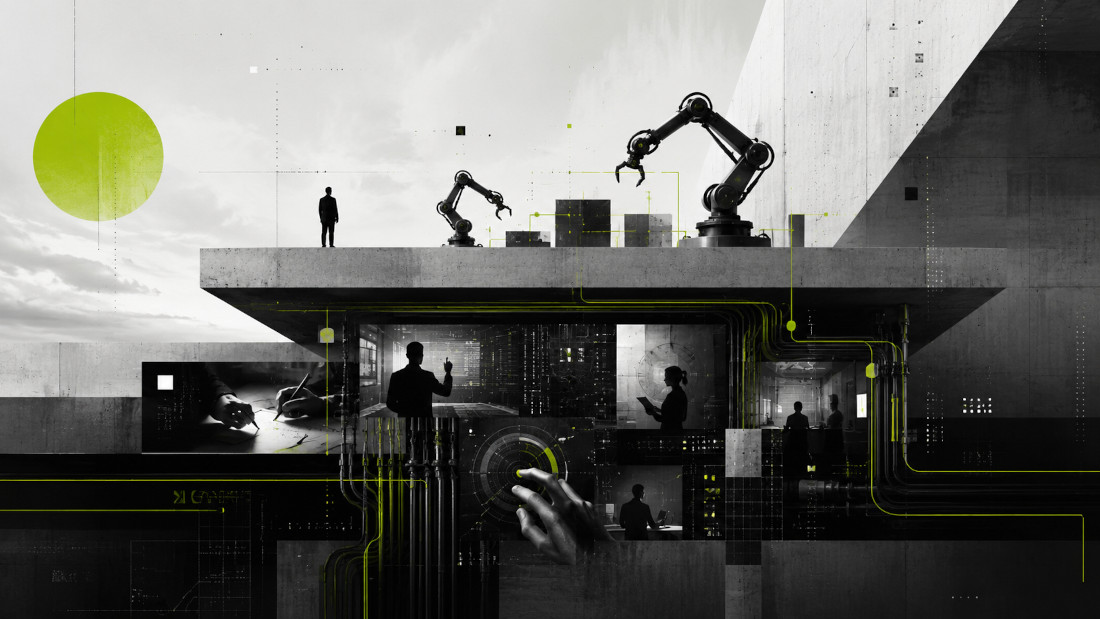
AI is usually introduced through the work it appears to eliminate.
A report is generated automatically. A customer inquiry is answered without an agent. A contract is reviewed in minutes. A system monitors thousands of operational signals and recommends what should happen next.
The visible process becomes faster, smaller, and increasingly autonomous.
Behind it, however, another form of work begins to accumulate.
Someone must decide which information the system can use. Someone must define what a satisfactory result looks like. Someone must examine exceptions, resolve contradictions, update instructions, review failures, manage permissions, protect sensitive data, and determine when the machine must surrender control.
AI does not simply remove work. It redistributes it.
The repetitive activity may disappear from view, while a new layer of organizational labor emerges around the system. This labor is less visible because it does not always belong to a traditional role, department, or workflow. It lives between technology, operations, management, compliance, and professional judgment.
For leaders, this invisible work may become one of the defining management challenges of the AI era.
The Work Moves Upstream
Traditional automation concentrates on execution.
A stable task is described, translated into rules, and performed by software. Once the system is working, the surrounding process may require relatively little interpretation.
AI systems operate differently. They can work with ambiguity, language, incomplete information, and variable situations. This makes them more capable, but it also moves much of the human effort upstream.
The machine may write the answer, but people must determine what the answer should accomplish.
The machine may recommend an action, but people must define the acceptable range of actions.
The machine may analyze a customer, supplier, employee, or market, but people must determine which signals matter and which conclusions would be inappropriate.
This is not ordinary configuration. It is the translation of organizational judgment into a system that can act repeatedly.
Companies often underestimate this work because the final interaction appears simple. A user enters a request and receives an output. The apparent simplicity conceals the decisions embedded beneath the interface: data selection, prompt architecture, access rights, evaluation criteria, business rules, escalation thresholds, and institutional standards.
The more capable the system becomes, the more consequential these hidden decisions become.
Context Becomes Infrastructure
An AI system performs according to the context it receives.
That context may include documents, customer history, operational data, internal policies, product information, previous decisions, contractual conditions, professional standards, and real-time signals from other systems.
Collecting information is only the beginning.
The organization must determine which source is authoritative. It must identify outdated material, resolve conflicting instructions, control access, maintain classifications, and ensure that the system sees enough information to act without exposing information it should not use.
This creates a new operational discipline: context management.
In many companies, knowledge is fragmented across email, documents, databases, messaging systems, and individual memory. Humans have learned to navigate this fragmentation informally. They know whom to ask, which spreadsheet is current, which written policy is routinely overridden, and which apparent exception is actually standard practice.
An AI system does not automatically inherit this organizational intuition.
The effort required to make knowledge usable by machines may reveal that the company never had a coherent knowledge system in the first place.
AI therefore transforms documentation, data quality, and information architecture from administrative concerns into strategic infrastructure.
Exceptions Do Not Disappear
Automation is most attractive when it appears to remove the ordinary case.
But organizations are rarely defined by ordinary cases alone. They are shaped by exceptions: the customer whose situation does not fit the policy, the supplier whose delay has unusual consequences, the transaction that looks normal but carries unusual risk, the employee request that requires discretion rather than consistency.
AI may process the majority of cases efficiently while concentrating the difficult remainder in human hands.
This can create an unexpected effect. The total volume of human work declines, but the average complexity of that work increases.
Employees are no longer handling a balanced mixture of routine and difficult situations. They receive the ambiguous, sensitive, high-risk, or unprecedented cases the system could not resolve confidently.
Human intervention therefore becomes less frequent but more demanding.
Organizations must prepare for this change. Escalation cannot be treated as the point where automation failed. It is part of the designed process.
The system must explain what it observed, what it attempted, why it stopped, and what decision is required. The human operator must receive enough context to intervene without reconstructing the entire case from the beginning.
Poorly designed escalation saves machine time by wasting human attention.
Verification Becomes a Permanent Function
AI can produce plausible results without producing reliable ones.
This familiar limitation creates a broader organizational problem. When a system operates at scale, verification cannot depend on occasional individual caution. It must become part of the architecture.
Some outputs can be checked automatically against databases, calculations, rules, or external sources. Others require sampling, professional review, customer feedback, or observation of downstream outcomes.
The important question is not whether every output should be reviewed by a human. That would eliminate much of the benefit.
The question is how the organization will know when the system is becoming less reliable.
Errors may increase because a model changes, data quality deteriorates, customer behavior shifts, internal policies evolve, or the system begins encountering cases outside its original operating environment.
AI processes therefore require continuous evaluation rather than one-time approval.
This creates work that many organizations have not yet assigned clearly. Who watches system performance after deployment? Who decides that an error pattern is significant? Who owns the correction? Who determines whether the problem lies in the model, the data, the instructions, the interface, or the process itself?
Without explicit ownership, verification becomes everybody’s concern and nobody’s responsibility.
Authority Must Be Designed
The strategic importance of an AI system depends partly on what it is allowed to do.
A system that can only draft has limited operational impact. A system that can update records, communicate with customers, approve transactions, allocate resources, modify schedules, or initiate payments becomes part of the organization’s decision structure.
Authority cannot be granted as a single permission.
It must be decomposed.
What can the system observe? What can it recommend? What can it prepare? What can it execute with approval? What can it execute independently? Under which conditions must authority be withdrawn?
These questions are technical, but they are also managerial.
They determine how responsibility is distributed between people and machines. They define which decisions remain attached to formal roles and which are delegated to systems. They establish who is accountable when an automated action produces an undesirable result.
The danger is not only that AI may receive too much authority. It may also receive authority without corresponding organizational clarity.
A manager may believe the operator remains responsible. The operator may believe the automated system made the decision. The technology team may believe it merely implemented the business rule. The business owner may believe the model provider is responsible for the output.
Responsibility dissolves when authority is automated without being redesigned.
The Machine Must Be Managed After Launch
Traditional software is expected to behave consistently until someone changes it.
AI systems are exposed to more fluid conditions. Their inputs change, their surrounding data changes, their users adapt, and their role inside the organization expands.
Once people discover that a system is useful, they begin using it for situations it was not originally designed to handle. A tool that summarized documents starts influencing decisions. A support assistant begins making informal promises. A recommendation system gradually becomes the default allocator of attention.
The system’s formal specification may remain unchanged while its practical authority grows.
Leaders must therefore manage not only technical performance but institutional drift.
How is the system actually being used? Which decisions are beginning to depend on it? What behaviors are employees developing around it? Which manual checks have quietly disappeared? Which new dependencies have formed?
A successful pilot can become a critical operating system without a deliberate moment of transition.
That transition must be recognized and governed.
New Roles Will Form Between Departments
Much of the invisible work of AI does not fit comfortably inside existing organizational boundaries.
Technology teams understand infrastructure but may not own the business judgment being automated. Business units understand the process but may not understand model behavior, data dependencies, or evaluation methods. Compliance teams understand obligations but may enter only after the system has been designed.
The necessary work sits between them.
Organizations will need people capable of translating operational goals into system behavior, examining failures across technical and organizational layers, and coordinating the continuous improvement of AI-enabled processes.
Some companies will create new roles. Others will extend existing ones. The title matters less than the function.
Someone must own the relationship between the model and the process.
This person or team must understand the objective, the information environment, the decision rules, the exceptions, the performance metrics, and the consequences of failure. They must be able to coordinate engineers, operators, subject-matter experts, security teams, and executives.
Without this integrative function, the system may be technically impressive but organizationally orphaned.
The Strategic Implication
The invisible work of AI is not an argument against automation.
It is the reason some organizations will create durable advantage from it while others will accumulate fragile demonstrations.
The companies that succeed will not be those that remove the largest number of tasks from human hands. They will be those that redesign the surrounding work with the greatest clarity.
They will invest in context infrastructure rather than treating information as a collection of files. They will design escalation as carefully as automation. They will monitor outcomes rather than merely outputs. They will assign ownership after deployment. They will make authority explicit and preserve accountability when execution becomes autonomous.
Most importantly, they will recognize that human work is not simply disappearing.
It is moving toward definition, supervision, exception handling, interpretation, and system design.
This changes the role of leadership.
Leaders must stop evaluating AI only through hours saved or positions avoided. They must ask what new responsibilities the system creates, where those responsibilities will live, and whether the organization has the capacity to perform them well.
The machine may execute the process.
But the organization must still construct the environment in which that execution becomes reliable, legitimate, and valuable.
That is the invisible work.
And increasingly, it is the work that will determine whether AI changes the company or merely accelerates it.