Burning Tokens Is Not Working
Why measuring AI use by consumption risks turning productivity into digital theater.
From the Man-Hour to the Token Economy
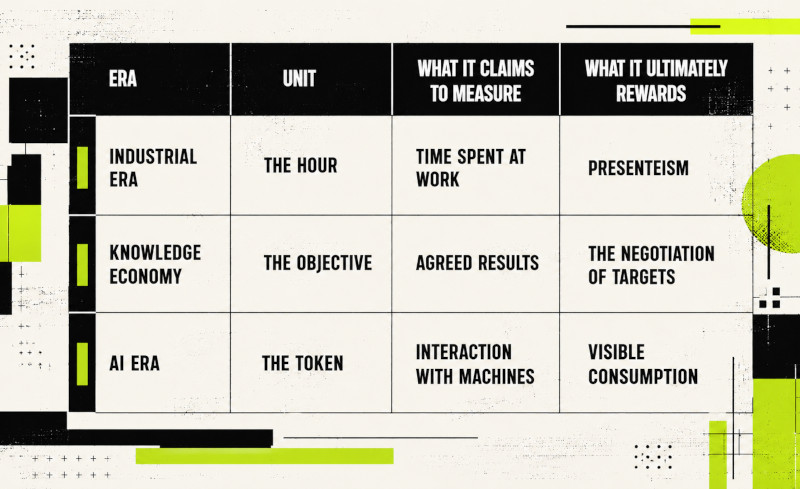
In the late nineteenth century, Frederick Taylor walked through the workshops of Midvale Steel with a stopwatch in his hand. He measured how long it took a worker to load a shovel, turn a piece of metal, or return to his station. From this emerged the idea that work could be broken down into units of time, and that paying by the hour meant paying for something objective. The hour became the currency of effort, and for a century almost no one questioned it.
Then the knowledge economy arrived, and the hour began to fall short. One programmer could solve in twenty minutes what another could not solve in a week, yet both billed the same amount. Peter Drucker proposed looking at results instead of the clock, and that insight gave rise to management by objectives, performance indicators, and OKRs. Work was no longer measured by presence but by delivery. It was progress, although it came with a catch: objectives can also be inflated, negotiated downward, or fulfilled on paper while the business collapses.
Today, we are witnessing the emergence of a third paradigm—one far more abstract and with profound methodological implications: the tokenization of work.
What Does It Really Mean to Tokenize Effort?
A token is the smallest fragment of text processed by a language model, something like a syllable for the machine. Every question you ask an AI system, every report you request, and every line of code it suggests consumes a certain number of tokens. Someone pays for them, and their use is recorded. While AI was still a toy, that record was merely a technical billing detail. Once AI entered companies in earnest, it became something else: an accounting trail showing how much, and how, each person works with machines.
Jensen Huang, Nvidia’s CEO, proposed a few months ago that elite engineers should receive, in addition to their salaries, an annual token budget equivalent to half of that salary. He added that if an engineer consumes only a fraction of it, the problem lies not with the company but with the engineer. Low consumption, which had always been synonymous with efficiency, became a symptom of obsolescence.
This is not an isolated eccentricity. Meta uses an internal tool to track how many lines of code are generated with AI assistance and rewards the most intensive adopters with bonus multipliers. Amazon monitors how frequently and deeply its employees use corporate AI tools, factoring that data into promotion decisions. According to The New York Times, Meta, OpenAI, and Shopify maintain real-time internal rankings showing how many tokens each employee consumes. One OpenAI engineer reportedly processed 210 billion tokens in a single week—the equivalent of reading the entirety of Wikipedia 33 times. The sport already has a name: tokenmaxxing.
The Metamorphosis of Workplace Measurement
The Illusion of Volume and the Need for Friction
This is where we need to stop and examine exactly what we are measuring. There is an enormous difference between effort invested and value generated.
A token is, in essence, consumed computing capacity. Measuring a person’s productivity by the number of tokens they burn is like evaluating a driver’s skill exclusively by how much fuel they use. A professional who approaches the model with a well-defined problem, organized context, and precise instructions can solve in a few hundred tokens what someone with diffuse thinking needs thousands of tokens to solve—and may still solve worse. Studies of coding models show consumption differences of three to one for equivalent outcomes. When a company rewards volume, it rewards waste.
There is also a familiar trap: when a metric becomes a target, it ceases to be a good metric. As soon as employees know that their token consumption is being monitored, they stop using AI to solve problems and start using it to leave a visible trail. They generate redundant automations, summaries of things that have already been summarized, and queries nobody needs. The metric no longer describes the work; it deforms it.
In the pursuit of absolute efficiency, technology promises to eliminate all friction. But in high-risk environments or strategic decision-making, that “friction”—double-checking, pausing long enough to doubt, enduring the discomfort of evaluating alternatives—is precisely the mechanism that prevents disaster. By delegating problem-solving to massive algorithmic exchanges merely to feed a metric, we risk confusing the speed at which outputs are generated with the soundness of the judgment behind them.
The Future of Measurement
On the human side, meanwhile, the signals are uncomfortable. A study published by Duke researchers documented a social penalty for using AI at work: colleagues tend to attribute success to the machine and judge the user as less competent.
The paradox is cruel. The company demands that you use AI visibly, while the people around you discount your merit precisely because you do. Add to that the fatigue of constantly deciding what to delegate, what to review, and what to correct. Sometimes the person burning the most tokens is not the most sophisticated, but simply the most exhausted.
The token will follow the same path as the hour and the objective, moving from useful discovery to worn-out metric—only faster, because no unit of measurement has ever been so easy to inflate. The interesting question was never how many tokens someone consumes, but what relationship exists between that consumption and the value they produce. Organizations that understand the difference will use consumption as a diagnostic signal, not as a measure of merit. Those that do not will discover, a few years from now, that they purchased digital theater at the price of productivity.
The future of work will belong neither to those who consume the most nor to those who record the most hours, but to those who best convert computing capacity into judgment. That conversion—which includes knowing what to ask, what to delegate, what to discard, and when to distrust—still has no unit of measurement.
For 130 years, we have been searching for the precise scale with which to weigh human work. It most likely does not exist. And perhaps the greatest value of every new unit is not what it measures, but the question it forces us to ask: what, exactly, do we value when we say that someone works well?