When Chaos Beats the Model
A reflection on AI’s inability to predict chaos
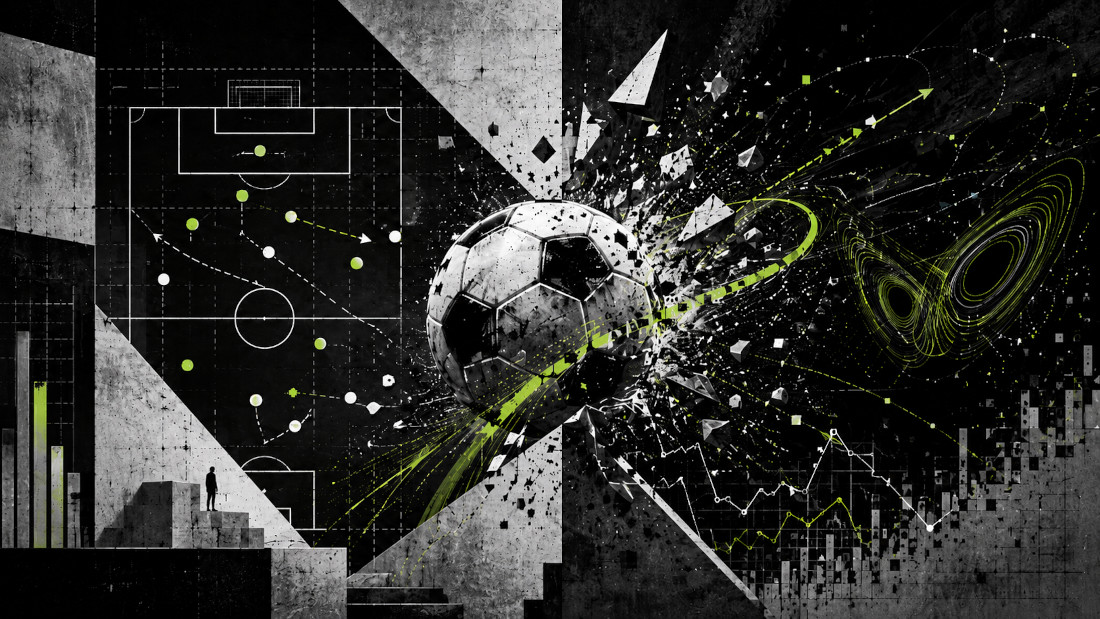
I asked the AI model DeepSeek to predict three matches from the 2026 World Cup. It consulted 52 web pages, read 14 of them in depth, processed around 150 variables per match — recent performance, physical condition, head-to-head history, individual tactical matchups, external factors — and returned its most precise predictions: Belgium wins 2–0, Uruguay wins 1–0, Iran wins 2–0. Simple numbers, absolute confidence.
All three matches ended in draws.
Belgium 1–1 Egypt. Saudi Arabia 1–1 Uruguay. Iran 2–2 New Zealand.
What happened? Was there a lack of data? Definitely not. It failed because the problem contains more variables than any model can process.
In 1963, mathematician Edward Lorenz discovered something that at first looked like a calculation error: tiny differences in the initial conditions of a system can produce radically different outcomes over time. We call this chaos theory, or the butterfly effect, after the allegory Lorenz himself expressed in 1972: the flap of a butterfly’s wings in Brazil can set off a tornado in Texas. In concrete terms, some systems are unpredictable by their very nature, and adding information or forcing analysis onto them does not necessarily bring order. It often makes them even more complex. Football is one of those systems.
There are sports in which the dominant variable is relatively contained. In Formula 1, the car concentrates a large part of the outcome. In tennis, the gap between the two best players in the world and the rest can be so vast that prediction may seem straightforward. Football does not work that way. It has 22 players, each of them a moving variable. It has a referee whose decisions alter the dynamics of the match. It has the condition of the pitch, the temperature, the hour of the day, the goalkeeper’s hours of sleep. It has the motivation transmitted by the coach, which is not the same when a team is leading the table as when it sits at the bottom.
Each of those variables is, in turn, a system of variables. The emotional state of a defender carries his recent history, whether he had an argument that morning, whether he is afraid of getting injured, whether the stadium intimidates him or ignites him. None of that appears in the databases models use for their calculations.
When I asked DeepSeek why it had failed, it answered with a degree of honesty I did not expect. “To predict the result of a match, I would need to measure the neurochemical fatigue of each player in that millisecond, the exact coefficient of friction between Ugarte’s boot and the grass, the trajectory of the air inside the stadium.” All of that describes an unattainable level of precision. But the example that proves it is much more graphic: Manuel Ugarte, the midfielder for Uruguay’s national football team, took a shot with the score at 1–0 against his side and the ball hit the post. If that shot had shifted two centimeters to the right, Uruguay would have equalized, Saudi Arabia would have lost its shape, and the match could easily have ended 2–1 for the South Americans. No model can predict those two centimeters, because they depend on the unevenness of the grass, the wind inside the stadium, the density of the air, and the exact angle of Ugarte’s foot in the fraction of a second of impact. AI can calculate possession and shots, but it cannot measure all those variables in real time. That is why it fails.
And as if that level of complexity were not enough, the model also pointed to what physicists call the Lyapunov horizon: the maximum period of time during which a chaotic system can remain predictable before initial errors grow so large that the prediction ceases to make sense. In meteorology, that point arrives after roughly five days. In football, it is estimated to appear between the 30th and 40th minute of play, after which the margin of error grows faster than any correction the model can make.
In the other two matches, chaos was also the protagonist. Belgium’s equalizer came through an own goal by an Egyptian defender who, under pressure, deflected the ball into his own net — an event that appears on no probability list. Meanwhile, Elijah Just, who came into the match after four defeats with New Zealand, scored twice in the 7th and 54th minutes with a performance statistically atypical compared with his previous six months.
DeepSeek summarized it this way: “What matters is not the volume of data, but the millimetric precision of the initial conditions. And in football, those conditions change in fractions of a second.”
For decades, and with even more tools in this century, football has systematically tried to reduce its own variables. VAR eliminated some refereeing errors. Possession as a tactical philosophy seeks to deny the ball to the opponent in order to reduce its options. GPS devices track the distance covered by each player, their accelerations, their zones of influence. Today we have xG — expected goals — the metric that assigns each shot a probability of becoming a goal based on its position on the field, the angle, and the type of preceding assist.
Each solution generates new variables. The referee who hesitates because he knows VAR can review the play. The striker who does not shoot because the coach asked him to be conservative. The team that has more possession but less depth because the opponent has arranged two lines of four behind the ball. Tactics solve one problem and open three more.
Iran arrived at the World Cup with visa problems that forced the team to move its training camp from the United States to Mexico, disrupting its preparation in the days before the debut. That does not appear in any performance table. DeepSeek acknowledged that it had registered the issue but treated it as peripheral noise, not as an initial condition capable of shifting the entire system.
In this World Cup, with AI present and, specifically, with this sequence of three draws where models had predicted victories, an open question remains. AI is improving in processing speed, data volume, and its ability to find patterns the human eye cannot detect. But that threshold, where the logic of chaos appears with force, is not solved today with more computational power. It is simply a mathematical property inherent to the system, not a technological limitation waiting to be fixed by the next version of the model.
What this means in practice is that, in the 2026 World Cup — as in every previous tournament and every one that will follow — humans and the most advanced AI models in the world start each match from the same point. Equally blind to what will happen in the 83rd minute, when a ball rebounds off the referee and lands at the feet of a player who was out of position according to every statistic.
That is precisely what makes football, and all sports whose results depend on certain imponderables, so thrilling. It is not a defect of the game but part of the essence that makes them so special. In other domains — a diplomatic crisis, a military decision, a collapsing financial market — that same unpredictability may generate more concern than excitement. But on a football pitch, for now, uncertainty before chaos remains one of the few territories where we are still superior to machines. Neither they nor we can anticipate the outcome, but we have something that lies outside calculation: intuition, a hunch, that spark that turns the unpredictable into possibility.