The Time That Cannot Be Saved
On entropy, memory, and the cost of irreversibility in the face of AI
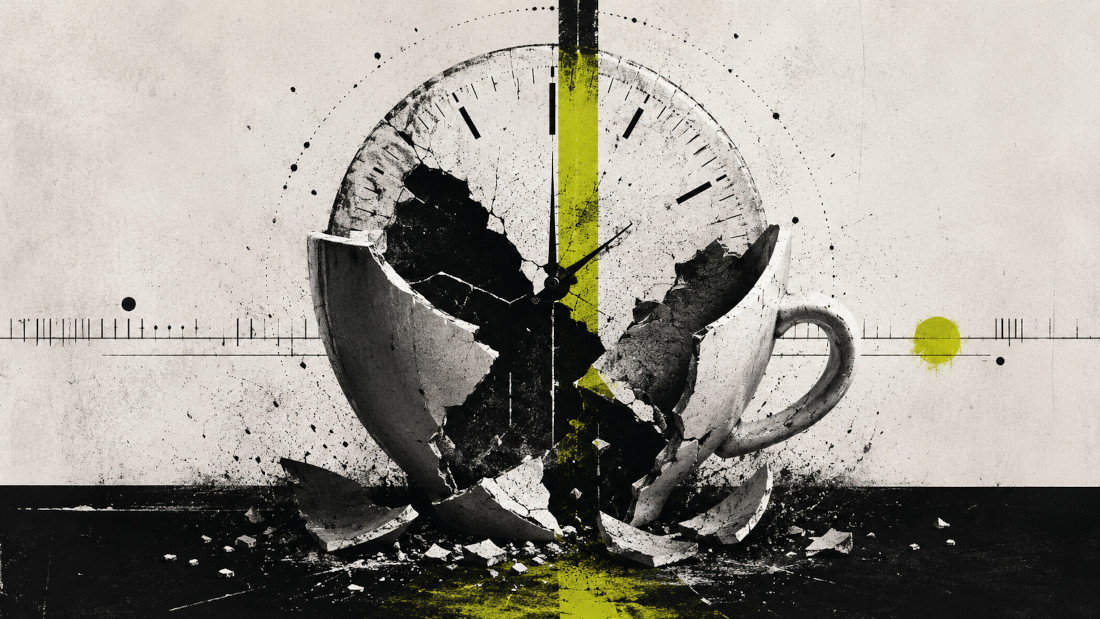
There is an asymmetry at the heart of physics that troubled theorists for a long time: the vast majority of the fundamental equations that describe our world work the same way forward and backward in time. Except for very subtle processes at the subatomic level, the mechanics of everyday life are reversible. A video of billiard balls colliding is mathematically indistinguishable if played in reverse. And yet, in the macroscopic world, no one confuses the past with the future. No one has ever seen the fragments of a broken cup gather themselves back onto the table.
The most intriguing part appears when trying to unify quantum mechanics with gravity. In one of the most ambitious frameworks in theoretical physics, the Wheeler-DeWitt equation, the variable t simply disappears. This suggests that the universe, at its most fundamental and quantum level, may exist without an external time that flows. And yet, here we are. Aging.
If linear time were not built into the foundations of the universe, where would it come from? One profound theoretical hypothesis holds that the time we perceive may emerge from entropy. The arrow of time — the undeniable fact that the past is behind us — would not be a fundamental property of quantum reality, but a statistical consequence of our macroscopic perspective. That thermal irreversibility, which condemns the cup to remain broken, is precisely the condition that turns a sequence of physical events into something we can call life.
The past exists only as a trace in the present: the scar, the oxidized photograph, the weight of accumulation. And this is where the structural difference with an artificial intelligence model lies. It is not that AI has no past, but that its past has no cost. It processes information about events, but it does not undergo the thermal irreversibility of having lived them. It can describe, with probabilistic precision, what it feels like to lose something. But it has lost nothing. This is the difference between simulating the experience of time and being inside it.
The real risk is that we stop seeing this fracture.
Human memory is a selective practice, built with partiality. We remember what marked us, or what we could not hold onto. We are the story we tell about our own time, and that story has a specific weight: the weight of what cannot be undone. AI, by contrast, processes millions of these stories, but because nothing is irreversible for it, it neither regrets nor anticipates.
Today, technology tempts us to treat the future as something calculable, and to optimize time as if it were just another metric of efficiency. Algorithms recommend before we ask, managing the future before it happens. But time is not optimized. It is inhabited. And inhabiting it requires accepting that each moment that passes does not return. That impossibility of return is not a flaw in the system. It is the physical constraint that gives value to our decisions and meaning to what we choose to preserve.
The broken cup does not reassemble itself. That is exactly what made it matter.
Some things cannot be saved. And precisely for that reason, they have value.