The Conductor’s Paradox
Human Judgment in the Era of Systemic Noise
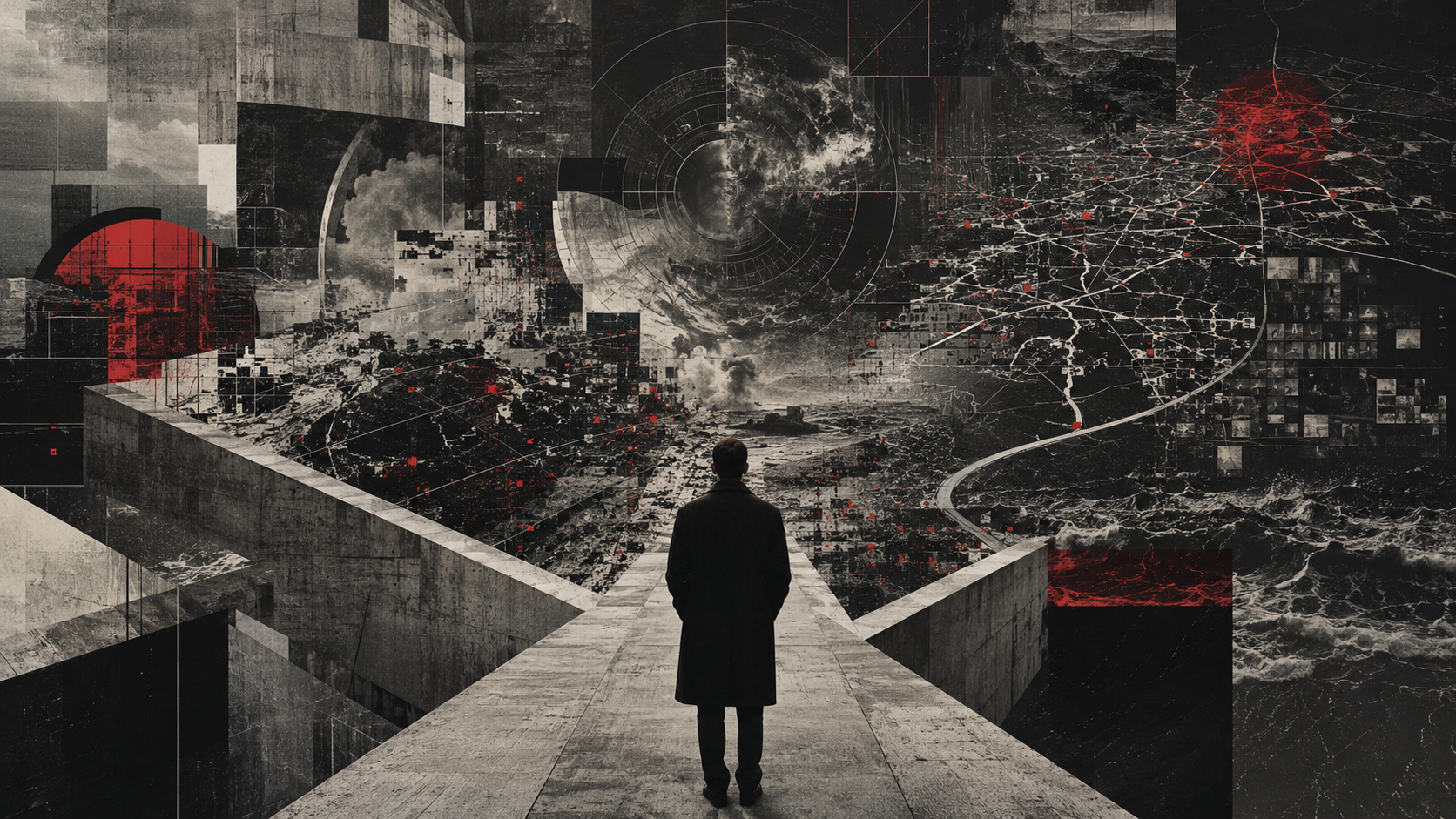
We are living in the age of analytical saturation. For two centuries, the challenge for anyone faced with making a high-impact decision — deploying logistics in an international theater of operations or coordinating the flow of essential services in a region in crisis — was to pierce the “fog” of uncertainty. The historical objective was to accumulate data in order to see clearly.
Today, the problem has been inverted. The fog we face now is no longer made of an absence of information; it is made of an excess of data so dense that it threatens to paralyze action. Contemporary command dashboards do not suffer from a shortage of signals, but from the deafening noise those signals generate. Technological hype sells us artificial intelligence as the great dissipater of that fog, but often it only makes it thicker.
In this new ecosystem, the conductor’s paradox emerges: the greater the automation and predictive capacity of machines, the more exposed and decisive the judgment of the human operator becomes. Systems can optimize logistical variables at infinitesimal speeds, but they completely lack the capacity to assume the ethical responsibility of risk. In the face of collapse, leadership is not delegated to the algorithm; it is redefined through the ability to operate in symbiosis with it, preserving judgment where the machine only detects quantitative correlations.
My first encounter with this paradox did not take place in front of a screen at a Silicon Valley “startup,” but in the theaters of operations of Kuwait and Kosovo between 2001 and 2003. There, in the midst of the transition toward the digitalization of command systems, I experienced for the first time the suffocation of massive information flow. Screens filled with automatic alerts, satellite reports, and real-time variables. Technology promised absolute clarity, but what it delivered was paralysis by analysis.
In that saturated environment, the real challenge was not to obtain more data, but discernment: the almost artisanal ability to separate what was critical from what was merely contingent. No software automated that filter; it was achieved through critical thinking. The human team was responsible for translating the chaos of the screen into viable decision options, applying a maxim that artificial intelligence still does not understand: in crisis management, accumulating information is not the same as generating understanding.
Years later, in 2016, that same tension took me to the United Nations in Geneva. I was part of a two-man delegation tasked with presenting Argentina’s destruction of its last anti-personnel landmine. Yet the corridors of the UN were already buzzing with a much more urgent debate: the regulation of Lethal Autonomous Weapons Systems.
There, we upheld what is now an unavoidable reality of modern hybrid conflicts: technology can automate the trigger, but it is incapable of computing the humanitarian principles of proportionality and distinction. Not because it lacks data or computing power, but because these are not mathematical formulas; they are moral dilemmas.
The recurring error of modern technocracy is precisely to confuse the mechanization of diagnosis with the understanding of reality. When an organization transfers the analytical phase entirely to an automated system, it begins to mistake statistical correlation for structural causality.
Today, we are witnessing volleys of AI-guided drones and the paradox of robotic attrition warfare. The geopolitical response to the prohibitive cost of traditional defenses has been to embrace the doctrine of “Affordable Attritable Mass.” The horizon toward 2027 is marked by massive contracts to deploy thousands of low-cost autonomous drone swarms. The strategy seeks to wear down and saturate the opponent not through the superiority of sophisticated platforms, but through massive, fungible, and expendable quantity.
However, this economic optimization hides a tactical trap: real geography reminds us of the limits of the theoretical model. No routing algorithm can calculate the friction of a frozen high-mountain road at four thousand meters above sea level, nor can it weigh the psychological toll on the driver, the impact of hypoxia-induced fatigue, or the complexities of territorial negotiation with local communities.
Optimization on the screen is perfect; in the mud of the mountain, it is only a suggestion. The same is true in any conflict: an autonomous swarm can saturate the space, but it is incapable of consolidating terrain or reading the political currents that define human will.
Every complex structure tested by a rupture suffers surface wear. The machine reacts by applying standard protocols based on historical data. But protocol is useful only until reality overflows the model. It is at that instant, when the original plan becomes obsolete five minutes into the incident, that flexibility is required: the human capacity to break procedure in order to save the objective.
Problems of command are never purely technical; they are, above all, human. Management is not solved with next-generation software or a massive low-cost swarm. It requires understanding the psychology of organizations, anticipating wear, and sustaining team cohesion when technical solutions take time to materialize.
A conductor who blindly trusts the transparency of the screen, without contrasting it with the direct pulse of reality or the morale of their people, is condemned to strategic failure. Technology is a formidable amplifier of control capacity, not a substitute for character or for direct knowledge of the human condition.
The future of leadership in an automated world does not consist of competing with the processing power of servers, but of refining what remains forbidden to them: intuition grounded in history, the empathy required to coordinate opposing wills, and the moral courage to decide with incomplete information. When screens saturate or go dark, the only compass that remains steady is rigor in planning and the resilience of the human factor at the center of the storm.