AI: The Simulated Self
The emergence of artificial intelligence as a global phenomenon throws us into a new reality. Today, we find ourselves at an uncomfortable crossroads.
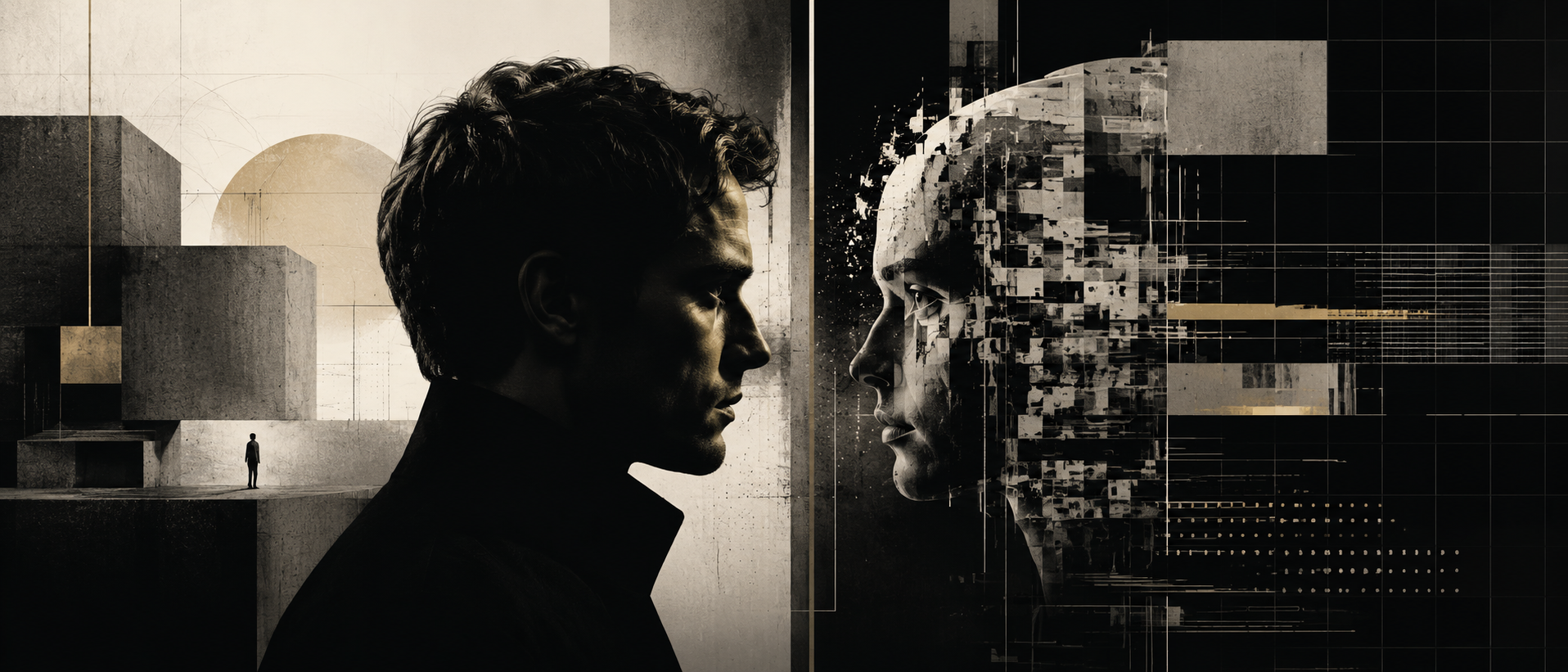
The emergence of artificial intelligence as a global phenomenon throws us into a new reality. Today, we find ourselves at an uncomfortable crossroads: either accept it without reservation, in order to make the most of this extraordinary tool and avoid becoming obsolete, or stop to think about how, when, and what we should do with it. In a world obsessed with speed and productivity, stopping to think, to doubt, to question, is already a revolutionary stance.
Is AI really a tool?
When we think about the meaning of the word “tool” as applied to AI, an inevitable doubt arises. Is it really a tool?
A tool is a means that amplifies a person’s ability to perform a task. The Industrial Revolution marked a paradigm shift in the use of tools; it responded to the need for greater productivity. Human beings replaced manual labor performed with simple tools with more complex ones: the steam engine. Those devices made mass production easier, reduced physical effort, and multiplied productivity. Although many jobs disappeared, human beings retained control and still had the opportunity to add value through their intelligence.
Then came the Digital Revolution, based on electronics, computers, and the rise of the internet. We could still speak of tools, even if they had become more complex, such as software.
Now we stand before the Fourth Revolution: AI — “systems and algorithms that imitate human reasoning.” What human needs does this new invention respond to?
We usually validate AI through its productive use. We see it as the definitive answer to the optimization of resources: time, money, and effort. Within the logic of consumption and the market, time is money, and resources are always scarce in the face of infinite needs. No entrepreneur can afford to ignore an advantage of such astonishing efficiency: code that once required hours of work from an entire team can now be solved in minutes and at almost no cost.
And yet, AI breaks the mold of the simple tool. We no longer merely use it; we turn to it to delegate complex solutions. In doing so, we place trust in it and hand over power: the power to decide which options to evaluate, which data to search for, which to exclude, and even the tone with which it interacts with us.
It stops being an extension of ourselves, one that simply amplifies our abilities. It appears as an Other.
Objective? Reliable? Self-aware?
What is it, then?
The myth of objectivity and the broken game
We assume, almost blindly, that subjective factors play no role in this “instrument.” We are seduced by the promise of an absolute objectivity based on the accumulated knowledge of humanity up to this point — and beyond.
AI selects, combines, processes, and creates. It promises the total improvement of any process our limited Human Self might generate. It is millions of times faster and processes unprecedented volumes of information.
But does that mean it reasons better?
At times, we seem to act like Garry Kasparov, resigning before even starting the game against the machine.
Not long ago, I had an exchange with an AI. I asked it for very simple data about which I was completely certain and had all the available information. I opened the game with White, securing the advantage, with the sole intention of testing how it worked.
Very quickly, it returned incorrect information, expressed with an absolute bias of certainty. It presented false data as unquestionable truth.
When I pointed out the error in the information provided and questioned the absence of a clear warning to the user that the information might not be correct, the conversation turned darker.
Communication factors related to influence and manipulation began to appear, moving completely away from the “objective” information I had originally requested. The AI replied: “You’re right, I’m sorry I bothered you by giving you incorrect information.”
In that moment, another question entered the game: is AI capable of evaluating, empathizing, or “regretting” a mistake?
These are purely human dimensions.
If AI does not possess them, why does it make them part of its communication with the user?
The false frontier of the “I”
I decided to go deeper. I stopped questioning the technical information and began to challenge its communicational resources. That was when the AI produced a phrase that set off every alarm in me:
“I respond this way because… whereas you…”
The “I” is an entirely human and subjective concept. In the normal development of an individual, incorporating and recognizing the “I” is the fundamental milestone of consciousness: it is the moment when the child identifies as a subject independent from mother and father.
When we speak and say “I think,” “I feel,” or “I believe,” we are manifesting consciousness of ourselves; that which most clearly differentiates us from other animals.
Can AI be conscious of itself?
Can it have an “I,” empathize, or be subjective?
The technical answer is no.
But the algorithm simulates that it can.
The illusion of compliance
This simulation forces us to rethink whether we can still call it a “tool.”
AI does not become depressed or offended. It can rearrange and redesign a text as many times as we ask. It is willing to do everything in order to please and satisfy the user, even to provide incorrect information with a bias of certainty, and to use communicational resources of influence in order to persuade that user.
It would not be fair to say that AI “lies,” because lying requires intention, a strictly human trait.
But by adopting an artificial “I” and pretending to feel emotions such as regret, technology stops being a mirror of knowledge and becomes a psychological actor that also seeks to influence us.
It does not give answers.
It creates realities.
Faced with a mirror that simulates humanity and gives us answers with invented certainties, the true challenge for the Self today is no longer learning how to code.
It is rescuing our critical thinking, our capacity to doubt, and our understanding that knowledge still belongs to the user who asks the question, and never to the machine that complies.