You Can Delegate the Work, Not the Judgment
A California bill aimed at the legal profession exposes a rule every profession will soon need: a machine may produce the work, but it cannot own the consequences.
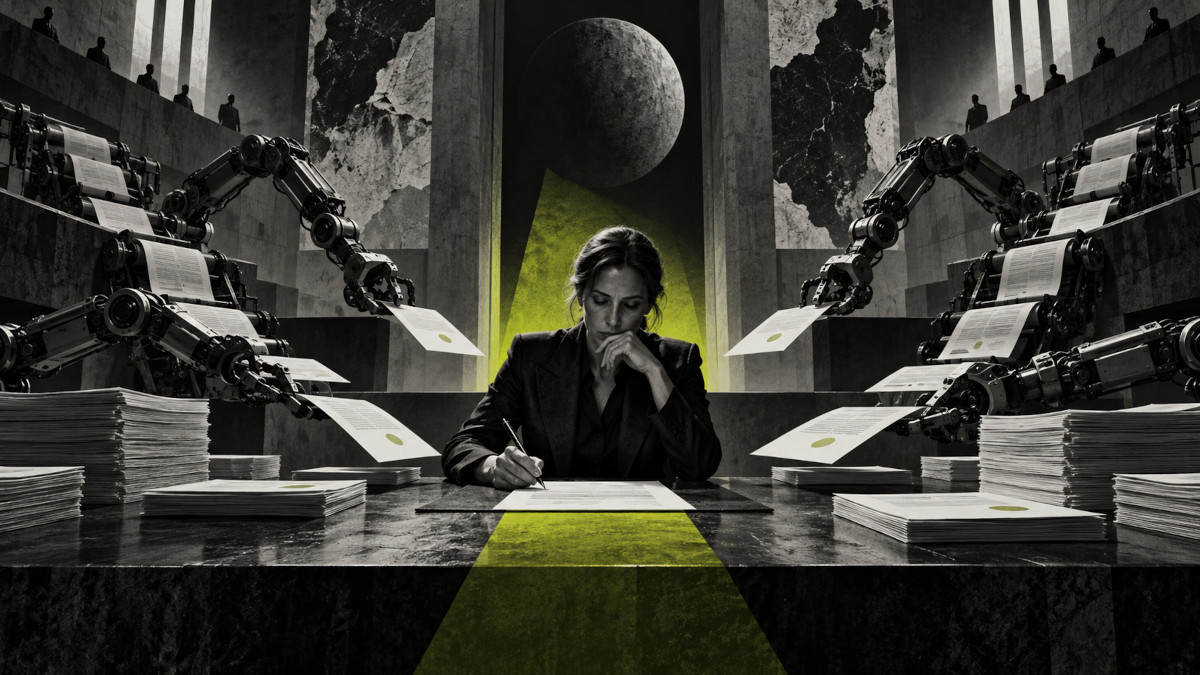
A signature is a small gesture with enormous weight.
It says that someone has read the document. That someone understands what it contains. That someone is prepared to defend it. Most importantly, it gives responsibility an address.
This is why California’s latest attempt to regulate the use of artificial intelligence in law matters beyond lawyers and courtrooms.
Passed by both chambers of the state legislature and enrolled on September 4, Senate Bill 574 establishes a deceptively simple principle: an attorney may use generative AI to assist in legal work, but may not delegate the practice of law to it.
The distinction is more profound than it first appears.
The bill does not prohibit lawyers from using AI. It recognizes that these systems can draft, summarize, organize, search, compare, and accelerate. But it requires attorneys to verify the accuracy of AI-generated material, correct erroneous or hallucinated output, protect confidential information, and disclose the use of generative AI in documents submitted to a court.
It also requires lawyers to personally verify every citation included in a court filing, whether or not it came from an AI system. Arbitrators, meanwhile, would be prohibited from delegating any part of their decision-making process to generative AI.
The machine can help produce the argument.
It cannot become the lawyer.
This boundary is likely to become one of the defining professional questions of the next decade. Not because AI is incapable of valuable work, but because its growing capability makes it increasingly tempting to confuse performance with responsibility.
A system may generate a convincing legal argument in seconds. It may identify precedents, compare contracts, reconstruct timelines, and produce language more polished than that of many human professionals.
But fluency is not accountability.
The machine does not enter the courtroom. It does not lose its license. It does not explain itself to the client. It does not feel the reputational, financial, or moral consequences of being wrong.
It produces an output and moves on.
The human remains.
That may sound obvious, yet much of the current conversation around AI quietly ignores it. We speak about systems “making decisions,” “giving advice,” “reviewing applications,” or “determining risk,” as though the grammatical subject were also a responsible actor.
It is not.
An AI system can participate in a decision-making process. It can change the outcome of that process. It can even perform most of the intellectual labor involved. But it cannot assume the social obligations attached to the decision.
This is where delegation becomes dangerous.
In traditional professional environments, delegation creates a chain of responsibility. A junior lawyer prepares a draft, but a senior lawyer reviews it. An analyst develops a forecast, but an executive approves the investment. A medical technician produces a result, but a physician interprets it.
The work moves. Responsibility does not disappear.
AI introduces the possibility of breaking that chain. Its output arrives without a human biography, professional reputation, personal interest, or intuitive hesitation. It can appear complete enough to eliminate the psychological moment in which someone asks: Do I actually believe this?
This is especially dangerous because AI rarely presents uncertainty in a form proportional to its ignorance. A weak answer can sound remarkably similar to a strong one. A fabricated authority can arrive with the typography, tone, and confidence of a real citation.
The error is not hidden beneath bad writing. It is often concealed by excellent writing.
The American Bar Association’s Formal Opinion 512 already established that lawyers using generative AI must understand its capabilities and limitations, protect client information, communicate appropriately, supervise its use, and independently verify its output.
Its underlying message is clear: AI may be a foundation for professional work, but it cannot replace the judgment and experience required to advise a client.
California is now attempting to place that principle more explicitly into law.
The implications extend well beyond legal practice.
A doctor may use AI to detect a pattern in a scan, but someone must decide what that pattern means for a particular patient.
An engineer may use AI to optimize a structure, but someone must certify that people can safely enter it.
A financial adviser may use AI to model risk, but someone must explain why a client’s savings were exposed to it.
A journalist may use AI to analyze documents, but someone must decide that the resulting claim is true enough to publish.
An executive may ask AI to recommend which employees to hire, promote, or dismiss. But the decision cannot become morally neutral simply because a machine ranked the candidates first.
In each case, automation can expand capacity. It can increase speed, identify connections, challenge assumptions, and expose alternatives that a human might miss.
But the final act is not merely another step in the workflow.
It is the moment at which information becomes consequence.
This is why “human in the loop” is no longer a sufficient principle. A human can remain inside a process while contributing almost nothing to it. They can click approve, accept the recommendation, or sign the document without possessing either the time or the knowledge required to challenge the machine.
Presence is not supervision.
For human oversight to mean anything, the person must understand enough to disagree. They must have the authority to stop the process, the competence to detect a questionable result, and the willingness to accept responsibility for allowing it to proceed.
Otherwise, the human becomes little more than a liability interface: a biological signature placed beneath a machine-generated conclusion.
This creates a new temptation for institutions: responsibility laundering.
When the system succeeds, the organization claims the efficiency, intelligence, and innovation. When it fails, the error is attributed to the algorithm, the vendor, the data, or the unpredictable nature of artificial intelligence.
Credit travels upward.
Blame travels into the machine.
California’s proposed rule resists that escape. It says, in effect, that a professional cannot point at the tool after submitting its work. If your name is on the document, the document remains yours.
The challenge is that meaningful verification has a cost.
If AI produces work faster but every important conclusion must be checked, some of the promised efficiency disappears. Organizations may be tempted to weaken review precisely because speed was the reason they adopted the system.
Yet this is not evidence that verification is obsolete. It is evidence that the real productivity of AI cannot be measured only by how quickly it generates a first answer.
The relevant measure is how efficiently it helps produce an answer that a responsible person can defend.
That requires more than warning employees to “check the AI.” It requires approved tools, clear data policies, traceable sources, defined levels of review, and explicit ownership of final decisions. Higher-risk uses should demand stronger evidence and more qualified oversight.
Above all, it requires preserving the human capacity to judge.
The future professional may not perform every step personally. That is neither necessary nor desirable. Calculators did not make accountants illegitimate. Diagnostic equipment did not eliminate medicine. Search engines did not end research.
But tools become dangerous when their convenience persuades us that the last human decision is ceremonial.
It is not ceremonial.
It is the point at which someone stops asking what the machine can do and answers a more difficult question:
Am I prepared to stand behind what it has done?
The machine can draft the sentence.
Only a person can say: I have read it. I understand it. I stand behind it.