The Train Is Moving. Your Burger Isn't.
How a high-speed rail turned a 3-minute pit stop into the most elegant supply chain you've never thought about.
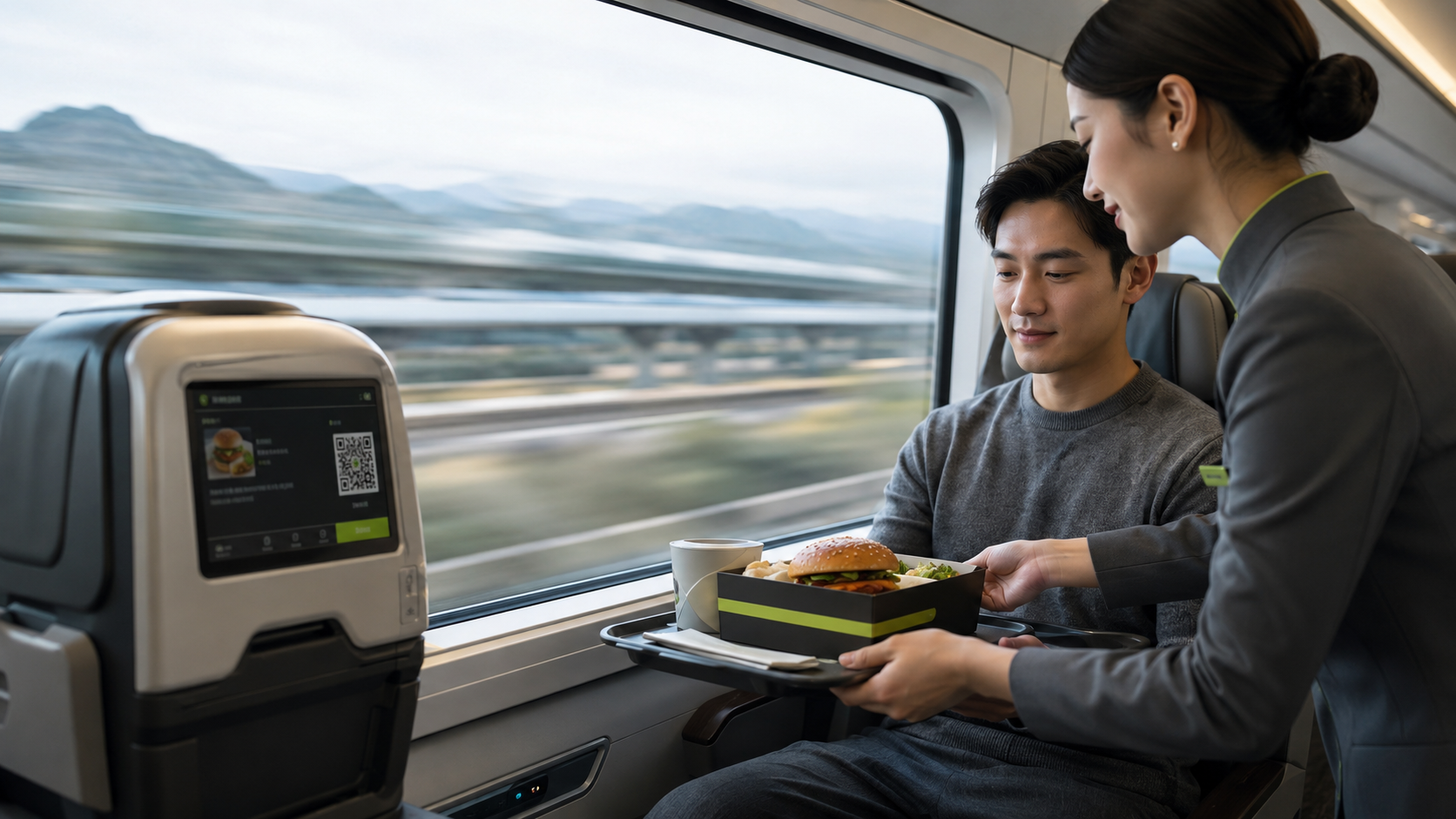
The setup is almost too simple.
You're on a train doing 300 km/h somewhere between Shanghai and Beijing. You scan a QR code on the back of the seat in front of you. You pick Nanjing salted duck, or a KFC Double Beef Burger, or Wuhan hot dry noodles. You pay through WeChat. You go back to looking out the window.
Forty minutes later, someone walks up the aisle and hands you your lunch.
Through China's official 12306 railway app — the exact same one used to buy your ticket — passengers browse menus from restaurants located at upcoming stations along their route. The integration is total: one app, one account, one tap.
That's the user experience. Clean, almost boring. But what's happening behind it is anything but.
The 3-Minute Constraint
Here's where it gets interesting.
Trains often spend no more than a few minutes at each station. If the meal is late to a departing train by even a few seconds, it's a lost sale, a disappointed customer, and a logistical failure cascading back through the entire chain.
This isn't a restaurant with a forgiving 20-minute delivery window. The "address" is a 400-meter train that will leave whether your food is on it or not.
A passenger must place an order at least one hour before arriving at the designated "delivery station." As the train pulls into the platform, delivery riders — who are already waiting — hand insulated bags to train attendants. The attendants then navigate the aisles to deliver the meal to the passenger's specific carriage and seat number.
Read that again. The riders aren't dispatched when the order arrives. They're already on the platform, waiting, because the train schedule is known to the minute and the system works backwards from it. The order doesn't trigger fulfillment — the train's arrival time does. The kitchen knows before the rider does. The rider knows before the train does. The attendant knows before you do.
That's not food delivery. That's choreography.
The Supply Chain Nobody Drew on a Whiteboard
Let's trace it, because the process engineering here is genuinely beautiful.
Ordered meals flow from the restaurant to a distribution center at the station, then station staff deliver the meals en masse to railway crew, who bring them to the correct seat. Five distinct handoffs. Five distinct actors. Each one operating on a countdown they didn't set.
The anchor point is not the customer and not the restaurant. It's the train schedule — a hard, external, non-negotiable constraint that every upstream node in the chain is synchronized against. The kitchen preps not to order time, but to departure time. The rider routes not to distance, but to platform number. The attendant delivers not by floor plan, but by seat manifest.
What's truly wild: a single station, Nanchang East, was processing around 1,700 on-demand meal orders per day for high-speed rail as far back as 2020 — and that's one station on a network that now spans over 45,000 kilometers, enough to circle the Earth.
The system isn't impressive because it moves fast. It's impressive because it moves precisely, at massive scale, with a hard physical deadline baked into every single transaction.
What the Super-App Makes Possible
China's digital life is centralized. The integration of food delivery into a state-run transit app demonstrates a great level of software synergy.
When your ticketing app already knows your train number, your departure point, your seat number, your route, and every station you'll pass through — the food ordering layer essentially writes itself. The system doesn't ask you where you are. It knows where you'll be, and when.
This is a fundamentally different design philosophy: identity as infrastructure. Your ticket isn't a ticket. It's a delivery address, a payment credential, a seat manifest, and a scheduling anchor — all at once.
The operator behind one regional system put it plainly: "We will continue to collect passenger feedback and dynamically optimize meal options and supply models." Which means this isn't frozen. It's a living system tuned by data, continuously.
The MAN/MACHINE Angle: What Should This Trigger for You?
This is the part that matters for your own work.
1. What if your delivery address moved? The entire standard logistics chain was designed around a constraint most systems would call impossible — a recipient in motion on a fixed schedule. What "moving targets" exist in your own service chain that you've simply accepted as too hard? A construction site that shifts weekly? A sales team always in transit? A client whose context changes before you can respond?
2. The forcing function of zero slack. A 3-minute window doesn't allow for fat. It doesn't allow for "we'll sort it out." It forces every node in the chain to pre-position, pre-commit, and pre-execute. Most business processes are designed with slack because slack feels safe. This experience proves that sometimes removing slack doesn't create chaos — it creates clarity.
3. Anchor to the constraint, not to the customer. Standard process design starts from the customer request and works forward. This system works backward from a hard external constraint (the departure time) and then sequences every upstream actor against it. In your own operations: what if you designed backwards from your hardest constraint instead of forwards from the request?
4. The captive audience window. A passenger on a 5-hour train ride is a captive audience with known appetite timing, known location, and a phone in their hand. The insight isn't the QR code — it's recognizing what kind of moment a train ride is, and building a service that fits that moment perfectly. What captive windows exist in your customer's day that you haven't designed for?
The QR code on the seat back is almost irrelevant. It's just the visible tip of the iceberg.
The real story is what happens when you synchronize a kitchen, a rider, a platform, a train attendant, and a seat number against a clock that nobody controls — and you do it 1,700 times a day, at one station, on a network that circles the Earth.
Stop for a second. Let that land.
A hot burger travels from a kitchen, crosses a platform, boards a moving train, and lands at seat 14C in carriage 5 — all while the world blurs past the window at 300 km/h. No friction. No failure. No margin for error.
What a beautiful piece of engineering. What a system. What a perfect dance between the human who's hungry, the machine that knows exactly where they are and when they'll arrive, and everyone working invisibly in between to make the moment happen.
This is MAN/MACHINE. Not in the sense of robots replacing people — but in the only sense that truly matters: humans and systems designed together, each doing what the other cannot. The machine brings the relentless precision of the schedule. The human brings judgment, movement, the last ten meters to your seat.
Apart, they're a kitchen and an app. Together, they're something that doesn't have a name yet — but that's already running, at 300 kilometres an hour, while you stare out the window.
The machine is hungry. And so are you.