VINYL — The Human Experience
A format that should be dead keeps outliving its obituaries. That's not nostalgia. That's something else entirely.
The Cult That Logic Can't Kill
By every rational measure, vinyl should be a museum artifact. It warps. It scratches. It collects dust with the enthusiasm of a religious calling. It degrades with every single play — physically, measurably, irreversibly. And yet, global vinyl sales have grown for eighteen consecutive years. People born into the age of lossless streaming are buying turntables and carrying twelve-inch cardboard squares out of record stores like they found something sacred.
They did.
Before we go any further, let's acknowledge the elephant in the room and then politely ask it to leave: digital audio is, in strict theoretical terms, perfect. The Nyquist-Shannon sampling theorem guarantees that any signal sampled at twice its highest frequency can be reconstructed without error. A 44.1 kHz CD captures everything human ears can hear, with mathematics to prove it. That argument is not wrong. It is also, somehow, completely beside the point. Vinyl's resurgence has never been about winning a frequency response argument. It was never about the science. That's a different conversation for a different article. This one is about why people keep choosing the format that fights back.
The vinyl cult exists precisely because it demands something from you. It is not passive. It is not a playlist. It does not shuffle. It does not algorithmically suggest. It asks you to decide, to commit, to handle something physical with a degree of care that streaming made extinct. And in that friction — that beautiful, unnecessary friction — something human happens.
The Machine
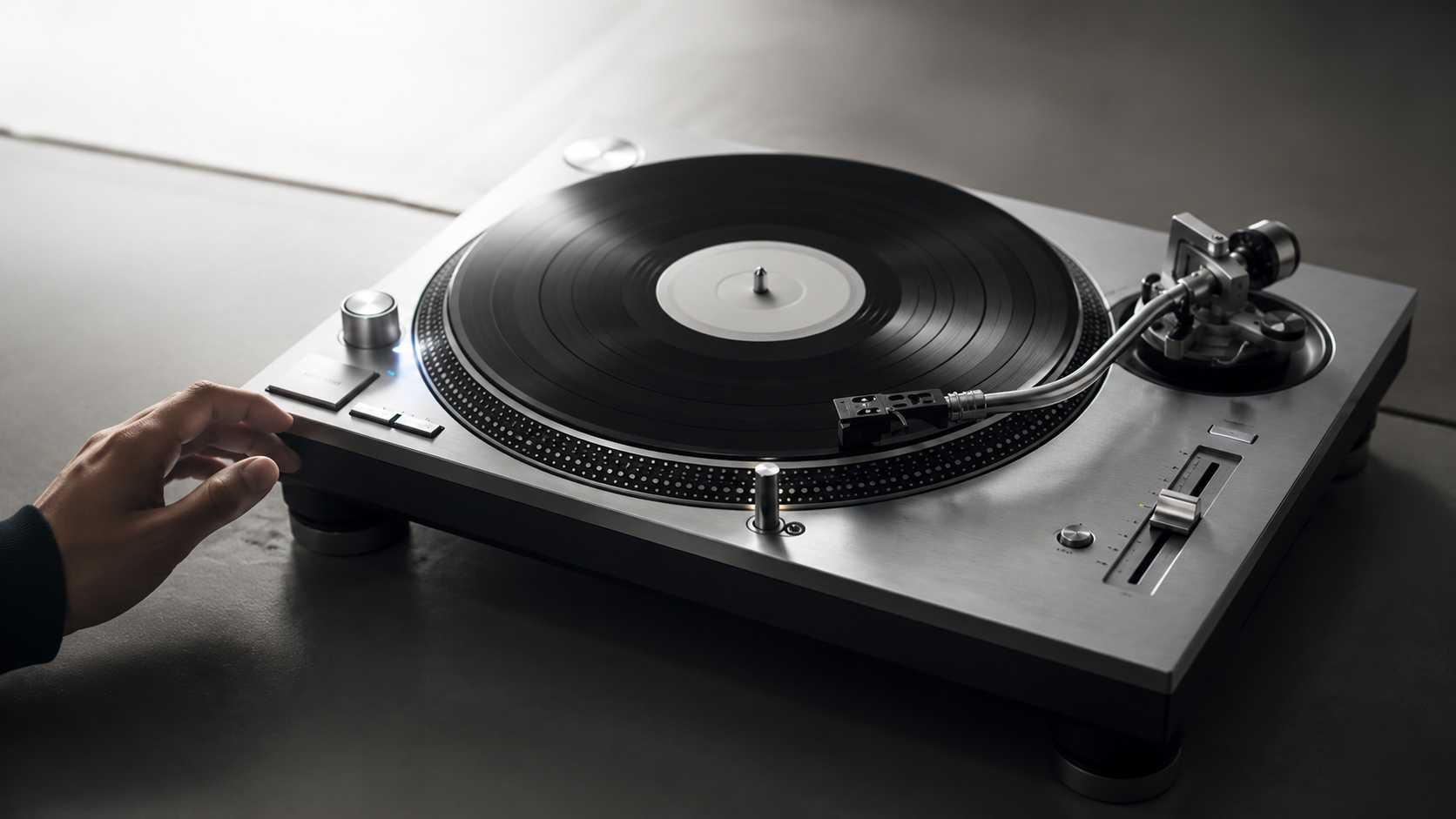
Strip away the mystique and a turntable is a precision mechanical system operating at the edge of its own tolerances. Four components. One implausible conversation.
The motor must spin the platter at an exact, unwavering speed — 33⅓ or 45 RPM — while generating as little vibration as possible. Vibration is the enemy. Every microscopic tremor travels through the chassis, up the tonearm, into the cartridge, and becomes audible as noise. The motor's entire existence is a contradiction: it must move and must not be felt.
The platter is mass as philosophy. Weight means inertia, and inertia means speed stability. A heavy platter resists the motor's inevitable imperfections, smoothing them through sheer physics. It spins, and keeps spinning, like a system that has already made up its mind.
The tonearm is perhaps the most elegant mechanical problem in consumer audio. It must glide across a record with almost no friction — fractions of a gram of lateral resistance — while simultaneously tracking a groove that moves in three dimensions at microscopic scale. Its geometry is obsessive: overhang, azimuth, vertical tracking angle, anti-skate force. Each parameter intersects the others. Get one wrong and you're not just losing high frequencies; you're accelerating wear, distorting the stereo image, and slowly destroying both the record and the stylus. The tonearm is an exercise in calibrated compromise, endlessly tuned, never truly finished.
And at the end of that arm: the cartridge and stylus. A diamond — sometimes literally — riding the walls of a groove cut at 1/1000th of a millimeter precision, translating mechanical movement into electrical signal at frequencies measured in the tens of thousands per second. The stylus is the point where physics becomes music. It is absurdly small. It is doing an absurdly difficult job. It is wearing out right now, as you listen.
This machine is not supposed to work as well as it does. The fact that it produces music at all is a minor industrial miracle performed in your living room, thirty-three times a minute.
The Session
Nobody just plays a record.
There is a ritual, and the ritual is not incidental — it is load-bearing. You choose the album. That choice already means something; you didn't hit shuffle. You pull it from the shelf, and the sleeve is already communicating: its weight, its condition, the graphic design decisions made by someone decades ago who believed this music deserved a visual language. You read the liner notes, or the credits, or just the track listing. You slide the vinyl from its inner sleeve with the particular care of handling something that matters.
You place it on the platter. You lower the cartridge.
Research in environmental psychology and sensory integration is unambiguous: context shapes perception. What you see, smell, and touch while listening to music alters what you hear — not metaphorically, but measurably, neurologically. The large-format artwork in your hands is not decoration. It is part of the sound. The act of choosing and handling and placing is not preamble. It is the opening movement.
Then there is the visual of the record itself spinning — that slow, hypnotic rotation, the light catching the grooves differently as each track passes beneath the stylus. It is a clock and a mandala simultaneously. It marks time while dissolving it. You watch it. Everyone watches it.
Vinyl listening sessions produce a different quality of attention than streaming. Not superior attention — different. Focused. The format imposes its own tempo: two sides, a defined arc, a moment where you must stand up and flip. That interruption is not a flaw in the design. It is the design. It breaks the passive consumption trance and re-introduces choice. Do you flip it? Do you get up and get a drink? Do you sit with the silence between sides and think about what just happened?
The machine enforces presence. In 2026, that is genuinely disruptive.
The Slow Death
Every time a stylus tracks a groove, it removes material. Microscopically, imperceptibly, but without exception. The diamond is harder than the vinyl, and so the vinyl loses. The groove walls, pressed to sub-millimeter precision at the manufacturing plant, become incrementally less precise with each revolution. The music you are hearing right now is, in the most literal physical sense, disappearing.
This is usually framed as a deficiency. It is worth considering it differently.
Everything analog ages. Photographs fade at the edges. Wood develops patina. Leather softens in the places most touched. A vinyl record wears in the places most played — the opening track of the first side, always. The songs you loved so much you returned to them. Wear is a map of affection. It is the format's memory of your attention.
There is a parallel here that doesn't need to be made dramatic to be true: all systems that produce meaning are subject to entropy. The fact of eventual degradation does not diminish what happens in the time before it. If anything, the knowledge that this pressing is finite — that yours is one of a limited number of plays before the groove loses resolution — focuses the listening. You are present because the moment is genuinely not repeatable in exactly this form.
The record is slowly dying. The music plays on. This is not sad. This is what analog feels like.
The Investment
Nobody talks honestly about what it costs to play vinyl well.
The entry point is seductive — a starter turntable for the price of a dinner out, and suddenly you're buying records. But the entry point is also a trap. Budget cartridges track with more force than necessary, accelerating that groove wear. Budget phono stages add their own coloration. Budget platters wobble. The format reveals its mechanical nature by rewarding better mechanics, and better mechanics cost real money.
What's more interesting than the numbers is the shape of the investment. Vinyl forces you to make conscious choices about where you put value. The audiophile path is one of progressive realizations — each improvement in the chain reveals deficiencies you couldn't previously hear, which is either a journey of deepening appreciation or a beautifully designed consumer trap, depending on your perspective. Probably both. The point is that vinyl spending is intentional spending. You don't drift into a better tonearm. You decide it.
There is also the inverse investment: the used record. A first pressing of something extraordinary, found in a bin for almost nothing. The knowledge that an object worth real money passed through someone else's hands and somehow ended up in yours. Cost and value behave strangely in vinyl culture, and that strangeness is part of the texture.
The acceptable quality threshold is personal. But reaching it requires you to think about what you actually want, and to put something real behind that preference. In a streaming economy where music is effectively free, that act of deliberate investment is almost radical.
The Gift
Consider what it means to give someone a vinyl record.
You must know something about them. Not a vague algorithmic profile built from passive listening data — actual knowledge. Their taste. Their reference points. The gap between what they have and what they might love. You walk into a store, or search a database of pressings, and you make a judgment call about another human being's interior life. Then you carry it home and hand it to them.
The gift says: I thought about your tastes specifically. I made a choice.
A streaming gift card says none of this. A digital album purchase arrives as a link. Both are generous, but only one of them is a translation of knowledge into object. The vinyl pressing has weight — literally, physically — and that weight is the weight of consideration. It takes up space in the recipient's home. It sits on their shelf and every time they see it, they see the decision someone made about who they are.
Vinyl as a gift operates on a register that digital formats structurally cannot access. The physical object is the proof of thought. There is no digital version of that.
Emotional Value Takes Physical Space
Here is a concept worth sitting with.
We live in an era that has systematically dematerialized value. Music, films, books, photographs — all compressible now into servers we will never see, accessible through screens we barely notice. The logic is efficiency, and the efficiency is real. But something happens to the relationship between a person and a thing when the thing has no physical form. It becomes easier to abandon. Easier to forget. Easier to treat as interchangeable, because the next version is one tap away and costs nothing extra.
Vinyl refuses this. A record collection is furniture. It occupies cubic meters. It requires shelving decisions, organizational systems, and a certain commitment to the idea that these objects are worth the space they consume. When you move, you move them. When you run out of room, you make choices. The collection is a three-dimensional record of who you have been and what you have loved, and it takes up your floor.
In MAN/MACHINE terms, this is the most interesting thing about vinyl: it is the machine that insists on leaving a human residue. The interaction is not clean. It is not optimized. It generates dust and scratches and a pile of inner sleeves and a corner of your apartment that is, objectively, inefficient. And it generates something else — a physical autobiography, a curated mass of objects that someone will eventually have to decide what to do with.
Your streaming library evaporates when the service changes its licensing terms. Your record collection outlives you.
Emotional value takes physical space. In a world designed to eliminate physical friction, the people who choose vinyl are making a quiet argument that some things are worth the weight.