Nature Has Codes
From flowers and gardens to cities, architecture, and light, Chevalier translates the world we inhabit into a digital language.
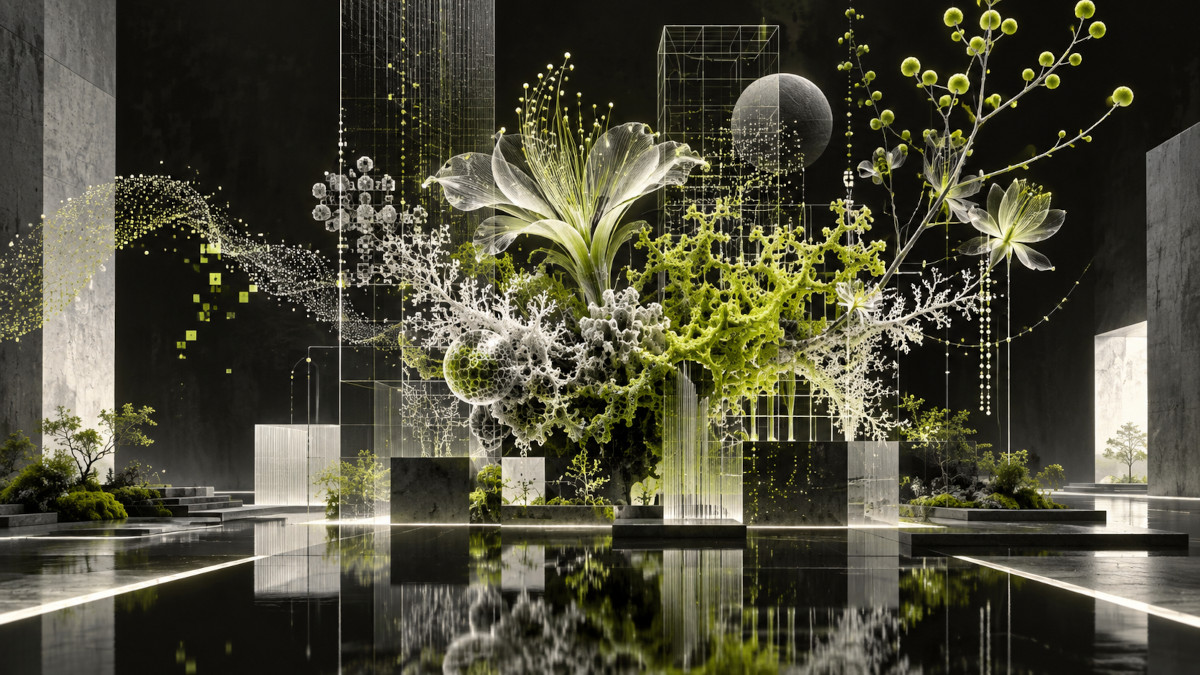
No matter which hemisphere you are reading this column from: first, thank you for doing so. Where I live, spring is about to arrive. The landscape is beginning to change, buds are appearing, and flowers are reclaiming their place. But the work I want to tell you about today could just as easily be experienced in the depths of winter, summer, or autumn.
Because it seems to speak about nature, flowers, and gardens, when it is actually about something far more interesting: processes unfolding in a world permeated by technology and marked by the fragility of climate change.
Growing. Multiplying. Transforming. Disappearing. Beginning again.
Miguel Chevalier (born in Mexico in 1959; lives and works in Paris since 1985) has spent decades working with these movements of nature, but he transfers them to another territory: the digital. His gardens need no soil and depend on no season. They bloom through algorithms, light, movement, and code.
That is why this story begins with a flower but does not end up being about flowers. It is about how an artwork can grow. Chevalier does not illustrate nature. He programs it. Since the 1980s, when digital art still occupied a rather marginal place, he has used computers and generative systems to construct landscapes that transform before the viewer.
In October 2026, Museum de Fundatie, in Zwolle, the Netherlands, will open Digital by Nature, an exhibition bringing together around 120 works and spanning different stages of his practice. Miguel Chevalier belongs to a generation of artists who experimented with computers long before images generated through computational systems became part of our everyday lives.
In Digital by Nature, Chevalier, a pioneer of digital art, invites us to think of technology and nature as territories capable of enhancing one another. There are generative and interactive installations, videos, sculptures, and drawings created with 3D printing and robotics; works in which algorithms produce images in permanent transformation; and pieces that respond to the movements of those who walk through them. The result is an exhibition that does more than display technology: it constructs a space where nature, code, perception, and participation converge. The experience also revisits a classic theme in art history: the landscape as a reflection of our relationship with the world. It carries that idea into a contemporary territory, where the analogue converses with the digital and the organic with what is generated by code.
Chevalier’s nature is not a landscape to contemplate. It is a system that operates.
Flowers That Follow Different Rules
Since the 1990s, his Sur-Natures series has constructed virtual gardens capable of growing, proliferating, and transforming. The images do not remain still. They generate new forms by following mathematical instructions and models inspired by natural processes.
In Fractal Flowers, the flower loses its recognizable condition and becomes structure. It expands, branches, and repeats. Forms appear that simultaneously evoke a plant, a coral, a cell, or a microscopic creature. The screen ceases to be a surface on which to observe images. It becomes fertile ground.
A Garden Without a Calendar
His flowers can bloom again and again. They can grow for hours, change in response to the presence of the public, and disappear only to begin again. Entering one of Chevalier’s works means passing through an ecosystem, a nature governed by different laws.
The history of art is filled with gardens. The Renaissance garden imposed order on nature. The Baroque turned it into spectacle. Modern art experimented with new relationships between space, body, and landscape. Chevalier introduces a new variable: code. His gardens are not organized through paths or pruning. They are organized through algorithms. The artist does not control the landscape; he controls the conditions that allow a form to appear, develop, and disappear. What Chevalier stages is the movement of life: growing, expanding, transforming, and beginning again.
Bloom. Transform. Activate.
A digital flower has no fragrance, but it can make us remember one. The most interesting behavior of an artwork is not always what it does in front of us, but what it manages to activate. When experiencing Chevalier’s work, we can give it memory, a season, and even a fragrance. His technology is not seeking to imitate nature. It is trying to activate our own. Because nature has codes.
And Us?
Miguel Chevalier
Digital by Nature
October 3, 2026 – April 4, 2027
Museum de Fundatie, Zwolle, the Netherlands