When AI Gets a Body
Digital AI scales by copying software. Physical AI scales by building machines, reorganizing work and securing the energy to keep both moving.
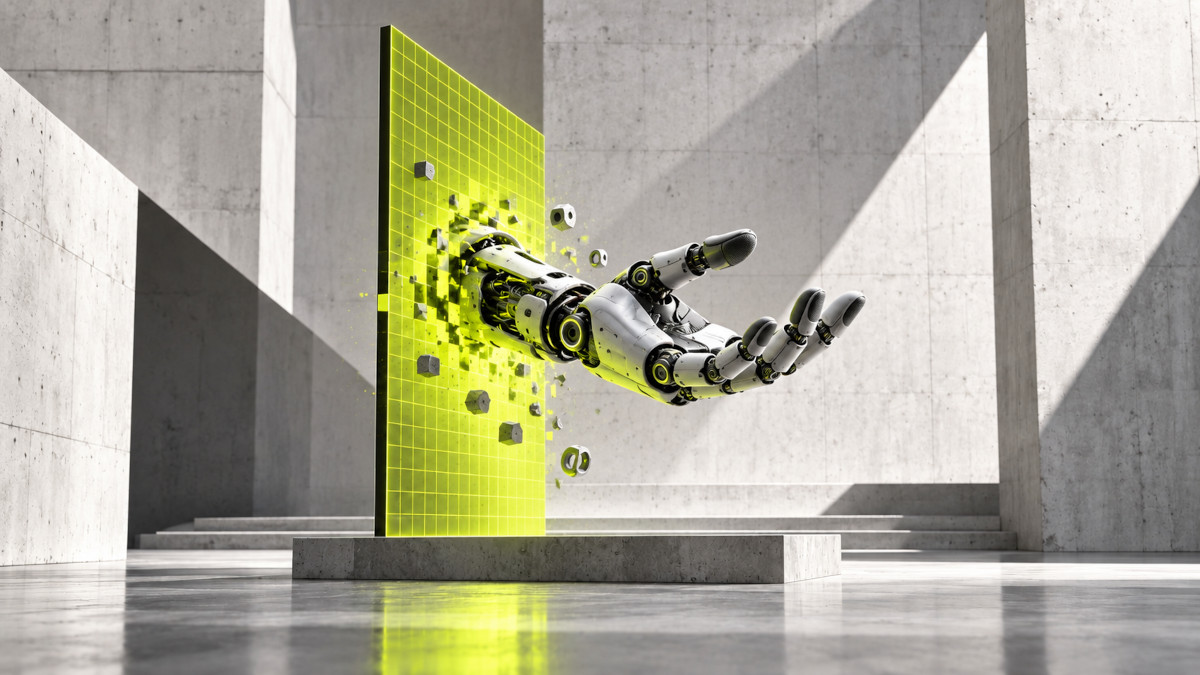
For the last few years, artificial intelligence has lived mostly behind glass. It wrote, calculated, designed and advised. Now it is acquiring hands, wheels, cameras and balance. The economic question is no longer what intelligence can produce on a screen. It is what happens when intelligence begins to move matter.
The Body Changes the Economics
Digital AI is unusually easy to reproduce. Once a model and its infrastructure exist, another user can receive an answer at low marginal cost. A physical system obeys harsher rules. Every new robot needs materials, motors, chips, assembly, transport, installation, power, maintenance and somewhere to work. Software can appear everywhere at once. A machine must arrive through the loading dock.
That difference gives physical AI a distinct economic character. It is a capital good: an asset purchased today in the expectation that it will produce more value tomorrow. The relevant comparison is not robot versus salary. It is the full cost of a redesigned process versus the value of the additional output, quality, safety and availability that process can deliver.
The Austrian tradition is useful here because it treats capital as a structure, not a single pile of money. A robot has little value in isolation. It depends on complementary equipment, trained people, reliable suppliers, energy, floor space, software and a production sequence capable of using it. The entrepreneur’s advantage comes from seeing that combination before competitors do. The expensive mistake is buying the visible machine without rebuilding the invisible system around it.
Robots Were Already Here
Factories have used robots for decades. The old industrial robot was superb inside a narrow world: a known component, a fixed trajectory, a controlled speed and a carefully engineered cell. It could weld the same seam thousands of times with extraordinary precision. Change the object, move the workstation or introduce an unexpected obstacle, and the system often needed new programming, new fixtures and another round of integration.
Those robots transformed manufacturing, but they did not understand the process in any broad sense. Their reliability came from removing uncertainty from the environment. They were powerful because the world around them had been made simple.
The new generation tries to operate before every uncertainty has been engineered away. Cameras and force sensors provide perception. Vision-language-action models connect what a robot sees, what a person asks and the movements available to the machine. Demonstrations, simulation and shared models can shorten the path from a new task to useful action. A system may identify an unfamiliar object, interpret a natural-language instruction and adjust when the object is not exactly where expected.
This is why the current wave matters. Intelligence is moving from the program for one cell toward a reusable layer across tasks and machines. A model trained on many environments may transfer part of that learning to another robot. The dream is generality. The present reality is narrower: impressive demonstrations, improving pilots and a stubborn gap between performing once and performing safely through an entire shift.
The Billion-Robot Claim
In September 2026, Elon Musk offered the maximal version of the physical AI thesis: more than one billion humanoid robots within ten years, each eventually producing roughly five times as much as a person, with robots helping to manufacture more robots. The final image is irresistible: industrial capacity compounding itself.
It is also a forecast, not an established trajectory. The International Federation of Robotics counted about 4.66 million industrial robots operating worldwide in 2024, after 542,000 new installations that year. Those figures include mature industrial machines, while Musk’s claim concerns humanoids, a much smaller category. Even if we generously used the entire industrial stock as the starting point, reaching one billion units in ten years would require multiplying it by roughly 214, equivalent to about 71 percent compound growth every year, before accounting for retired machines.
The productivity phrase needs equal care. One billion machines at five human equivalents would represent five billion worker equivalents, more than today’s global labor force of roughly 3.7 billion people. The arithmetic is internally consistent. The assumptions are doing all the work. A robot’s useful productivity depends on uptime, task range, error rates, supervision, maintenance and whether there is real demand for what it produces.
Robots already help build robots. Automated lines manufacture motors, gears, electronics and other components used in automation. That is not the same as an autonomous, self-replicating factory. Raw materials, semiconductor capacity, energy systems, logistics, finance and human engineering remain part of the loop. The recursive factory is a direction of travel, not a machine that has escaped economics.
Productivity and the Price Signal
Productivity is the central promise. More output from the same resources can lower costs, improve quality and make scarce goods more abundant. Competitive markets tend to pass part of those gains to customers through lower prices or better products. Free prices and competition matters because productivity has social value only when it serves demand. A factory full of tireless machines can still destroy capital by producing the wrong thing.
The gains will not arrive evenly. Automation can increase output and create complementary work while also displacing particular tasks, weakening some wages and hollowing out specific places. Economic progress is not a promise that every existing job survives. It is a process in which labor and capital move toward more valuable uses, sometimes with painful delay. Policy can soften that transition, but protecting a task from competition also protects its cost. Instinct would favor transparent, broad support for people over permanent protection for a particular occupation or company.
At company level, this puts judgment ahead of spectacle. The winning deployment may be an articulated arm, an autonomous cart or a purpose-built inspection system rather than a humanoid. The right form is the one that fits the process. Human shape is valuable when the environment was designed for human bodies. Elsewhere, wheels, rails or fixed machinery may be cheaper, safer and more productive.
Process Engineering Returns to the Center
Generative AI encouraged companies to begin with individual users: give people access, let them experiment and watch useful practices emerge. Physical AI is less forgiving. A robot touches inventory, equipment and people. Errors can stop a line or cause injury. Deployment therefore returns process engineering to the center of the AI discussion.
Leaders need a map of the actual process before choosing a machine. Where does work wait? Which variation causes rework? Which task is dangerous, ergonomically poor or chronically understaffed? What happens upstream when one station accelerates? What happens downstream? Automating a local task can move the bottleneck without improving the system.
The engineering target should be total flow, not the robot’s utilization rate. A machine that runs constantly while work piles up elsewhere is a beautiful local optimum and an expensive global failure. Success requires stable interfaces between people, software and hardware; measurable quality; recovery procedures; cybersecurity; safe operating boundaries; and a clear owner when the system encounters something it does not recognize.
The Energy Bill Arrives Twice
Physical AI carries two connected energy bills. The first sits behind the intelligence: data centers train models, run inference and store the information on which fleets depend. The International Energy Agency estimates that data-center electricity consumption could rise from about 415 terawatt-hours in 2024 to around 945 terawatt-hours in 2030, slightly more than Japan uses today.
The second bill sits in the physical economy. Robots must be manufactured and powered. They also enable factories and warehouses to produce for longer hours and at greater volume. Research does not support a simple conclusion that robots always worsen energy efficiency. Precision, lower scrap and better process control can reduce energy per unit of output. Yet lower energy intensity does not guarantee lower total consumption. When production becomes cheaper, the market may demand much more of it. Efficiency can reduce the energy in each object while abundance raises the energy used by the system.
This is the shadow attached to unleashed productivity. Intelligence may become cheap before electricity, grid connections, transformers, copper, batteries and generation capacity do. Energy is therefore not a sustainability appendix to an AI strategy. It is a production constraint and, increasingly, a competitive variable. Prices will reveal scarcity, as the Austrian and Chicago traditions would expect, but leaders still have to respond before the invoice does.
What Leaders Should Decide Now
Company leaders do not need to predict whether the world will contain ten million or one billion humanoids. They need to understand which assumptions would make physical AI valuable inside their own economics.
Begin with a process whose cost, delay, quality loss or safety risk is already measurable. Establish the baseline before the pilot. Model the full cost, including integration, downtime, supervision, maintenance, energy, software subscriptions and future switching costs. Test the difficult exceptions, not only the clean demonstration. Decide which data generated by the robot belongs to the company and whether the system can continue operating when a cloud service or network connection fails.
Then examine the surrounding capital structure. Can suppliers support the equipment? Can the workforce maintain it? Does the facility have the electrical capacity? Will a faster station expose a weaker one? Is the organization prepared to redesign roles rather than simply remove headcount? Physical AI changes the process, and the process changes the business case.
Finally, preserve optionality. Standards, models and hardware are moving quickly. A narrow pilot with a credible path to scale is more valuable than a large symbolic purchase. The aim is to learn where machine intelligence earns the right to occupy physical space.
The World After the Screen
Digital AI made intelligence abundant enough to appear in every office. Physical AI could make productive capacity abundant enough to appear beside us: in factories, hospitals, farms, warehouses, construction sites and eventually homes. The passage will be slower because atoms resist, machines wear and energy must be generated somewhere.
That friction may be precisely what makes the next phase consequential. When AI writes a paragraph, it changes information. When it lifts, cuts, sorts, repairs or assembles, it changes the supply of real things. The economic prize is larger, the engineering discipline is stricter and the bill has more lines.
The future will combine digital intelligence with physical execution. Between them remains the part no machine can make abundant on demand: the judgment to choose what should be built, what it is worth and what we are willing to spend to bring it into the world.