Frida Before the Avatar
Some artists create a body of work. And some also create the character who inhabits that work. Frida Kahlo did both.
It is no coincidence that Frida is once again occupying so many galleries in September 2026. In London, Tate Modern presents Frida: The Making of an Icon. In Santander, Faro Santander has just opened its doors with a selection from the Colección Gelman Santander, bringing together works by Frida and other major figures in Mexican art. And in Buenos Aires, MALBA is preparing to present Viva Frida from September 20, as part of its 25th anniversary celebrations.
Three institutions. Three perspectives. One question that returns, almost inevitably, in 2026:
What is it about Frida that we still need to see?
Perhaps the answer lies precisely in something that feels familiar to us today: Frida understood that an identity can also be constructed as an image.
Her father, Guillermo Kahlo, was a professional photographer. Frida grew up among cameras, photographic plates, and photographs. She learned to work with images and used photography not only to document herself, but also to construct her own representation.
Then came the mirror.
Following the accident in 1925, Frida spent long periods immobilized. During her recovery, a mirror placed above her bed and an easel adapted so that she could paint while lying down allowed her to turn her own body into an object of observation and, eventually, into artistic material.
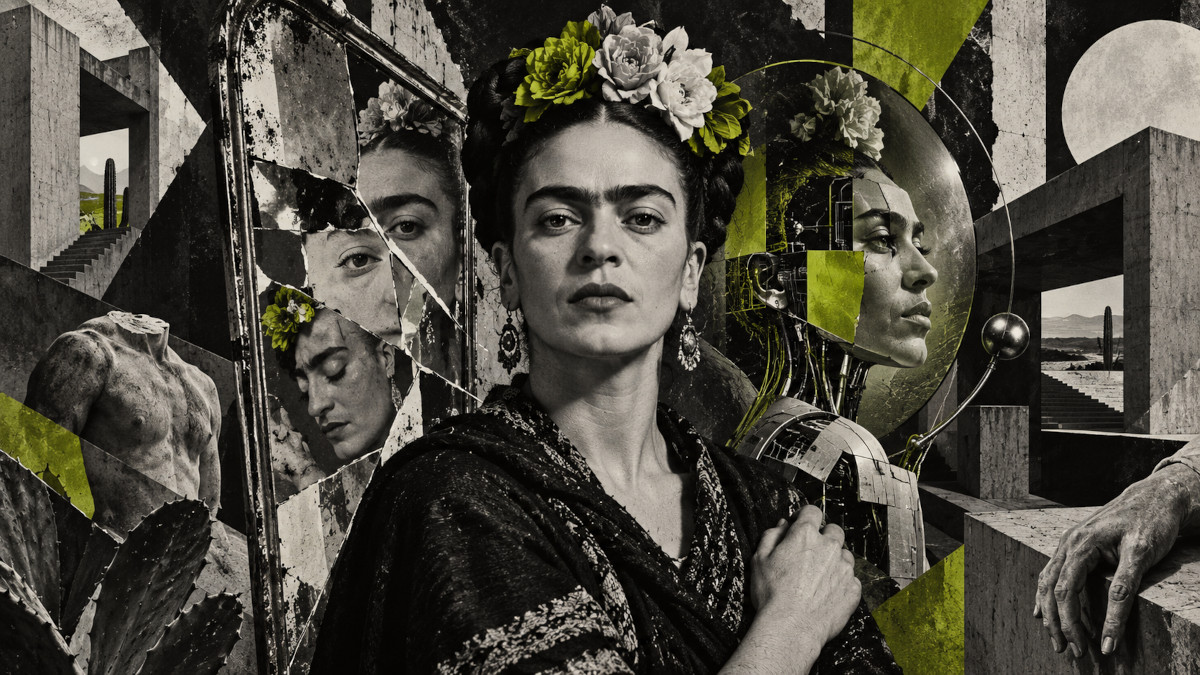
Frida began painting herself. Again and again. Flowers in her hair. Jewelry. Traditional dresses. Animals. Colors. The famous brow. A direct gaze that asks no permission.
Frida created a recognizable visual identity long before Instagram, filters, or avatars existed.
She was, in a sense, her own avatar.
But there is a fundamental difference: Frida did not use the image to hide. She used it to reveal herself.
And she revealed everything that contemporary technology would probably try to correct: pain, operations, corsets, disability, amputation, scars, fragility.
She did not produce an improved version of herself. She produced a more intense one.
Decades later, Cindy Sherman took that idea somewhere else: she used her body to construct characters and question identity, without her photographs necessarily being self-portraits. Today, artists such as Lu Yang work with avatars, video games, and virtual worlds, where the character can exist independently of the artist’s physical body.
Between Frida, Sherman, and Lu Yang, there is an interesting transformation: from self-portrait to character, and from character to avatar.
It is not that Frida anticipated digital art. It is that the questions she explored through painting and photography have now found new tools.
We do not know whether Frida would have used AI.
But we can look at her relationship with the tools of her time: photography, the mirror, clothing, staging, and the deliberate construction of her own image.
In Self-Portrait on the Borderline Between Mexico and the United States, from 1932, she literally places herself between two worlds: on one side, Mexico, nature, and tradition; on the other, factories, electricity, and machines.
She is not an artist removed from modernity. She is an artist who negotiates with it.
A 21st-century Frida would probably not ask artificial intelligence to make her more beautiful. She would ask it to multiply her.
One Frida transformed into a machine. Another with wings. Another with cables running through her body. Another confronting her own digital double. Ten Fridas looking at one another. An elderly Frida speaking with the young woman who still did not know what awaited her.
Not to disappear. To expand.
Because the great question running through her work is not merely what a body looks like. It is who has the right to construct the image of that body.
And that question feels especially contemporary now that a machine can reproduce her image.
It can reproduce her brow. Her flowers. Her colors. Her symbols. It can manufacture a Frida aesthetic. What it cannot manufacture so easily is the experience.
It can create a broken spinal column. But it cannot have lived inside it.
It can generate a tear, but it cannot suffer the pain that caused it.
And it can produce a perfect Frida. Although I suspect that would be the Frida who interested her least.
Because what makes Frida extraordinary is not that she turned her image into an icon. It is that she turned her wound into language.
That is why the exhibitions now bringing her back into view feel so timely. Tate examines her through the construction of an icon. Faro Santander returns her to the context of Mexican modern art through the Gelman Collection. MALBA places her life, her work, and especially the construction of her identity at the center.
Frida works in a world dominated by artificial images because she, too, manufactured an image of herself. Except that behind that image was a life that could not be edited. The wound that made Frida Frida.
Today, we can ask a machine to create a thousand Kahlos. We can make them young, old, happy, perfect, impossible. Perhaps, if she were sitting in front of a screen today, she would not ask AI to copy her. She would ask it something far more radical: to imagine who Frida might have been if her body had never known pain.
And then, probably, she would paint herself again.
FRIDA. Three Perspectives
Tate Modern — London, England
Frida: The Making of an Icon
June 25, 2026 – January 3, 2027.
Faro Santander — Santander, Spain
México Moderno en la Colección Gelman Santander
September 8, 2026 – January 10, 2027.
MALBA — Buenos Aires, Argentina
Viva Frida
September 20, 2026 – March 15, 2027.