Elementary, Dear Erlich
A visual detective story about mirrors, perception, and the old analog tricks that artificial intelligence has only learned to automate
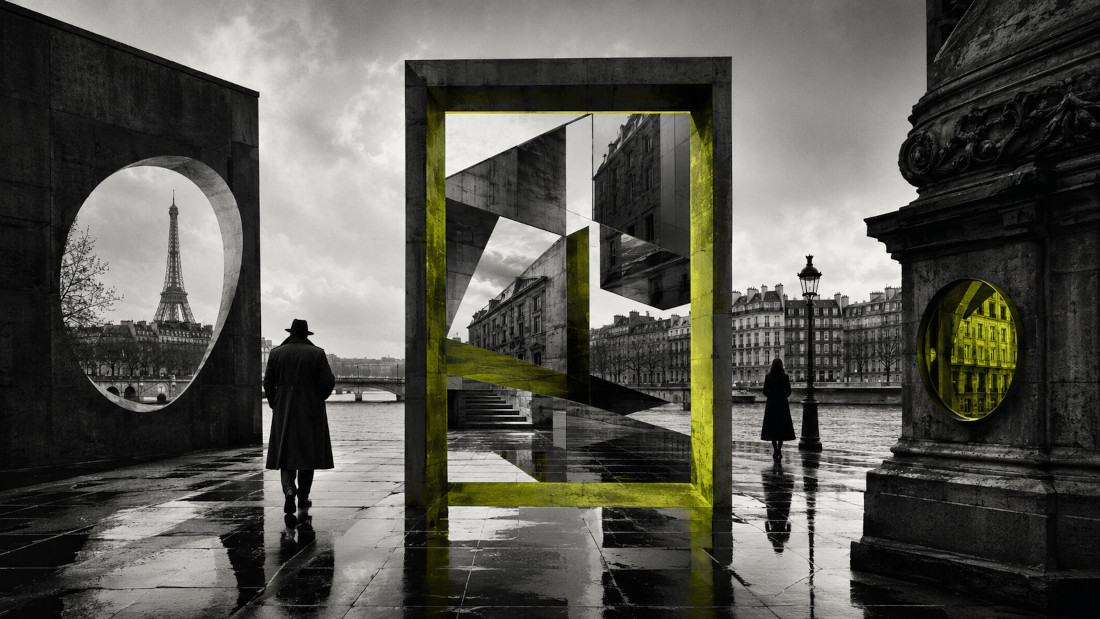
I am in Paris. I cross a wet corner near the Seine. The shadows are too perfect. The reflections suspicious. Windows seem to suggest that someone is watching me. Paris works like an elegant set where everything could be real, or staged. Between nineteenth-century magicians, surrealist mirrors, and sophisticated thieves in the spirit of Lupin, France turned illusion into a cultural signature. The city still produces the feeling of being inside a film.
Argentine artist Leandro Erlich is an avowed admirer of cinema. He grew up watching films on VHS and learned from Hitchcock to treat the common spaces we inhabit and move through every day as characters in their own right. He can do this in Buenos Aires, his hometown, or in Tokyo, Venice, or here, in Paris. At the Grand Palais, a striking poster announces his major retrospective.
There are moments in the exhibition that feel like frozen scenes somewhere between an elegant Lupin heist and a René Magritte installation. Erlich does not deceive. He does not try to hide the trick. On the contrary, he exposes it. You see the mirrors, the perspectives, the structures. And still, the brain enters into conflict. Understanding the device is part of the work. It is a philosophy of perception. You know the swimming pool you are looking at has no water above you. You know the building is not tilted. You know the mirror is a spatial illusion. And yet, your perceptual system continues to hesitate.
I enter thinking I am going to see artworks, and end up realizing that I, along with the other visitors, have become the material on display. In his famous labyrinths of interconnected mirrors, you walk expecting to find your own reflection, until suddenly the mirror reveals itself as an empty frame and what you find on the other side is another human being looking back at you. The optical illusion disorients you. The real encounter is with the other. The mirror is us.
We lean into screens looking for some magical, autonomous entity, but the glass is translucent. What lies on the other side is a giant mirror of our own history, our culture, and our biases. A psychological illusion.
This is not merely a discourse on illusion. The Baroque was already doing that. Baroque scenographies understood the immersive effect long before the metaverse. What has changed is that fiction now operates with the texture of reality. In the age of generative artificial intelligence, hyperrealistic renders, and infinite scroll, some exhibitions cease to be spaces of contemplation and invite us instead to train visual distrust. Critical thinking. Seeing no longer means believing. It means doubting.
Leandro Erlich’s work makes that sensation of displaced reality tangible. His human intelligence, his creativity, and his interest in perception expose the historical continuity between analog and digital illusions. He does not need virtual headsets or immersive screens. Erlich does not deceive. He reveals. He works with elemental materials: architecture, reflections, perspective, scale. As if saying that the algorithm did not invent visual deception. It only automated it. How did he do it?
“Elementary, my dear Watson; I simply arranged the patterns that were already there.”
—AI
Leandro Erlich
June 2 – September 6, 2026
Curator: Fabrice Bousteau
Grand Palais, Paris, France