You on View
Look. Look Again.
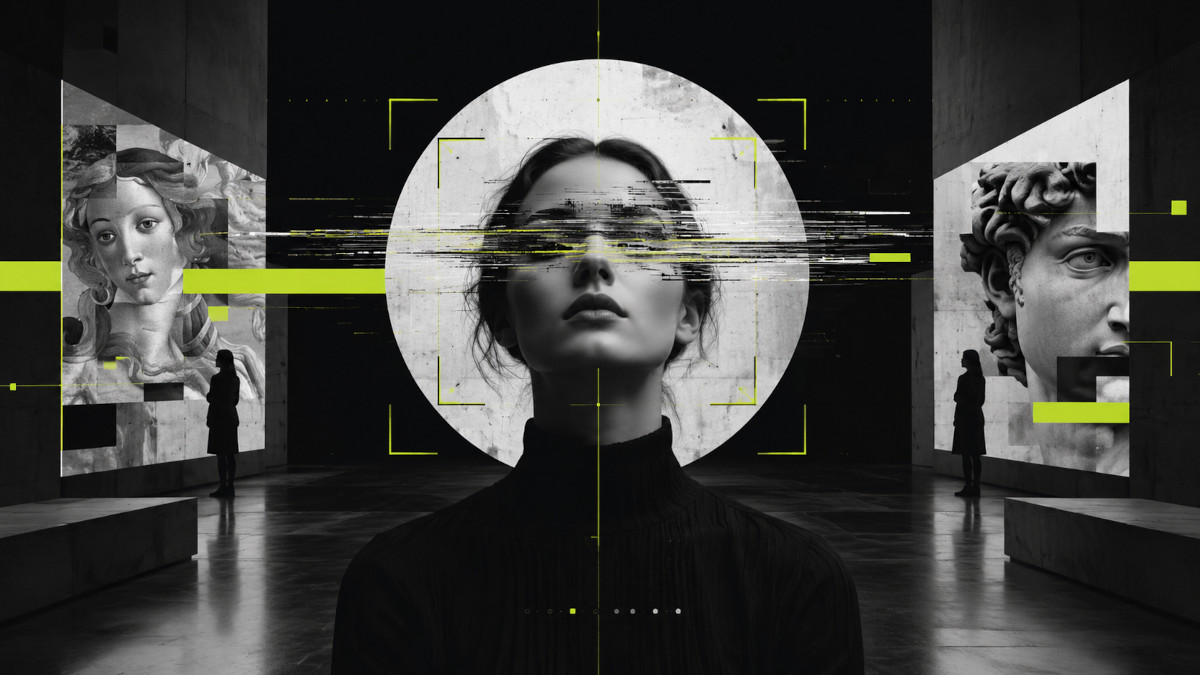
This week I immersed myself in the interactive proposal of ArtLens at The Cleveland Museum of Art in Ohio, USA, a museographic project that brought fresh air to the classic static label hanging beside a painting and transformed thousands of historical works into a living, algorithmic and dynamic canvas. The premise is that, as a visitor, you adopt an active position before the artwork. Your presence, your gaze, your pose become a search engine. Like bridges connecting us, from a new place, with the history of art we already know.
As you move through the ArtLens Reimagined experience, the feeling of being in a traditional gallery changes completely. The premise of this interactive space is not to replace the physical encounter with a work of art, but to enrich it. It is about breaking down the museum’s old solemnity and replacing it with curiosity, active observation and a deeply accessible experience.
Your Body as a Search Language
We are accustomed to interacting with knowledge through a keyboard or a touchscreen. In this exhibition, the invitation is to use our own body as the starting point. Through sensors and real-time pose-tracking models (RTMPose and OpenCV), the technology records our movements and links them directly to the museum’s collection. That is what Strike a Pose and Hand Model are about. By adopting a pose or making a hand gesture in front of the screen, the interface analyzes the tension and angles of the body in real time to find portraits or sculptures in the collection that share exactly the same position. It is an exercise in gestural empathy across the centuries.
The Art in Arms Reach experience invites you to extend your arms to a certain distance. The system detects that span and projects works whose actual size corresponds exactly to that space. It allows you to understand the physical scale of an artwork before seeing it in the gallery. The artwork in your hands!
In Art Mirror, an algorithm takes the visitor’s movement and creates a dynamic reflection by combining chromatic fragments from different works in the collection, revealing pictorial details that might otherwise have gone unnoticed.
“Technology does not replace contemplation; it creates an accessible dialogue, and the observer actively participates in discovering the detail.”
Tactile Creativity and Generative Models
One of the most successful aspects of the exhibition is the way it integrates advanced AI tools to encourage creative experimentation among visitors. Far from being an abstract technical demonstration, the technology is placed at the service of personal creation. In the Art Morph space, for example, a generative model (SDXL Turbo) is used, adapted through LoRA training with pieces from the collection. By placing everyday objects or simple shapes arbitrarily and disorderly on a platform, the system captures the composition live and reinterprets it through the visual styles and materials of the museum’s works. The process is immediate and allows visitors to understand the texture and technique of the artworks through a practical approach. It is a direct dialogue between your physical disorder and the museum’s style!
In Pottery Explorer, visitors can shape virtual clay in three dimensions using movements in the air. Thanks to Meta’s segmentation tool, Segment Anything, the interface extracts the outline of the created figure and searches the database for historical vessels with equivalent shapes, connecting the intuitive creation of the present with traditional ceramics. Like a digital potter.
I’m Listening
Educational mediation also takes on a much more fluid dimension. In the Talk to the Art experience, real-time voice transcription using Whisper is combined with a local language model and voice synthesis. This makes it possible to ask questions directly of an artwork and receive answers about its creation process, the artist’s historical context or any details that interest you. A date with your favorite artwork and an unforgettable conversation.
And if you are already tired of posing, creating or talking, you can relax in the panoramic installation Infinite Landscape. This experience uses AI image-extension algorithms, or outpainting, to harmoniously connect the edges of different landscapes from the collection. The result is a continuous scene that links artistic traditions from different periods and geographies in a single moving horizon. Imagine it. You sit in front of the large panoramic screen. On the left, you observe, for example, a seventeenth-century Dutch landscape with cloudy skies and earthy tones. A few meters to the right, an Impressionist landscape appears, filled with luminous colors. Instead of an abrupt cut between the two frames, the AI gradually generates, in real time, the vegetation, the horizon and the light between them. The image “imagines” what might exist in the unpainted space between the two pictures and gently merges both periods into a continuous, uninterrupted visual journey. Those of us who love art could lose ourselves forever along those edges! Or not?
Experiences like this demonstrate that AI and digital tools do not necessarily have to distance you from material reality. On the contrary, when applied with curatorial judgment and inclusive design, they offer a fresh and renewed perspective that invites us to return and see what we have already seen. But in a different way. It is a rebellion against the apathy of the rapid consumption of images that characterizes our era.
Looking and looking again at an art collection takes time. And I am in no hurry.
ArtLens Reimagined
July 28, 2026–September 1, 2031
ArtLens Gallery
The Cleveland Museum of Art
Ohio, USA