And Your Tears?
Marina Abramović, Maria Callas, and what artificial intelligence still cannot copy. Or can it?
When Ulay sat across from her at MoMA, the silence filled with decades of shared history, love, and wounds from the past. Marina Abramović could not contain her emotion: her eyes overflowed with tears, and she broke the rules of her own performance by reaching out to touch him.
As part of the performance The Artist Is Present (MoMA, 2010), Abramović (one of the most influential artists in the history of contemporary performance art) had spent weeks sitting motionless across from strangers, without speaking, without touching, holding their gaze. But when Ulay appeared—the man who had been her partner and artistic collaborator for years—something broke.
The rules of the performance gave way to something more powerful: the memory of a real love.
Those tears are, to me, one of the most moving images in the history of contemporary art. Because in that moment, the body ceased to be an instrument of the work and became evidence. Evidence that there are experiences that cannot be completely controlled, represented, or repeated.
And tears appear again, years later, in her latest project. In September 2026, at AaltoSiilo in Oulu, Finland, Abramović presents Skin, Salt and Tears, an exhibition created with Factum Arte, the Madrid-based studio specializing in recording, reproduction, and conservation technologies.
The exhibition brings together new works born from a collaboration spanning several years between the artist and Adam Lowe’s team.
Here, skin appears literally as an artistic material. Ten works are made from Abramović’s own skin using innovative printing processes. It is a profoundly coherent decision for an artist who, for five decades, has turned her body into a territory of experimentation: a body that endures, resists, ages, feels, and ultimately disappears.
But Abramović does not limit herself to preserving her own trace. She also transforms pain into matter.
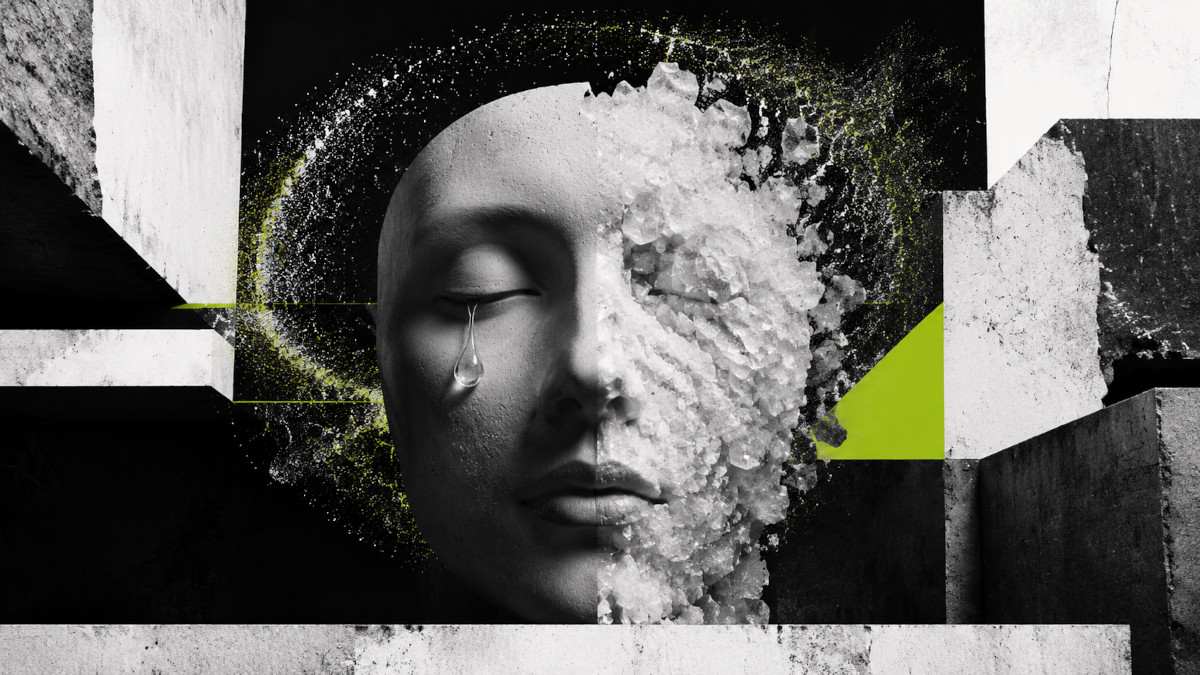
A head of the artist, made of salt, serves as a kind of vulnerable self-portrait. The choice of material is not accidental: the work speaks of the Baltic Sea, which is losing salinity as a consequence of environmental change. As it cooled, the sculpture cracked. And those cracks, far from being treated as a flaw, became part of the work as an image of fragility.
Then there are the tears. Abramović turns them into glass: tears of sadness and tears of hope. The former are connected to Venice, a city threatened by rising sea levels; the latter to Oulu, where the land is currently rising faster than the sea due to post-glacial rebound. Two cities, two opposing movements of the landscape, and the same artist trying to turn emotion into matter.
There is something almost alchemical about the operation: skin, salt, and tears cease to be parts of the body and become works capable of outliving it.
When Electricity Draws
The project also includes Electrostatic. Abramović and Factum Arte turn their attention toward another invisible phenomenon: electricity. At Factum’s studio, the old industrial lights were removed, but the traces of electrostatic charge that had attracted and accumulated dust on the surfaces remained. The resulting prints record those marks. There is no drawn image. There is a trace. An invisible force that, over time, left a visible mark. Electricity, dust, time, and absence.
The work makes tangible a concern that runs through much of Abramović’s work: making the invisible visible. It records an attraction that occurred slowly, over an extended period.
Multimedia Callas
The exhibition also presents Seven Deaths of Maria Callas, Abramović’s project born from her fascination with the legendary soprano. The artist encountered Callas’s voice as a teenager, when she first heard her on the radio in Belgrade. Decades later, she decided to reconstruct the deaths of seven operatic heroines associated with Callas, performing alongside Willem Dafoe.
The relationship between them is not biographical but emotional. Abramović recognizes in Callas a woman who transformed pain, love, and death into a form of artistic expression. The seven scenes take fundamental arias from Callas’s repertoire as their starting point and transform them into a hybrid experience combining opera, cinema, performance, and multimedia art.
There is also a fundamental conceptual decision: Abramović does not attempt to bring Callas back to life. In an interview, she explained that there had even been an attempt to recreate the soprano as a hologram, but that this technological image could not replace her. That is why, in 7 Deaths, Callas’s voice emerges from a gramophone and stops before the aria is finished. The ending must be completed by the viewer’s memory.
In Skin, Salt and Tears, Abramović seems to construct a chain of translations: from the body to the trace, from emotion to object, from energy to image, and from experience to archive.
The artist does not try to fill the voids. She makes them visible. Marina’s tear in front of Ulay cannot be separated from that moment. Neither can Callas’s tears, nor our own. And yet art translates them into a universal language.
A tear is tiny. Fragile. Impossible to repeat exactly. It contains water, salt, and, above all, an unrepeatable circumstance that still cannot be digitized. A tear is not a JPG, a bit, or 8K. It has no resolution and no weight in megabytes.
It has something no archive can store: the fact that it happened.
Skin, Salt and Tears,
September 2–5, 2026 AaltoSiilo, Oulu, Finland